

Consented, p.1
Consented, page 1


CONTENTS
Title Page
Praise for Consented
Copyright
Dedication
Preface
1: Medical Rape Culture—The Unifying Diagnosis Inside My Own Medicine
A Nameless Monster
I, the Monster
The Unifying Diagnosis
In It Together
2: Bad Consent The Anatomy of Bad Consent
Consent in Forms
Consent in Trust
3: Patient Blaming The Noncompliant Patient
The Drug-Seeking Patient
The Difficult Patient
The Fat Patient
The Gaslit Patient
4: Medical Misogyny Midwifery Magic
The Takeover of Midwifery
A Prescription of Pain
Not That Bad
A Silencing Killer
5: Objectifying the Body Cashing In on the Uterus
Wombs Before Women
No One Spared
Welcome to My Department
6: Standing with Gender and Sexual Diversity Diagnosing Gender
The Good Fight
Un-Converted and Un-Consented
A Genital Emergency
A Gendered Emergency
7: Medical Racism The Perfect Storm
The Great Unequalizer
The Real Risk Factor
The Colors of Life and Death
The “Hispanic Paradox”
The Asian Dilemma
8: Trivializing Trauma Trauma Is Everyone’s Department
No Sides in Healing
Play Some Music
First, Do No Harm
9: Workplace Inequity The Untitling Truth
The Trust Gap and Beyond
The Beast in the House
My Tongue and I
Women, Girls, All of Us
10: Fair and Just
Acknowledgments
Glossary
Endnotes
Index
About the Author
About North Atlantic Books
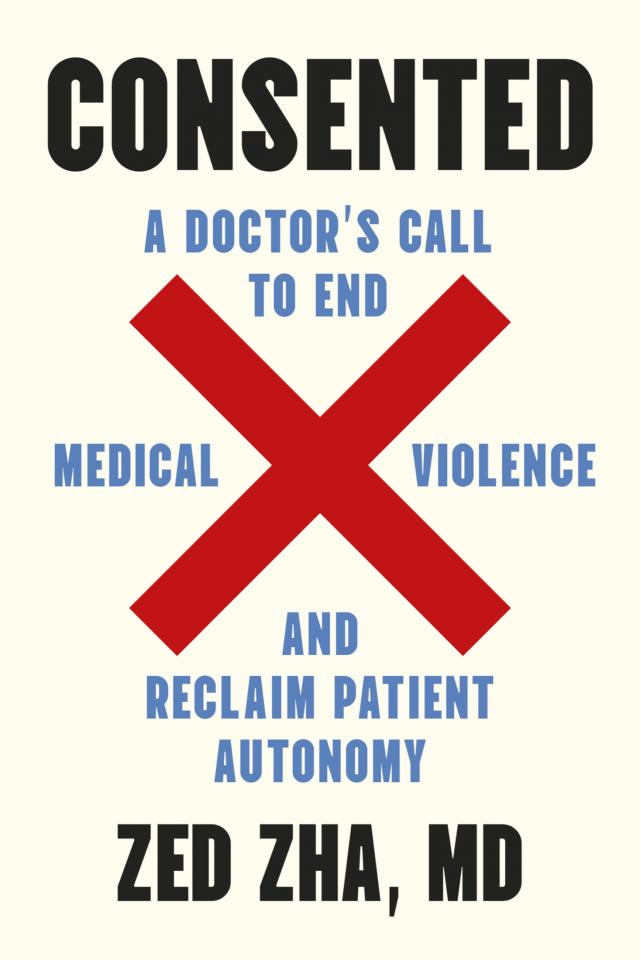
Consented
A Doctor’s Call to End Medical Violence and Reclaim Patient Autonomy
Zed Zha, MD
Praise for Consented
“In a system where medical authorities routinely override individual agency, Consented exposes how clinical norms and medical culture dictate the experiences of the body and healthcare.”
—DANIELLE OFRi, MD, PhD, author of What Patients Say, What Doctors Hear
“[A]n unflinching review . . . examining everything from consent forms to pain management under the harshest fluorescent lights, highlighting the many ways we fail ourselves and our patients, despite our best efforts. Not even Dr. Zha herself is safe from her own criticism, as she vulnerably shares the lessons she learned from times she did not live up to her own standards. Where others might stop at describing the problem, Dr. Zha shares a vision of a different future, one in which both patients and physicians are far better served.”
—ARGHAVAN SALLES, MD, PhD, bariatric surgeon, Special Advisor for DEI Programs in Stanford’s Department of Medicine, and national leader in gender equity
“Dr Zha’s unique blend of humour, knowledge and compassion shine through in this book. She has the ability to speak to doctors, patients and their families in a way that helps to break down the barriers that we experience when seeking healthcare. Consented should be required reading for all medical students and aspiring healthcare workers so they can begin to better understand how to best serve their most vulnerable patients.”
—DISABLED GINGER, a leading Substack voice on disability advocacy and chronic illness justice
“Through deep reflection and piercing storytelling, Consented shows readers how physicians can hold on to our humanity while doing the superhuman work of caring for others. Dr. Zha calls out the dehumanizing and violent traditions of modern medicine and calls us into a healthcare revolution that begins with believing patients.”
—ALYSSA BURGART, MD, MA, Stanford pediatric anesthesiologist and bioethicist, author of the Substack Poppies & Propofol, and op-ed voice in The Washington Post, USA Today, Slate, JAMA, and more
“This book is many things—honest, raw, compelling, and courageous. Dr. Zed Zha delivers a heavy message with lighthearted clarity, weaving together historical context, vivid personal stories, and well-documented evidence.”
—JAMES WITHERS, MD, founder of Operation Safety Net and The Street Medicine Institute and internationally recognized pioneer of street medicine
“As physicians we learn to ignore fear, deny flaws, and push forward. This book challenges this, showing how unchecked behaviors harm both us and our patients.”
—ZEEST KHAN, MD, Stanford-trained anesthesiologist turned Long COVID advocate, host of the Long Covid, MD podcast
“This book demonstrates how modern medical care has deteriorated into toxicity and harm, far from its roots in patient advocacy and caring. Dr. Zha shows us how an approach to healthcare can be human-forward, remind[ing] us that empathy has an essential role in healthcare.”
—ROBIN TAYLOR, writer and community-builder, trans and queer activist, and founder of SmallStack and GenderWild Press
“In Consented, Dr. Zha takes a laser focus on consent, autonomy, and medical trauma . . . [and] points us to the possibilities for a future of equitable, collaborative, and safe health care. A validating guide for patients and essential reading for every health professional, this book charts a clear path toward fair and just medicine.”
—CHRISTINE GIBSON, MD, family physician, trauma therapist, speaker, and author of The Modern Trauma Toolkit
Copyright © 2026 by Zed Zha. All rights reserved. No portion of this book, except for brief review, may be reproduced, scanned, or distributed in any form or by any means without the written permission of the publisher. No part of this book may be used or reproduced in any manner for the purposes of training artificial intelligence technologies or systems.
North Atlantic Books
Huichin, unceded Ohlone land
2526 Martin Luther King Jr Way
Berkeley, CA 94704 USA
www.northatlanticbooks.com
Interior design by Happenstance Type-O-Rama
Cover design by Lauren Smith
Consented: A Doctor’s Call to End Medical Violence and Reclaim Patient Autonomy is sponsored and published by North Atlantic Books, an educational nonprofit that collaborates with partners to develop cross-cultural perspectives; nurture holistic views of art, science, the humanities, and healing; and seed personal and global transformation by publishing work on the relationship of body, spirit, and nature.
North Atlantic Books’s publications are distributed to the US trade and internationally by Penguin Random House Publisher Services. For further information, visit our website at www.northatlanticbooks.com.
The authorized representative in the EU for product safety and compliance is Eucomply OÜ, Pärnu mnt 139b-14, 11317 Tallinn, Estonia, hello@eucompliancepartner.com, +33757690241.
Library of Congress Cataloging-in-Publication Data
Names: Zha, Mengyi author
Title: Consented : a doctor’s call to end medical violence and reclaim
patient autonomy / Zed Zha, MD.
Description: Huichin, unceded Ohlone land, Berkeley, California : North
Atlantic Books, [2025] | Includes bibliographical references and index.
| Summary: “A physician’s bold critique of medical rape culture-and her
call for a new model of care that centers consent and empowers
patients”-- Provided by publisher.
Identifiers: LCCN 2025036047 (print) | LCCN 2025036048 (ebook) | ISBN
9798889842965 trade paperback | ISBN 9798889842972 ebook
Subjects: LCSH: Medical ethics--Popular works | Informed consent (Medical
law)--Popular works | Involuntary treatment--Popular works |
Discrimination in medical care--Popular works | Physician and
patient--Philosophy--Popular works
Classification: LCC R725.5 .Z43 2026 (print) | LCC R725.5 (ebook)
LC record available at https://lccn.loc.gov/2025036047
LC ebook record available at https://lccn.loc.gov/2025036048
For my mother, whose consent was never sought when her
infant daughter was taken for adoption,
who scaled the hospital walls to “steal” me back in the
middle of the night.
You taught me never to surrender love,
not even when there are mountains to climb and there is
no light in sight.
Because what’s rightfully ours must be reclaimed.
Preface
In medicine, we tell stories.
To be a good doctor is, first, to honor the story of another with compassion, respect, and the willingness to truly listen. Consented is my way of doing that. It’s a book of stories, some painful, some healing, all deeply human. And through telling them, I hope to grow into a better physician and a better person.
The stories in this book are grounded in real experiences, though many of the characters are composites, carefully shaped to protect identities and to highlight deeper truths. Unless someone has given explicit permission or is publicly known, all names have been changed. For those stories that are not composites, I share them only with permission, and always with care.
Many of the book chapters contain descriptions of medical procedures or experiences that violate bodily autonomy. Particular ly, Chapter 8 includes references to child and adult sexual abuse and a personal memory of a traumatic medical exam. If you choose to read it, please take care of yourself. And please know that I carry each of these stories with humility, love, and deep respect.
You’ll notice the hashtag #AskThePatient throughout the book. Ask the Patient by Dr. Zed Zha* is the name of my Substack newsletter. And I use a hashtag with the same name online to gather stories, uplift patient voices, and ask questions the medical literature can’t always answer. The idea is simple: When we don’t know, we should ask the patient.
Finally, I hope you’ll see that in Consented, I am not afraid to implicate myself in a medical culture of harm. I hope you hold my story with the same gentleness as I hold my patients’ stories. In the end, or perhaps from the beginning, I hope you see me as a fellow human being.
Thank you for being here.
Let the story begin.
—Zed
* Ask the Patient by Dr. Zed Zha can be found here: https://drzedzha.substack.com.
1
Medical Rape Culture—The Unifying Diagnosis
“Hello, Dr. Zhaaa!” Katie had this charming way of saying my last name, stretching out the single syllable like someone might when calling their favorite niece or nephew. And, as always, her wide smile followed.
After nearly two years of being Katie and her husband John’s family doctor, I had become conditioned to this warm greeting, so much so that I found myself smiling in anticipation before even stepping into her exam room.
Katie was a sixty-five-year-old woman and a retired school bus driver. She was by no means a healthy retiree. She was not physically active and had uncontrolled diabetes when I first met her. Over the years, we had been working on lifestyle changes and adjusting medications. It had helped. By early 2021, Katie had become more active, and her diabetes was well controlled.
Things were looking up. Or so we thought.
For the past few weeks, Katie and John had been calling frequently to report that she was experiencing new back pain and left leg weakness. As a family physician, I saw back pain all the time and knew that most cases were caused by muscle pain. But Katie’s pain was unusual.
First, in all the years I had known her, she had never complained about her back, yet this new pain was escalating quickly. Katie had gone from taking daily walks in the neighborhood with John to spending most of her time in bed within a matter of weeks. Second, most muscle pain doesn’t cause leg weakness, and Katie’s weakness was only in her left leg. This made me think there might be a herniated disc pressing on the sciatic nerve, or spinal stenosis, a narrowing of the spinal canal. And lastly, Katie’s previously well-controlled blood sugar level had shot up. Pain is a well-known stressor for the body and can trigger higher glucose levels.
It was possible that these changes were not connected: Katie could simply have new muscle pain in her back, and new leg weakness totally unrelated to that pain. And at the exact same time, her diabetes could have worsened without trigger.
In clinical medicine, we look for a unifying diagnosis, a basic diagnostic principle that says one diagnosis that can explain multiple symptoms is much more likely than multiple diagnoses that explain multiple symptoms.1 In other words, what were the odds that three things had gone wrong for Katie at the exact same time, versus one underlying issue causing a cascade of symptoms?
I believed the unifying diagnosis was there; we just needed to find it.
Over the next two months, Katie and John frequented my clinic as her symptoms worsened. We tried all the usual treatments for back pain, including physical therapy, medications, and trigger point injections, all to no avail. And an X-ray and a CT scan didn’t show anything abnormal in the bones.
Katie needed an MRI, which is the next step in cases of back pain persisting for over six weeks or when neurological involvement is suspected.2 Having had this pain for months and experiencing leg weakness (a neurological symptom), Katie met both criteria. However, we didn’t have an MRI machine in my town. I ordered an urgent MRI to be done in a nearby city, but Katie’s insurance denied it. This forced me to file an appeal. Worried about the neurological symptoms, I also made an urgent referral to neurosurgery, which had a wait time of three months. Clearly, urgent becomes an irrelevant term when confronting a physician shortage and insurance companies dictating medical care.
So, we urgently waited.
On a Friday afternoon, John called my team again: “Dr. Zha, Katie is not doing well. She has been in bed all day, unable to eat. I’ve been trying to convince her to go to the ER, but she said she’d rather see you. And . . . ”
There was an unusual hesitation in his voice, “and I am having a hard time taking care of her at home.”
John was an incredibly dedicated husband. For him to admit that he couldn’t do it anymore meant things were really bad. Luckily, as a full-scope primary care doctor with hospital admission privileges, I could bypass the emergency room (ER) and directly admit patients into our small twelve-bed local hospital.
“John, meet me at the hospital. Let’s have Katie stay for a couple of days and try to figure out what is going on, come up with a pain control strategy, and give you a little rest.”
I glanced at my watch: 6:30 p.m. I hadn’t been home for dinner on time most days this week.
Don’t wait for me for dinner, I texted my husband, feeling a surge of guilt for not making it home, again.
Someone in labor? he texted back.
No. Admission.
Ah. Good luck! God bless this man! Being a country doctor is a hard life. No wonder we’re a dying breed.
When I met Katie in the hospital, she was sitting in a wheelchair, wincing in pain. “Hi . . . Dr—” Katie tried to give me her signature smile, but her heavy leaning toward her right side in the chair and the big droplets of sweat on her forehead betrayed her misery. I fought the urge to cry when I saw the couple’s sunken eyes. Had they slept at all last night?
I squeezed Katie’s hand and said, “Hi Kaaatie. We’ll take care of you, okay?” I hoped I could keep that promise.
Over the weekend, Katie improved. By Monday, she was able to walk a little, and her signature smile returned. We decided to send her home on a temporary pain medication regimen while we awaited responses from the insurance company and the neurosurgeon’s office.
As it turned out, Katie’s improvement was just the calm before the storm. A few days later, when I saw her for a follow-up, her pain and leg weakness had worsened. Whatever the cause, it was clearly advancing. Surgery might be needed sooner than later to prevent permanent neurological damage. We couldn’t afford to play the waiting game anymore; we needed help now.
“Katie, I think you need to go to the ER in the city. That’s the fastest way to get an MRI and see a surgeon,” I said, watching her sweat through the pain again.
Katie looked like she wanted to say something but couldn’t get the words out. Instead, she turned to John and shook her head.
“Dr. Zha, Katie really doesn’t want to go to the city ER. The last few times we went for something different, they made us wait for hours, and they just sent us home with Tylenol!” John protested, while Katie nodded and pleaded with her eyes. “Can’t you just admit her to your hospital again, like last time?”
“I’m sorry. But we’ve tried that, and it didn’t get us anywhere,” I told them. John might be right about the city ER, but I was at my wit’s end. I turned to Katie and gently cupped her hands: “You know if I could take care of you myself, I would.”
Katie looked deflated as her protest through John seemed to fail. Her eyebrows furrowed as she let out a deep sigh.
“Don’t worry. I will call the ER and explain why I’m sending you over,” I reassured her.
I knew it wasn’t much, but it felt like the only promise I could keep.
Inside My Own Medicine






