

The maskeys, p.1
The Maskeys, page 1


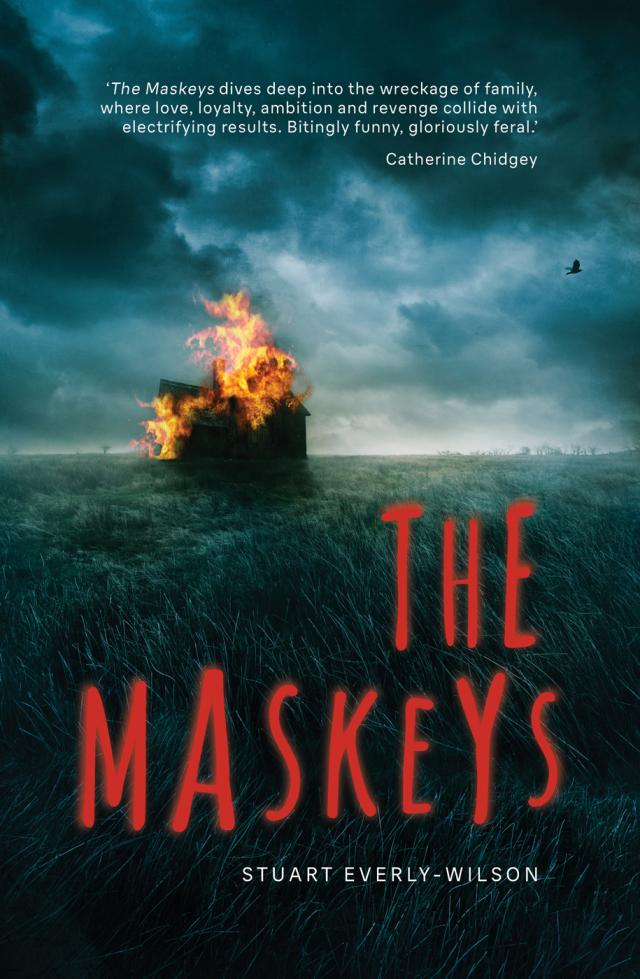
THE MASKEYS
THE MASKEYS
STUART EVERLY-WILSON
MELBOURNE, AUSTRALIA
www.transitlounge.com.au
Copyright © 2025 Stuart Everly-Wilson
First published 2025
Transit Lounge Publishing
This book is copyright. Apart from any fair dealing for the purpose of private study, research, criticism or review, as permitted under the Copyright Act, no part may be reproduced by any process without written permission. Inquiries should be made to the publisher.
Cover design: Peter Lo
Cover image: Silas Manhood/Trevillion Images
Author image: Darren Welch
Typeset in 12/16.5pt Adobe Garamond Pro by Cannon Typesetting
Printed in Australia by McPherson’s Printing Group
A cataloguing-entry is available from the National Library of Australia
ISBN: 978-1-923023-50-5
For Darren
I have always believed that good food and good cooking are part of all that is best in life, all that is warm, friendly and rewarding; and that love is as essential to any good meal as it is to a good marriage.
—Margaret Fulton
No one can be good for long if goodness is not in demand.
—Bertolt Brecht
Prologue
The problem to be disposed of dangled from the branches of a forest tree like a gym-muscled avocado pear. Hanging feet-first in a cocoon of prawning net, it swayed ever so gently, causing occasional squeaks from the branches and pulleys above.
In a lean-too enclosure nearby, the weasel, Rodney, was bent over a toolbox, wiping his brow, while he foraged for some suitable implements to dismember the body. Finding what he needed, he carried them over to the tree, dropped them on the ground and, picking up a sharp cane knife, began to slice through a nylon rope attached to a counterweighted sack of river stones. He, anticipated that this would be the quickest way to drop the corpse to the ground.
He severed the rope. Nothing happened.
Disappointed, he gazed up into the tree. Feeling too weak to climb the branches to investigate a jammed pulley, he went over to the body and, though scarcely able to reach it, managed to give it a nudge with the tip of the long cane knife.
It swung, but did not fall.
Throwing down the knife, the little man launched himself up onto the corpse’s feet, hoping his weight would pull it down. He tried this several times.
Standing in a puddle of the dead man’s urine, and panting, Rodney caught a glimpse of himself in a small shaving mirror nailed to a nearby tree. He went to it for a closer look. In the dwindling daylight, what he saw reflected in the glass, resembled a child’s drawing left out in the rain, of a face with its features all smudged in dust and tears. And regret.
Suddenly he turned and, running back to the problem, launched himself high up onto its knees. He gripped on tight. And after some moments suspended in mid air, he managed to bring it down. It landed feet-first on the forest floor, where it balanced for some seconds. Not falling forward. Not falling backwards. Quite still.
Rodney picked himself up, gave the stiff a push, and back it went, the way of its heels.
It took him several minutes, to disentangle his boyhood friend, Duncan Reynolds, from the netting. But when it was at last done, he recovered his breath and went for his tools; an axe and a hacksaw, and placed them on the corpse’s chest.
Taking Duncan’s body by the hands, he pulled the heavy deadweight over the dirt to a log chipper at the edge of his dope crop, where he would begin dismembering the limbs.
There, exhausted, he collapsed. But with no time left for disgust, remorse, or rest, he remembered the girl. Her body would be lighter to drag, he realised.
He went back for her.
ACT I
That Fire …
1
If the degree of mischief found at the spark of a fire could determine the heat of the flames, then the blaze that destroyed Gayle Reynolds’ cottage would have been the highest, brightest, and hottest to have taken hold in Naples since the ancient caldera that our town sits within last blew. But though the mischief at its spark was indeed complete, the orange flares produced by the dwelling’s incineration were of a modest scale, and the glow from them was only noticed by a few who lived in the surrounding hills.
The next morning, when the smoke had cleared and word spread that the fire had erupted only an hour after a housewarming party to celebrate the building’s completion, the exclamations of surprise peppered Main Street, Naples, like a busker’s high notes. For even those with no gift for the art of pyromancy knew that it had to be the result of arson, and that this – a repeat attack on Gayle’s property, identical to the first – meant that the feud between the service-station proprietor and her farmlet’s drug-lord neighbour, George Maskey, had once again caught alight.
As with local matters of a controversial nature anywhere, soon many exaggerations about the fire were being spread by those with frankly no fucking idea! One even alleged that Gayle’s hunky builder/tenant, Eric Lunarzewski, had perished in the blaze, and that she, his landlady/lover, had perished alongside him. But whatever the body count, most were certain that George Maskey had torched Gayle’s property as further retaliation for money and drugs stolen from him by her son, Duncan Reynolds, three years earlier. (And, to boot, because he was a nasty vindictive sonofabitch with a memory longer than the double white lines on the Naples Road!)
The town wasn’t always a success at keeping its private matters a secret from its many visitors; but happily, on that morning, for tourists casting an unfamiliar eye about, all seemed perfectly bucolic. Naples’ own went about their usual business: three young mothers throwing out a blanket on the grass in Civic Park, to sit and play with their toddlers in the sunshine; some eccentric old hippies sitting scattered about the quirky council assets; the town’s family of five peacocks roosting on the fence of the cop-shop and, setting up her Tarot table with one arm in a sling, the town’s glamorous mystic Serenade Theadora.
One or two citizens paused in their morning tittle-tattle to notice that the trans-glamazon elder had injured her arm. ‘Are you alright, Serenade?’ they enquired. ‘Fallen over again?’
The leggy sorceress was not in the mood. ‘I didn’t fall,’ she withered in reply. ‘I was pushed.’
‘Heard about the fire, ave ya?’ some said, moved on already from the horror that had befallen her, the previous afternoon, when she was savagely assaulted on Main Street.
‘Of course, I know about the fire,’ she said.
And she did too.
For the fire was personal to Serenade Theadora: the real reason for it, the guilty culprit, and the very ugly fate she would ensure they were doomed to meet. First, she had some crucial evidence that she needed to express-mail to a lab in Brisbane, for DNA testing.
Then she returned to her little table by the Visitor Information Centre where, bathing in the golden rays of morning sunshine that whiteys wear like a cheap stone, she declared, revenge will be sweet.
To no one in particular.
2
Over at the scene of the burning, the owner of the controversial property, Gayle Reynolds, was on the verge of combustion, herself. There is shame in a building lost to fire, and she felt a deep sense of failure. Not that the blaze was caused through any carelessness on her behalf – no overloaded power board, nightie left on a radiator, cigarette behind a sofa – still, it was the second time.
The volunteer fire crew, their night of sleep ruined thanks to her, departed; the disappointment on their weary faces, like a mirror to her own, was hard for Gayle to bear. She turned away, finding the blackened fridge – standing tallest now, in a kitchen of broken glass and smouldering hardwood benches – an easier sight for sore eyes.
In small towns, words take hold faster than flames. And up and down the length of the Naples Road, everyone would know what her neighbour, George Maskey, had done to her. And though many of her servo customers would be curious about the circumstances of this second attack on her property, none would offer too much support. Vendettas are ugly matters. Like tumours. If given too much oxygen they risk popping up in healthy tissue – your own – so generally, the concern of the townsfolk ran as deep as their fuel tanks. The feud between Gayle Reynolds and George Maskey was their business alone.
Gayle felt her airways tighten and fumbled in a pocket for her asthma puffer. She put it to her mouth and took a deep hit. Then another. She went over to her tenant/lover, Eric, who was face down on the grass, near the keg. ‘Are you sure you don’t need to go to hospital?’ she asked him. He was unresponsive. She wasted her breath repeating the query. But he did not need to go to hospital.
He got to his feet and pulled some grass from his blond dreadlocks.
‘You didn’t see anything – hear anything?’ she said.
He leant on her shoulder. ‘I was pretty smashed. I fell into bed – about 2 a.m., I guess. I was having a dream,’ he said, remembering. ‘I was in a club, and a fire broke out. That batty old Serenade was in it. Telling me to get out, get out.’ He shivered.
Gayle took his hand.
‘That dream saved my life,’ he said.
He went on to suggest that maybe the housewarming had been a mistake. He scanned the debris of the previous night’s festivities: molten party lights, a tipped-over table, crates, plastic chairs, the keg, bottles and garbage strewn about the grass wet with dew and the water of the firefighters.
The ro wdy celebration had mainly attracted folk who lived on small acreages within the multiple occupancy farm-share community that Gayle’s five-acre allotment was a part of, and which had once been the district’s largest farm. Her family’s own: the Reynolds Farm.
Everyone at the celebration had been curious to see the cottage that Eric had taken two years to complete. And throughout the evening he took them proudly through the place, repeating his delight that he would no longer have to live in the tiny studio down by the creek, with the leeches and the ticks. But many of his party guests, enjoying drinks and blunts on the cottage’s front verandah, while finding they had direct views of the Maskey farm across the gravel no-through-road, wondered how bad those leeches and ticks could have been for Eric to be so enthusiastic about the move.
The dead energy of Longwhile – the homestead belonging to Naples’ most notorious family – menaced the jolly evening as it stalked nearby, long, low and crooked in the grass. Its state of disrepair sent a deliberate message to any stranger who might consider entering the property, for whatever reason, to think better of it. Wheel-less car wrecks tangled in Kikuyu grass, rusting away on stacks of bricks. Trail bikes, quad bikes, ride-on mowers left to crumble where they’d broken down or been crashed into farm buildings; the forever barking dogs – mongrels that had a reputation for escaping and savaging neighbouring livestock on multi-day killing sprees – and then, the cars that did dare to enter, hooned about in by the young tenants of George’s three cabins: his dealers, and their friends. Who would arrive with a ruckus at night, keen to rave, after long days of dealing Maskey drugs on Naples’ main street.
Eric brushed ash from his jeans, and landlady and tenant saw a police vehicle drive up. A senior constable alighted, and took a pad and pencil from his shirt. Gayle did an eye-roll for Eric’s benefit. The cop approached, and after dispensing some routine niceties, went on to remark, ‘Brigade says you reckon it was arson. Any reason?’ He wet the lead of his pencil with the tip of his fat tongue.
Gayle clenched. ‘Let’s see – well, my neighbour is a murderous law-breaking thug!’
‘George Maskey?’ the cop enquired.
‘Who else? He’s done this before,’ she said.
Eric touched her gently on the elbow.
‘No proof of that, as I recall,’ the cop said, taking a closer look at the smouldering ruins, ‘and if I remember correctly, your son was breaking a hell of a lot of laws in that house, at the time.’
The comparison of her son, Duncan, to George Maskey enraged Gayle.
‘Easy girl,’ Eric said.
‘If I remember correctly, you’d taken an AVO out on him, hadn’t you?’ the cop reminded her.
Gayle turned, and kicking a beer bottle out of her way, stormed over to her Nissan Patrol. Reversing out in a spray of gravel, moments later, the cop and Eric watched her truck halt just as suddenly, in George Maskey’s driveway.
The Maskeys were seated around their large dinner table in the kitchen, finishing breakfast. Hilda Maskey noticed her husband’s plate was empty of bacon. She offered him some; he gruffly declined. ‘Come on, George,’ she urged.
‘I don’t want any, I said.’
‘I’ll have it,’ Caleb, his son, said, snatching some off the plate his mother was holding.
Billy Maskey, George’s stepson, was at the sink with a view out of the kitchen window as Gayle’s vehicle entered their property. ‘She’s coming here,’ he said.
‘She isn’t!’ Hilda exclaimed.
Straining at their chains, the dogs went berserk. Gayle jumped up onto the verandah and banged on the front door.
George slumped. ‘Do I have to? Jesus Christ.’
‘Answer this door, George Maskey, you fucking coward!’
He reached for his walking sticks and went to respond to the loud annoyance.
Caleb pushed ahead and opened the door for his father.
Leaning on his sticks, George was face to face with Gayle.
Longwhile’s interior smelt of dust and bacon. And George of his tobacco, and leather. Gayle noticed how much older the man she had known since childhood appeared: shrunken and kind of chewed out, he looked – like a rasher of smoky that was too tough to swallow but had all the flavour sucked out of it.
‘You think you can get away with anything.’ Gayle said, her voice buckling.
‘What?’
‘Because of who you are, what you do, the police you bribe, whatever – you think you can do whatever you want!’
‘What are you on about?’ George said. Caleb standing tall behind him.
‘I’m on about that!’ She pointed at the remains of her cottage, still smoking, across the road.
‘It’s curious, two fires on the same property. I don’t know anything. Do you son, do you know anything?’ George asked his son. Caleb shook his head.
‘This is about Duncan, isn’t it?’ She addressed them both, and Hilda. Who was standing impassively, at her husband’s heels. ‘He’s been back hasn’t he? You’ve seen him.’ She said, realising. She took George by the sleeve, and shook his arm.
Her sudden vulnerability triggered in George an unexpected pity. Starving it, he snatched his arm away. ‘Maybe he burnt your nice house down. Wouldn’t surprise me.’ He noticed the cop and Eric watching from the ashes across the road. ‘I doubt he’d approve of your tenant.’ He sneered the word. ‘But, if you do happen to see that boy of yours, get him to drop by. I’d like my money returned.’
‘I don’t know anything about any money.’
‘Cash stolen from me, before he pissed off for God knows where with that Swedish bitch.’
Hilda Maskey watched closely. Wiping her hands on a tea-towel.
‘You take me for an idiot,’ Gayle said.
The confrontation had become too much for George. ‘What other explanation can there be?’ he said, slamming the door on her.
Gayle gasped. ‘You’re a cancer, George Maskey,’ she cried, banging on the timber. ‘And you, Hilda – I feel sorry for you.’
She went back to her truck. ‘You’ll regret this, Maskey. You mark my words,’ she yelled, her voice buckling. ‘You cunt.’
‘Stupid bitch.’ George scowled. He went into his office and slammed another door.
Caleb watched him disappear and, knowing better than to follow him, joined his mother and brother in the kitchen.
‘What that woman doesn’t know, is a real lot,’ Hilda said, opening a cupboard. She reached for a wineglass and gave it a quick buff on her shirt.
‘Like what, Mum?’ Billy, her eldest, asked. He shared a disapproving look with his brother at their mother hitting it so early in the morning.
‘Forget it.’ She took wine from the fridge. Pouring it, she enjoyed the sound of the cold clear refreshment filling up her glass. ‘But I could never, ever, do anything like that, that’s for sure. Yelling out that awful word.’
Billy returned to the window above the kitchen sink. ‘The cop’s still there.’
‘So what?’ Caleb said, swooping on the uneaten bacon. ‘Will someone shut those fucking dogs up?’
‘Your father is the only one who can do anything with them.’ Hilda enjoyed a gulp. ‘Where is he?’
‘In his office,’ Caleb said.
‘Oh, that’s right.’ She remembered, wishing her husband had taken a piece of bacon rind with him – to soothe.
Caleb interrupted his chewing. ‘Is it true that Duncan’s been back?’
So much mention made of Duncan that morning, it was wearing on Hilda, as it had been on George. She pursed her lips. ‘He wouldn’t dare show his face here, that’s for sure,’ she said, returning her savvy to the fridge.
With a shrug Caleb left the kitchen, rasher in hand. Billy began to clear the breakfast plates.
‘You don’t have to do that,’ his mother said brusquely.
‘Why’s he done this again?’ Billy asked.
‘Done what?’ she said, nudging him away from the sink and his view of the destroyed cottage. ‘You don’t think your father had anything to do with that fire…?’
Billy didn’t like it when his mother referred to George as being his father.






