Saxons war, p.1
Saxon's War, page 1
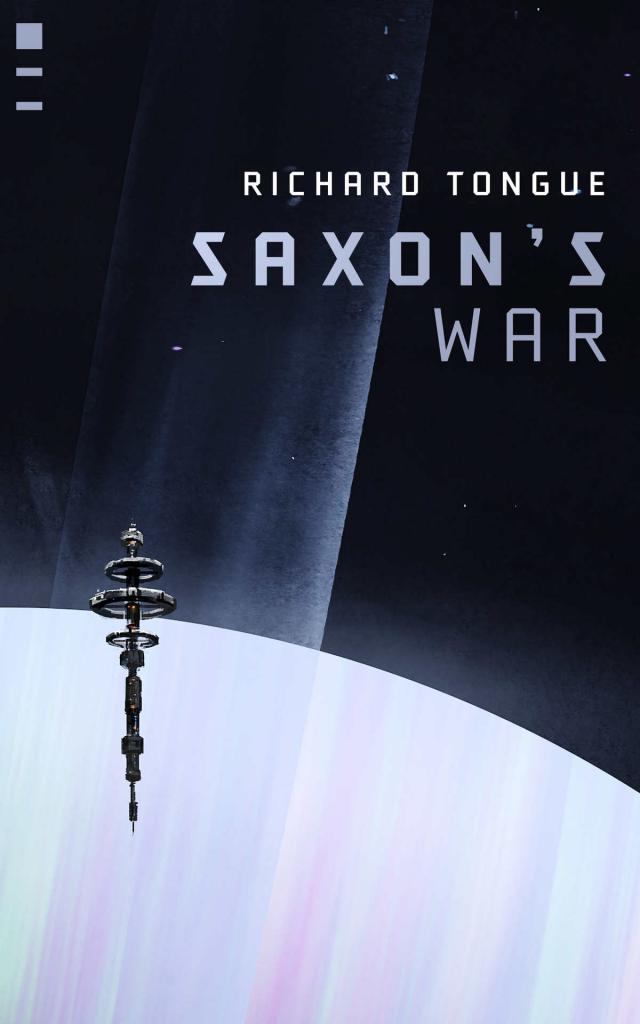


SAXON’S WAR
Richard Tongue
SAXON’S WAR
Ring Raiders: Book One
Copyright © 2021 by Richard Tongue, All Rights Reserved
First Kindle Edition: November 2021
All characters and events portrayed within this eBook are fictitious; any resemblance to persons living or dead is purely coincidental.
“Give me a lever long enough and a fulcrum on which to place it, and I shall move the world.”
Archimedes
Prologue
Colonel William Saxon hung from one arm, trying to take in the glory of Saturn, the rings now seemingly almost close enough to touch. He glanced up at the clock, turning back to the view, knowing that he had plenty of time before he had to return to the Control Module. In a little over ten hours, they’d be completing the breaking maneuver that would put his ship, Wayfarer III, into orbit around Saturn, commencing an eighteen-month exploration of the moons, commencing with the first manned landing on Titan.
His first landing. In a matter of weeks, if all went to schedule, he would be following in the footsteps of Neil Armstrong, Liu Yang, Gabrielle Dubois. The three astronauts who had taken the first steps on the Moon, Mars, Callisto. NASA and the Space Force had committed to Titan twenty years ago, a project that was finally about to reach its fulfillment. He’d still been in the Academy, then, lobbying for a Space Force commission, his goal to transfer into the Astronaut Corps at the first opportunity.
He’d made it, all the way. Class of ’31, two tours on Moonbase, then the Pilot’s seat on Wayfarer I, the Venus Orbital Flight, then into the training for the big jump, the expedition to Saturn, to Titan. Decades of work, and all of it was about to pay off. He kicked down through the hatch, pushing down the corridor, most of his crew asleep, off-watch, preparing for the burn, and swung through the aft node into the lander, still running through a series of diagnostic checks started by his co-pilot, Diana Benedetti, before she’d turned in for the night, leaving him the midnight watch.
The controls seemed to gleam, Saturn still shining through the small viewports, and he couldn’t resist the temptation to rest his hands lightly on the deactivated console, picturing himself taking the lander down as he had done in the simulator countless times back in Houston, or on the nine-month flight out from Earth.
Just as he was turning back to the corridor, he heard a loud report from the rear, the wailing of sirens followed by a dreadful sound that all astronauts feared above all else, the sound they prayed they would never hear. The hiss of escaping air. The hull had been breached, somewhere forward.
He glanced out of the viewport, the stars moving now, the ship out of control. He had to get to the Control Module, but the node hatches began to slam shut, one after another, blocking his passage into the main body of the ship. He tapped at a wall monitor, trying to bring up a status report, then felt another impact, the hull vibrating from the force of the strike.
He slammed his hand onto a communications control, fighting to shout over the noise of the alarms, quickly realizing that he was broadcasting to dead air, the systems failing one after another in a cascade. A new status update flashed on the screen, and Saxon’s eyes widened as he realized where that second impact had been.
Square on the Habitation Module, where all but two of the crew were fast asleep. Unless there had been some sort of miracle, four of his friends had just died, and in all probability, he was about to join them. He tried to call up the master controls, the command systems by some miracle still working, and brought up a structural diagnostic.
There was still some hope. The drive systems were undamaged, and the Command Module was still intact, though he couldn’t tell what Doc Clayton might be trying to do. If they’d passed through some sort of meteor swarm, they were likely clear of it now, and if he could just stabilize the ship, he might be able to set up for a flyby, swing low past Saturn and put them on a course to take them back to Earth in months, at least close enough for a resupply mission that might save the ship, save their lives, given them a chance to try again. He looked up at Saturn, still gleaming in the night, shaking his head.
“Next time,” he muttered. “Next time.”
Turning back to the lander controls, he tapped in a series of commands to deactivate the diagnostic checks, bringing the primary systems online. He couldn’t use the main engine, not without tearing what was left of the ship in half, but he might be able to make the needed course correction with the maneuvering thrusters. It had to be worth a try.
As the lights to the rear flickered, power conduits ruptured, the lander systems came on, all operating autonomously, the small fission reactor at the heart of the compact spaceship still running. If needed, he could just about run the whole ship from here, albeit at the cost of ever using the lander for its intended purpose.
Not that he had to worry about that anymore. The mission was over. All he could do was try and survive. He glanced up at the monitors again, a smile crossing his face as he saw someone trying to open the hatch from the inside of the Habitation Module. They’d managed to patch the hole in time. His crew were safe, at least for now.
He tapped in the control sequence to activate the thrusters, a series of warning lights winking on, alerting him that any maneuver would place undue stress on the hull, but he turned them off with the tap of a control. He didn’t have a choice, not if he was going to save the ship.
He fired a quick pulse from the starboard thrusters to test them, then turned the power as high as he dared, knowing that he’d need all the thrust he could muster to bring the ship back onto an even keel. Behind him, the lander hatch slammed shut automatically, a standard safety practice in the event of another breach, locking him out of the rest of the ship.
Grasping the controls, he fired again, a longer burst, then another, then another, each trying to correct part of the spin, to counteract the force of escaping air that was still threatening to rupture the hull. The two breaches they’d suffered could be repaired, at least patched. Anything larger would be the end of them all.
The ship was almost stable now. One more pulse would do it, from the lateral thrusters. He took a deep breath, then fired, the thruster bringing the ship back onto the correct attitude. As he reached to end the burn, a series of red lights flashed onto the display, warnings of imminent structural failure, and he heard a third, final report, somewhere aft, this one introducing a new hiss, here in the lander cabin. With a loud crack, the explosive bolts fired, the mother ship jettisoning the smaller craft in a desperate attempt to save itself.
It took less than a minute for Saxon to diagnose the source of the fault. Another impact, too small to register, catching the linkage between the lateral thruster and the fuel tank. When he’d fired it at full power, the system had given way, and the tank had ruptured, spilling its contents into space.
Frantically, he began to make a series of calculations. Someone was trying to contact him, but the bandwidth was too low for him to make out the transmission, and he didn’t have time to work the systems. He had to find out whether he’d done enough to save his ship, his crew, to put them back onto a safe course for Earth. The calculations taxed the lander’s computer to the limit, but finally, he managed to coax the figures out of the program, and a smile crept across his face. He’d done just enough. With a relatively minor course correction, Wayfarer III was going home, wounded and crippled, staggering across the finish line, but his crew would survive.
His life could now be measured in minutes. There was a spacesuit hanging in the locker behind him, designed for the surface of Titan but suitable for space if needed, but that would only grant him a few hours more. It hardly seemed to be worth it, but while there was life, there was hope. He pulled the suit down from its hanger, scrambling into it as fast as he could, the air getting thinner and thinner as he worked, the green lights of the suit winking on only just in time, helmet locking in place. Finally, his internal communicator burst into life, the transmission from his friends getting through.
“Benedetti to Saxon. Benedetti to Saxon. Do you read?”
“Roger that, I read you. Status report?”
“Five hull breaches, Science Module depressurized, Habitation Module almost there. Sanders is dead. Damn meteor went right through him. The rest of us are uninjured. I think we can patch, given time.”
“You’ve got a course correction to make in eighty-two hours, but you won’t need the main engine for that,” he replied. “Can you do it?”
“We’ll find a way, boss, if we have to get out and push.” She paused, then said, “Can you maneuver?”
“I’m dead in space, pretty much. I’ve got my landing thrusters, but they don’t have anywhere near enough delta-v for me to get back.” He looked at the readout on the arm of his suit, and added, “Signal strength’s beginning to go. Looks like the transmission relay is out.”
“Just stay where you are,” Benedetti said. “We’re coming to…”
“That’s a negative,” he replied.
“I repeat, we’re…”
“I heard you,” he interrupted. “I am irretrievable. Don’t worry about me. Worry about Wayfarer. That’s all that matters now. I guess I’ll be joining Sanders in about two hours, give or take. You’ll find my last letters home in my personal database. Mission Control has the access codes, but I’d appreciate you passing them on in person.”
“Damn it, Colonel,” she barked. “This is…”
“This is the way it is going to be,” he replied. “This is the way it is.” He paused, looked at his wrist computer again, then said, “Signal strength falling off a cliff. Give everyone my best, and get them home. That’s an order.”
Before he could hear any reply, static swarmed the channel, and he hit a control to silence his helmet communicator, killing the speakers. He looked back at Wayfarer, shrouded by a cloud of debris, his eyes wide. The long-range communications antenna was gone, ripped and torn into a million pieces by the meteor swarm they had blundered into. No surprise that he couldn’t get through to the ship. Nor would they be able to call home, not for months.
That was Benedetti’s problem now. He had problems of his own. He was a dead man, with perhaps a few hours left to survive. Two and a quarter, according to his suit computer, but he could potentially stretch that a little with controlled breathing, tinkering with the suit pressure. Not that there seemed to be any point in that. Benedetti could work the numbers just as he had. There was nothing Wayfarer could do to retrieve him, not in the time remaining. Had the lander held pressure, they’d have had weeks to conjure a miracle.
In hours, it was hopeless. Still, lander was still working, the hardened systems surviving depressurization, so he could at least set up one final maneuver, provide at least a chance that somebody might find the lander in the future. It took almost an hour to program the navigational systems with the necessary instructions, but in nineteen hours, the main engine would fire, burning all of its fuel to put itself into a stable orbit around Saturn. Perhaps Wayfarer IV would find it, three years in the future. Assuming there was a Wayfarer IV, that the program wasn’t cancelled in the wake of the disaster. He might be drifting through space for centuries, but sooner or later, the lander would be found, and his body with it.
By the time he had finished, his short-range radar showed nothing, and a quick check of his suit radio should no sign of a signal. Wayfarer had bigger problems than inquiring about the last words of a dead man. He looked around the cramped lander again, a smile on his face. He’d always known that there was risk in this mission, that there was every chance that he might not come back in one piece. At least he’d reach Saturn, his body, at any rate, perhaps destined to be an eternal monument to the space program, to all of the hopes and dreams of a nation, of a world.
He looked at his suit readouts. Less than an hour to go. No point trying to linger too long, but there were still a few duties he had to complete before the end. In the event that Wayfarer was lost but the lander was recovered, he had to make sure all of the onboard data was stored securely, in order to give an account of what had happened out here. The lander’s archive was almost empty, and he quickly filled it with copies of the telemetry from the accident, copy after copy in the hope that they would survive, even if the hardware degraded over years, maybe decades.
Then, one last task. He had to activate his suit containment protocol. The spacesuits were designed to lock down tight, in order to prevent microbiological contamination of an alien environment, contamination that might cause incalculable harm to an ecosystem unaccustomed to Terran organisms. The course he’d calculated was designed to keep the lander in a safe orbit for centuries, if needed, but sooner or later he’d impact one of the moons, if not discovered, and while his body wouldn’t survive, some of the bacteria that might lie dormant in his corpse just might.
If there was life on one of Saturn’s moons, the arrival of his corpse might mean its end, a wave of alien infection that could spread through a biosphere ill-equipped to counter it. At all cost, he had to prevent that from happening, and fortunately, it wasn’t going to be a problem.
The answer had been simple. Super-low-temperature death. First, his suit systems would gently lower the pressure in his suit, putting him into a sleep from which he would never awaken, then, once he could feel no more, the temperature in the suit would be dropped to match that of the outside, as near to absolute zero as possible.
With a last smile, he tapped a control, sending soft music playing in his helmet, and took a final look at Saturn, the rings still as glorious as they had been when he had first seen them with his own eyes, only weeks before. There were worse ways, worse places to die.
But none, perhaps, as final.
Chapter 1
Waves of pain shot through his body as he fought to rouse himself, to regain consciousness. He tried to move his arm, finding it entangled in cables, and forced open his eyes to reveal a room bathed in crimson light, crates and containers stacked on all sides, a low rumble in the distance the unmistakable sound of a ship’s engines at full power.
He was alive.
It was impossible. There was no chance that he could have survived. Unless someone had managed to snatch him out of the sky before the suit could complete its cycle, but no other nation was attempting to launch a ship that far from Earth, and even if they had somehow managed some sort of secret project, there’d been nothing on radar, no sign of another vessel.
And yet that had to be the explanation. As improbable as it might be, it was the only answer that made any sort of sense. Strength started to return to his aching limbs, and he glanced across to see a medical readout listing his vitals, all of them returning to normal. He’d had a brush with death, perhaps come closer than any ever had before, but had somehow survived.
He struggled to his feet, untangling himself from the cables, looking around to find some evidence of his rescuers, whomever they might be. All of the writing in the room was in English, which narrowed the list of possible candidates down somewhat. There had been rumors of an expedition planned by some of the orbital conglomerates, to exploit the resources of Titan, but as far as he’d known when he left Earth, that was years in the distance.
This ship was here. He looked around the room, the technology a mix of the familiar and the strange, the life-support monitors a flickering hologram that danced in and out of existence on the wall, the design of the wall speakers unfamiliar, but the medical instruments to which he was still connected little different from the unit on Wayfarer.
His ship. He had to contact his ship, transfer back over to her, try and organize some sort of assistance. They still had to complete a course change in order to guarantee their return to Earth, and while Benedetti had assured him that they could do it, he knew that right now, they needed all of the help they could get. With a struggle, he finished disconnecting the last of the medical cables, the readouts winking out, and eased himself loose, lowering tentatively to the deck. There was gravity here, the ship accelerating, and a smile came to his face. They’d already altered course, were heading to Wayfarer. That’s the only explanation that made sense.
He allowed himself to relax for a moment, then looked around, seeing a robe hanging limply against the wall, about his size. He cautiously walked over to it, careful not to move too quickly in the gravity field, and tugged it on, letting it drop over his arms. He looked down at his chest, his eyes widening as he saw an intricate network of threadlike scars covering his body, dozens of injection sites at all of his arteries.
What had happened to him out there? How long had he been out? There was no clock in the room, no way of telling whether he had been lying on that bed for hours, days, even weeks. He made his way to the hatch, working the release to open it, the design familiar once again, though the controls were not. Looking into the module beyond, he looked up and down, trying to see any sign of life.
“Hello?” he yelled. “Is anyone there?”
Only silence answered him, and he stepped back into the storeroom, looking around in vain for a communications control. As he made his way around the module, the tone of the engines changed, growing louder, and he felt the ship turn, thrusters firing to bring it onto a new course.
So far, this ship had been accelerating for at least five minutes, and evidently in an unplanned maneuver. That meant that this ship was way, way ahead of Wayfarer in capability, ahead of anything that either NASA or the USSF had on the drawing board, or anyone else for that matter.
He walked out of the module into a central node, two of the other hatches listed as ‘Storage Two’ and ‘Crew Quarters’, the opposite hatch to his obviously an airlock, a winking red light suggesting that it was open to vacuum. A final, fifth hatch was sealed, but as he reached for it, the acceleration finally stopped, and he started to float, being caught by surprise and pushed against a rear wall, inadvertently activating a display screen.