

The science of understan.., p.1
The Science of Understanding, page 1
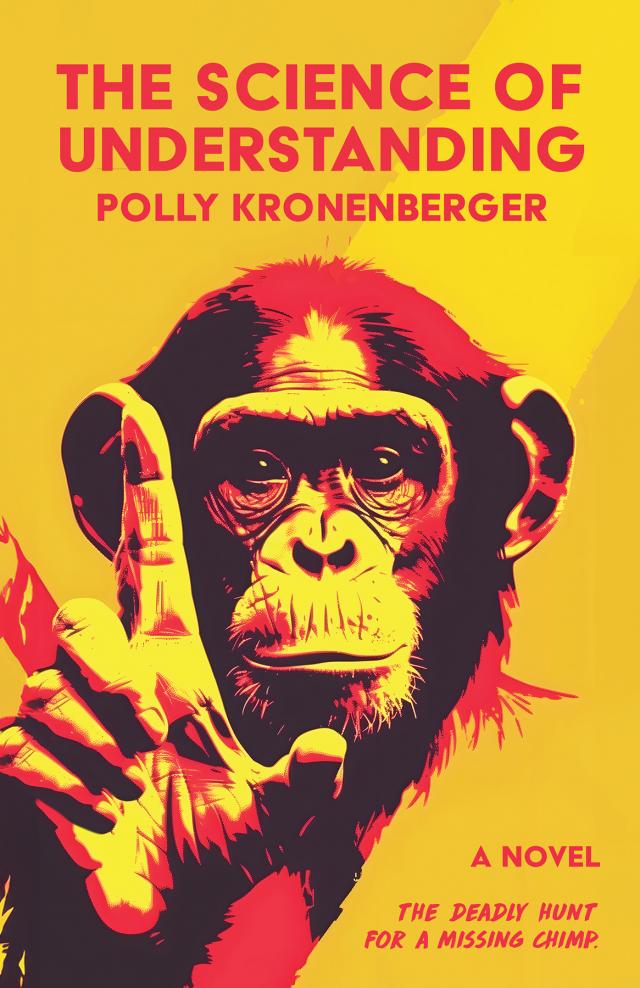


THE SCIENCE
OF
UNDERSTANDING
A Novel
Polly Kronenberger
Published by Flare Books.
© 2025 Polly Kronenberger
All rights reserved.
No part of this book may be used or reproduced in any manner whatsoever without written consent from the publisher, except for brief quotations for reviews.
For further information, write to info@catalystpress.org.
You can find out more at catalystpress.org.
In North America, this book is distributed by
Consortium Book Sales & Distribution, a division of Ingram.
Phone: 612/746-2600
cbsdinfo@ingramcontent.com
www.cbsd.com
First edition, first printing
9 8 7 6 5 4 3 2 1
ISBN 978-1-963511-13-0
Library of Congress Control Number 2024951886
“We are our breath. Without it, there would not be life.
Nature reminds us of this every time we breathe.
And we all breathe.”
—Charlie Greene, Siler, IN, 1987
“Lots of people talk to animals ... Not very many listen though …
That’s the problem.”
—A.A. Milne
“Speak to me: I will spend my lifetime trying to understand you.”
—Kamand Kojouri
Chapter One
I knew I had to be completely silent. The darkness of the walk-in cooler made me feel safe somehow. Well, I suppose as safe as I could feel as I watched my friend die. I sat there on the blood-soaked floor, holding him in my arms. I saw the life move out of him. A gunshot. Most likely the one to his neck. The metallic smell of his blood rose up around both of us. I kept my eyes locked with his, and I never left his gaze. Andy looked so scared at that moment, gasping for air, struggling to stay alive. And then, in the very next second, it all changed. He was gone.
Someone was still in our lab. I could hear him moving outside. I let go of Andy, got up quickly, and hid behind a stack of food boxes. Three boxes high, dates, plums, and other fruits. I hunched down so tightly under the back shelf and slid the boxes in front of me. And waited.
Perhaps only minutes had passed, but it felt like hours. The entire ordeal came crashing in on me when the door swung open with a thud. The person there, breathing hard, called out loudly, “Clear!” That is when I spoke, softly at first, then louder, telling them not to shoot. I realized then it was the police who had finally made their way to our floor. They cuffed me immediately and led me out into the main area. I explained I wasn’t the shooter and nodded down to my identification badge hanging around my neck. It didn’t matter. It would be hours until everything got sorted out.
The trouble started a couple of months earlier. Our work at Corrington and Ames Research, funded, this time, by a United States governmental grant, had been focused on communications with animals. CAR’s purpose, our mission, was to figure out how animals and humans might communicate most efficiently on a peer-to-peer level.
My name is Victoria Greene. Rory is what most people call me. I’m a human, first and foremost, a citizen of the planet. And secondly, I am a scientist. When I first became interested in science, in finding out how and why the world works the way it does, I never expected that I would be caught inside some tangle of murder and kidnapping. Ape-napping, more to the point.
It all started so harmlessly. I think it does for all people. In life, we begin so new, so fresh to the world. We are innocent, blameless, and so pure. Our lives are so new to this place, and as we draw each breath in, we learn. We find out about the world around us. I was born in 1984 in Siler, Indiana. It was the only place I ever knew or lived until the year I turned 18. I didn’t move too far away. Just slightly east, from Siler to Bloomington, where I attended the University of Indiana and lived on campus. I stayed in the dormitories for a couple of years. I couldn’t stand the Greek life there, and my family really couldn’t afford for me to get my own apartment in the early going of things. Regardless, I went to school and earned a double Bachelor—one in Communications and another in Biology. I worked like crazy in school and couldn’t decide which route I wanted to take. My communications degree had been inspired by Oliver, our family pet while growing up. And in the way of biology, I had followed in my father’s footsteps. Charles Greene. And then there was Magdalena Porter.
I suppose Siler was a perfectly nice little town, but all anyone talked about was getting out of there. I don’t know why. It was clean and quaint. There was always plenty of work, as the Patel Microcircuits factory was located in our county. We had very little crime, if any, and the sheriff never had much to do but walk around town and look smug.
My sister and I dutifully attended St. Ignatius Catholic Grade School and, later, Holy Rosary Catholic High School. Ruth. My sister. Ruthy, as everyone knows her. She is two and a half years older than me, and while we get along okay these days, she was always a little bossy and controlling when we were kids. I suppose the same is true in our adult lives.
I can’t tell you much about growing up Catholic other than that is what I did. It was the only thing I knew. We wore uniforms to school and went to church four days a week, on Mondays, Wednesdays, and Fridays at school, and on Sundays with Mom and Dad. Afterward, on Sundays, we always went back home and fixed a big breakfast of fried eggs and bacon, toast, and fried mush. I loved those breakfasts.
My parents are Charles Edward Greene and Corine Anne Ladner. Everyone referred to my dad as Charlie. I take after him, of sorts. He worked in the lab at Siler Community Hospital, running blood samples, or body fluids, or whatever came his way. I’m not sure if it was truly what he wanted to be doing, but his options for working as a scientist were limited in Siler.
It was Mom who wanted to live in that small town, after all. Not Dad. That’s where she was born, and Grandma and Grandpa Ladner gave us our house, or else sold it to Mom and Dad for a little bit of nothing. It stood two stories tall, made of dark brick from the bottom up. The front porch wrapped all the way around, and we had two extra bedrooms. The place had enough space for a family of ten, let alone just us, a family of four. I liked it that way. In the wintertime, especially, I could always sneak off to some corner of the house and be by myself, even to places like the creepy attic or the semi-creepy basement. But I loved being in those rooms by myself, reading or thinking or just plain old sitting.
We never had a cat or a dog or even a rabbit or hamster. Ruthy had no interest in animals, and while I always thought it would be fun to have a dog, I was completely happy with the one pet we did own. A bird. A beautiful African Gray Parrot named Oliver. My dad brought him home from work one day. Someone’s aunt or something had died where my dad worked, and no one in her family wanted her bird, so Dad took him. They said Oliver was 41 years old. Anyway, I loved that bird. I’d pull up a kitchen chair and stand at the front of his cage, talking to him for hours. I’m guessing he knew about 50 words. Maybe more than that.
Oliver, most likely, changed my life. He came to our house just after my eighth birthday, and for the first time, I started thinking about communicating. I started to wonder if this bird really understood what it was saying, or was it just good at mimicking? Then, I began to think about people talking to one another. What made people want to say things to each other? Sometimes out of need. Other times, out of personal wants or wishes. Learning about communication became a diversion for me. I tried to teach Oliver new words, holding up objects like pencils, a baseball, an apple. Then I’d say the word over and over, hoping he would catch on. One day, I didn’t say a word. I just held a fork up to his cage. He’d seen that fork a hundred times before and had heard its name. He popped off a couple of his regulars, like “hello” and “hold it right there.” And then it happened. Oliver rocked back and forth on his perch, as quiet as could be. He then made his way over to the front of the cage, took one peck at the utensil, and said out loud, “Fork.” I felt completely convinced that he understood the meaning of the word. I ran through the house screaming with delight until Ruthy slugged me and told me to quit being an idiot.
Ruthy. My older sister Ruthy. It’s not that we dislike each other. It is more along the lines that she never wanted to be bothered with having me around. For almost three years, she was the only child in the family, the center of attention. And then I showed up. Of course, I had spoiled the fun, and she let me know about it. Now she’s married and lives in Carmel, a suburb of Indianapolis. Her husband is a dentist, and they have two sons, Trent and Scottie. We send our yearly birthday and Christmas cards and see one another most holidays when we visit Mom.
Anyway, back to my job and the trouble at my lab. My bonobo had been stolen, and I wanted him back. Lazzy. Most people aren’t familiar with bonobos. But they are somewhat similar to chimpanzees. The main point to note is that bonobos are smaller in size and much less aggressive than chimps, which makes them ideal for studying in the lab. Especially where human communications and personal interactions are concerned. Both of those things are mandatory for our current investigations.
Nonetheless, Lazzy wasn’t actually “my” animal but a part of our primary studies there. Eons ago, when I was in college, my professor told me never to get attached to the subjects. But guess what? I did back then, and I have ever since. I can’t help myself. Sure, I’m a scientist, and I should be able to separate my emotions from the content of the rese arch. But, as circumstances would have it, I’m human, and since the time I could sit up and look around me, I’ve loved animals.
I know they say parents shouldn’t have their favorites. I can’t help myself there, either. I love my Lazzy. He isn’t like the other bonobos, I don’t think. Della and Gloria are smart, don’t get me wrong. But they find it easy enough to get back to their ape brains rather quickly. They are easily excited over things like bananas or anything else they deem as treats, be it food or otherwise. Also, Della and Gloria get distracted. One minute, we’ll be carrying on a conversation about the weather, and the next minute, they will be trying to put their fingers up my nose, or pull at the buttons of my shirts. Gloria has a thing for sparkly objects, like earrings or necklaces. Della loves the color blue.
But then there is Lazzy. Anyone with half a brain can see how completely intense he is when they look into his eyes. Lazzy is thoughtful. When I say thoughtful, I mean considerate. He will offer you half of his food, or he’ll let you go first through a door. I also mean he is heavy in his thoughts. He’s pensive, almost. Absorbed. Engrossed. Rapt. Somewhere in there, Lazzy is always considering something. Oftentimes, I’ll ask him through signing. “What are you thinking, Lazzy?” And he’ll respond with something like, “I is wondering why rain comes out.” Or “How come cars make big smells?” Always something far removed. Things you’d never expect a primate would be thinking.
The day he went missing, he’d been gone an hour. There’d been no word from anyone. All the staff had been accounted for in our department except for Martin. No one signed out Lazzy on the board, and Martin hadn’t signed himself out of the area either. Before I raised a global, corporate-wide alarm, I had all the lab techs search the building. We employed several techs per shift who were responsible for the general care of things in the lab, including the feeding, bathing, and housekeeping of the bonobos. There were just three of us who were considered researchers. Myself, Martin Boyle, and Andy Turner. I report directly to Dr. William Barber. Dr. Barber was out on vacation that week, so everyone else in the department was aware of Lazzy’s absence, and all of them went out searching, except for Martin Boyle, who was still nowhere to be found.
One little quirk about Lazzy. He loves corners. He would rather sit with his back to a corner than anywhere else. I’d scoured every corner I could find on our floor, under counters, behind desks, everywhere. But no luck. Fear overcame me. The more time passed, the more my chest began hurting. I could barely catch my breath even though I was standing perfectly still. None of us found even a trace of him, so after 71 minutes, I made the call to the head of our division, Dr. Aubrey Keegan.
“Keegan,” she answered.
“This is Rory, Dr. Keegan, in the Animal Communications Department. I’m calling to report that one of our bonobos is missing. We’ve been searching for more than an hour,” I said.
“What do you mean it is missing?”
“Just what I said. He’s not in his cage, which is where he’s supposed to be. No authorized personnel have signed him out. We do not know his location.”
“Do you have any idea how serious this is?”
Her question ran through me like a knife. What did she think I was, some kind of idiot? Of course, I knew how serious this was. More than she’ll ever know. Keegan had never even met Lazzy. But this went much deeper than Lazzy’s disappearance.
There had been an unspoken rift between Dr. Keegan and me. The tensions between us date back to a time before I was even born, back to a grievance between Keegan and an old friend of mine. I tried to set all of that aside and behave in a professional manner. Even still, most days, I felt she was a callous, uncaring administrator. And a bit of a narcissist to boot. I always behave cordially toward her, but beneath it all there lies a pool of animosity.
Now she was asking if I had any idea how serious this situation was. I swallowed hard.
“Yes, Dr. Keegan. I do.”
“Well, then. Find the damn thing. Do whatever it takes, but keep it quiet. We don’t want this getting out, especially to the press,” she huffed. I could almost see her rolling her eyes or inspecting her nail polish as she spoke.
“But, Dr. Keegan, how do you suggest we keep this quiet? I’m ready to sound a corporate-wide alert and lock down the exits.”
“You’ll do no such thing, Dr. Greene. You can call the head of security. Tell him your situation, but make sure he knows this is strictly need-to-know. Put an extra guard at the main exit.”
I hung up the phone and called Morris Mott, head of security, and repeated Keegan’s instructions to ensure that I was following the rules from the high-and-mighty offices above. I had known Morris since I began working at CAR. When we met, he hadn’t advanced to the head of security yet, but he was on his way up. On my first day, he loomed large behind the counter to issue all my security clearance information. He took my photograph, my fingerprints, issued my badge and my key fob. Morris stands at about 6’4” and looks a bit like a young Danny Glover, especially with his mile-wide smile. But he’s built like a rock. Even in long sleeves, you can tell his biceps are bigger than logs. Yet, despite his daunting physique, Morris is probably one of the nicest people I’ve ever met. Not that I’m around him all day long, but I’ve never heard him say a disparaging word about anyone. He’s always smiling and waving at people, and he looks like he is genuinely glad to see them.
Given the current situation, I was glad it was Morris who picked up the phone and not one of his underlings. I explained the circumstances, and, as always, he offered a sense of calm and reassurance, telling me they would be on the watch for anything suspicious. He felt fairly certain that no one had walked through the exit with Lazzy that day, which hopefully meant that Lazzy was still somewhere in the building.
Chapter Two
Stories connect us. Stories are how humans have communicated since the beginning of time. Even before we were humans, we told each other the things we needed to express. Stories have been around long before words were ever written down. We tell stories, first and foremost, with our minds, our voices, and our hearts. Stories have been moving through time. From one moment to the next. For thousands and thousands of years. We know because someone told us so.
I realized this early on with the help of many people. But it wasn’t until Magdalena Porter came along that I knew just how important stories were.
I first met Magdalena Porter in the fall of 1994. The world seemed good to me at that time in my life. Looking back, it was simple. My pursuits centered around one of three things. I either went to school, completed my chores, or played. That was about it.
My fourth-grade year had just started, and the school gave us a week off because they discovered the entire heating system had quit working since the last time they had turned it on during the school year before. It had to be replaced, and the school decided to do major repairs on the ductwork at the same time. As a result of our time off, Mom and Dad took me and Ruthy down to Red River Gorge. They rented a cabin for the week, and we were all set to do a lot of exploring.
We visited a couple of natural bridges in the area for the first few days. On about the fourth day of our little adventure, my parents decided we’d just hang around the cabin for the most part. Do little hikes. Or we could read. I was allowed to take a short walk on my own. As I ventured out, I went a little further than I intended and got a bit turned around. I couldn’t get over how, all of a sudden, everything looked the same. The afternoon got long, and so did the shadows. I was worried, but not quite to the point of being panicked. The bottom line, though, is that I couldn’t find our cabin or my family.
By the time I started to swing into full panic, I smelled smoke. Campfire smoke. A few steps more and a clearing appeared. And that’s when I met Magdalena Porter. Standing straight and strong, her back to me, she was tending a fire in a stove off to the side of a hefty-sized cabin. A couple of small outbuildings lingered in the rear. The smoke smelled especially sweet.
“Excuse me, ma’am,” I said.
“C’mon over here. Closer,” she said without turning one inch.






