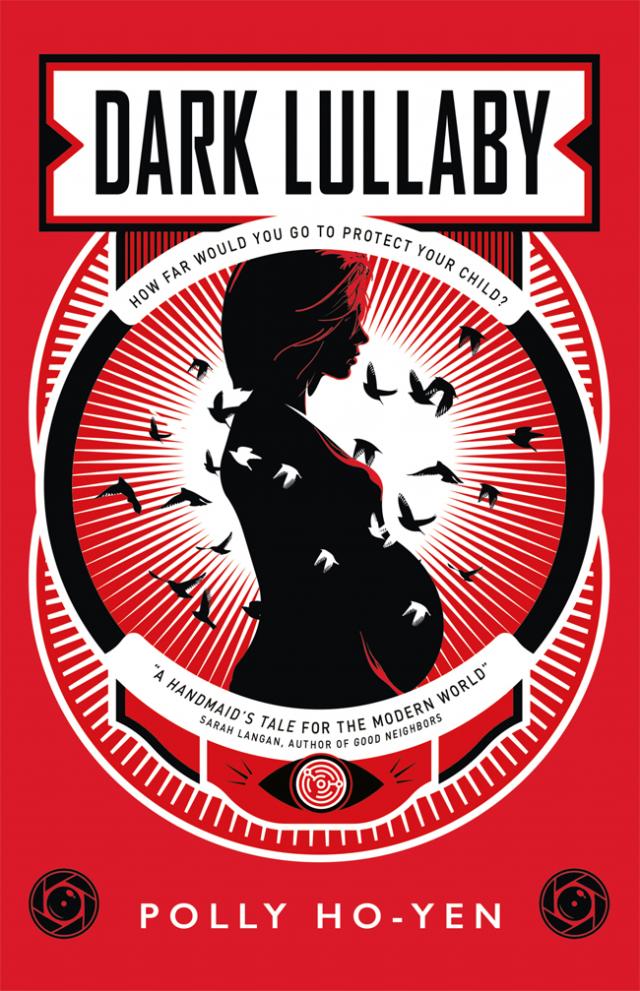
Dark lullaby, p.1
Dark Lullaby, page 1


CONTENTS
Cover
Praise for Dark Lullaby
Title Page
Leave us a Review
Copyright
Dedication
Then
Now
Then
Now
Then
Now
Then
Now
Then
Now
Then
Now
Then
Now
Then
Now
Then
Now
Then
Now
Then
Now
Then
Now
Then
Now
Then
Now
Then
Now
Then
Now
Then
Now
Then
Now
Then
Now
Then
Now
Then
Now
Then
Now
Then
Now
Then
Now
Then
Now
Then
Now
Then
Now
Then
Now
Then
Now
Then
Now
Then
Now
Then
Now
Then
Now
Then
Now
Then
Now
Acknowledgements
About the Author
Also Available from Titan Books
Praise for Dark Lullaby
‘With fabulous world-building and a plot so tight you could bounce a quarter off of it, Dark Lullaby is a Handmaid’s Tale for the modern world, about the ways our human need for love can serve as both society’s salvation, and its undoing.’
Sarah Langan, author of Good Neighbors
‘This gripping thriller has everything: beautiful writing, shedloads of tension, family drama. It made me grateful for my fragile freedoms.’
Emily Koch, author of If I Die Before I Wake
‘Dark Lullaby is hard-hitting, mournful and deeply affecting, reading like the offspring of Never Let Me Go and 1984, and it addresses universal fears about early parenthood without providing easy answers. I raced through it and when I’d finished, it made me hug my own children tight.’
Tim Major, author of Hope Island
‘A heart-wrenching and beautifully told novel, absolutely compelling, and scarily plausible. This is the best kind of speculative fiction: thoughtful, committed, alert to the outlines of a possible near-future, that inhabits your mind long after reading. One of the most important books to be published this year.’
Marian Womack, author of The Golden Key
‘An expertly crafted exploration of love and loss, with a truly haunting conclusion. Intimate, often poetic prose shines bright through the encroaching dread. Bleak, beautiful and bittersweet at every turn. I loved it.’
Martyn Ford, author of Every Missing Thing
‘Polly Ho-Yen masterfully balances eerie, dream-like prose with a distressingly realistic portrayal of a world where reproductive right has become reproductive responsibility. To be a parent is to live with your heart outside your body and, through smart world-building, memorable characters and sharp insight, Dark Lullaby perfectly encapsulates the power and terror of that love.’
Dave Rudden, author of The Wintertime Paradox
‘Dark Lullaby is a gripping story of love and desperation, of intimate and social structures, of sisterhood and motherhood that rings true as a bell. I devoured it.’
Deirdre Sullivan, author of Perfectly Preventable Deaths
Leave Us a Review
We hope you enjoy this book – if you did we would really appreciate it if you can write a short review. Your ratings really make a difference for the authors, helping the books you love reach more people.
You can rate this book, or leave a short review here:
Amazon.com,
Amazon.co.uk,
Goodreads,
Barnes & Noble,
or your preferred retailer.
Dark Lullaby
Print edition ISBN: 9781789094251
E-book edition ISBN: 9781789094268
Published by Titan Books
A division of Titan Publishing Group Ltd
144 Southwark Street, London SE1 0UP
www.titanbooks.com
First edition: March 2021
10 9 8 7 6 5 4 3 2 1
This is a work of fiction. All of the characters, organizations, and events portrayed in this novel are either products of the author’s imagination or are used fictitiously. Any resemblance to actual persons, living or dead (except for satirical purposes), is entirely coincidental.
© Polly Ho-Yen 2021. All Rights Reserved.
Polly Ho-Yen asserts the moral right to be identified as the author of this work.
No part of this publication may be reproduced, stored in a retrieval system, or transmitted, in any form or by any means without the prior written permission of the publisher, nor be otherwise circulated in any form of binding or cover other than that in which it is published and without a similar condition being imposed on the subsequent purchaser.
A CIP catalogue record for this title is available from the British Library.
To Dan
I scarce believe my love to be so pure
As I had thought it was,
Because it doth endure
Vicissitude, and season, as the grass;
Methinks I lied all winter when I swore
My love was infinite, if spring make it more.
from ‘Love’s Growth’ by John Donne
OSIP stands for the Office of Standards in Parenting.
IPS refers to an ‘insufficient parenting standard’.
Induction is the process of fertility treatments a woman undertakes to conceive a child.
Extraction is the process of a child being removed from the care of their biological parent or parents if the standard of care is deemed insufficient by OSIP.
Out is an unofficial term referring to a person viewed as one of ‘OSIP’s Un-Tapped’.
THEN
The last time that I saw Mimi she was almost one.
We decided to celebrate her birthday early, just Thomas and myself, along with Thomas’s mother Santa, the only parent we had left between us.
I’d made a cake out of little more than pure oats, butter and maple syrup; Mimi had just been diagnosed with an intolerance to gluten and I was now vigilant to the point of obsessive over any crumb that passed her lips since I had received the last IPS.
I suppose that as we sat down around our small table that night in November we were thinking of how little time we had left with her. We did not speak of it. We simply lost ourselves in my pathetic, flattened offering of a cake, with the electric candle that Thomas had bought especially sitting crookedly on top.
There was a part of me that knew then.
That very morning, I’d buried my face into the wispy fuzz that settled on the crown of her head after she napped. ‘Her little halo,’ Thomas called it, bouncing a hand upon its golden springiness. I knew it then, at that moment: We don’t have long left together. But it was such an awful thought, one so singed with pain, so full of blackness, an emptiness like no other, that I didn’t dare examine it. I shoved it away desperately and whispered, ‘Happy birthday, darling girl,’ into the silkiness of her tiny ear.
We gathered closer together as we began to sing ‘Happy Birthday’, pulled towards each other as though the little hard light from the candle’s bulb gave off something like warmth. We sounded weary. The words no longer bore any promise; they only seemed to spell out our shortcomings. Happy birthday, dear Mimi.
Santa’s singing rang out louder than Thomas and I combined, the off-key notes covering our faltering voices. She was dressed in her usual style, a gold and orange scarf hanging loosely off her shoulders, a skirt that matched her lips in its ruddiness, her dark hair flecked with a few errant silver strands pulled back from her face with a printed headscarf. Thomas and I were like shadows in comparison: grey, blurred, just behind her.
Her rose-red smile was fixed upon her beloved and only granddaughter. I remember thinking that she was making the most of these last moments, filling them with colour and light in the same way that she approached her canvases, her life. She had dressed that day with especial care, in the richer hues of her wardrobe, to offset the gloom, the sadness that had flooded through our life and carried us along with it. I tried to fix a smile on my face but I could feel it hanging there, a slipping mask.
Hap – py Birth – day to – you. Why does the tune slow as you sing it? The last few notes stretched on, awkwardly, until Santa started clapping, which made us all join in too. I looked at my daughter, at the centre of us, and wondered what I always wondered: had we created a world in which she was happy, in which she was safe?
Mimi sat perfectly straight in her chair. It had grown with her through her first year, being some sort of elegant Nordic-inspired design that could be made smaller or bigger depending on its sitter’s proportions. I insisted on it when I was pregnant with her, had coveted it in one of the OHs, the ‘Outstanding Homes’, which we had visited during the induction, despite myself .
Before we visited the OHs, Thomas and I had a frank conversation about money and how having stuff would not make us better parents. Love was the answer, we told ourselves, not stuff. And yet, as soon as I saw the chair, its honey-coloured wood and gently curving lines, I vowed to have it for her. I could already picture our daughter sitting upon it at dinnertime, completing the triangle. It was hers before her eyes were open, before she felt the breath of the world upon her skin, and long before she was ready to sit up or feed herself.
‘Blow it out, Meems!’ Santa bellowed. ‘Make a wish!’
Mimi was entranced by the candlelight – but then her eyes darted to me.
‘Blow it out, my darling!’ I said and I leant in close to her. ‘This is what we do on our birthdays.’ I ballooned my cheeks comically.
Then Thomas joined in too and in those moments, as we clowned and laughed and pretended to blow out the candle together, I think we forgot. I think we forgot what had brought us together a full twenty-two days before the date of her first birthday.
Mimi studied our faces and for a moment it looked like she was going to copy us and fill her bud-like cheeks and blow down on the plastic stump of light.
‘You can do it, Mimi!’ I called out in a burst. I was reminded of a long-distant memory of myself sitting in Mimi’s place, my sister Evie next to me. A birthday cake directly ahead, safe and sure in my absolute belief in everything that my sister did and told me. ‘Make a wish! You can do it, Kit!’ she’d yelled to me, desperately, as I had to Mimi, as though she could not contain it. I remembered thinking that I must do it because Evie had told me to; that it must come true for she had told me it would. But in those few moments I’d already blown the candle out and forgotten to wish for anything.
Mimi’s mouth unfolded into an open grin, and there, right there in her eyes, I saw it.
Pure delight.
Her brown eyes seemed to blossom, grow larger, and the light of the candle danced in her pupils. Or was it a light from within her? I let myself revel in it and I thought for that moment: Yes. Yes, my daughter is happy. Yes, all is right in the world. And no, there is nothing, not any one thing that I would ask for more than this single moment of her happiness.
She leant towards the blinking light of the LED candle as though she really did understand that she should blow it out.
‘Switch it off,’ I hissed. For a second longer that it should have, its bulb remained obstinately bright. I was mildly aware of Thomas’s panic beside me; he had been pressing and was now striking the remote that controlled the candle. Quite suddenly, the bulb went out.
I remembered again the candle that I’d blown out on the birthday when I’d forgotten to make a wish. Its wavering flame glowed and as I blew, it bent away from me until it diminished to nothing. Its smoke had streamed from the wick and the scent of it, though acrid and sharp, I’d liked and savoured. But I dismissed the memory: it wasn’t worth the risk to give Mimi a real candle on her birthday cake, however soft the light it cast.
I reached a hand out towards Thomas, feeling for the first time that day waves of contentment inside me. As though he’d had just the same thought, his hand was swinging towards mine and our fingers met in mid-air and clasped together fiercely. Mimi was triumphant now, toothy and innocent; her mouth gaped open with the thrill of it all.
It was then, just then, that we heard the rapping at the door.
NOW
There’s a knock on the car window; it jolts me awake.
I notice the crick in my neck from sleeping with my head to one side, the blaring lights of the charging station, the slight hum of activity tracing the air.
Thomas’s face shifts into focus, his eyes wide and searching. He mouths a question to me through the window: Want anything?
I shake my head and he turns away. I watch the quick rhythm of his steps as he crosses the forecourt. We can’t stop here for long.
I’m still not quite awake and for those few moments I forget what we’ve done, forget why we’re here. Then I turn to the back seat, suddenly, viciously. I whip my head round so that it jars, even though I know what I will find when I look back there.
The grey seats are empty; the seatbelts hang redundant.
I turn back to the front, deflated. I can see the top of Thomas’s head past the buckets of half-dead flowers, the glowing Spheres that revolve above. He’s eyeing something on one of the shelves as though he is about to pick it up but then he straightens, turns towards the sign for the toilets and disappears from view.
A car pulls up in the bay beside us. A man driving, a woman sitting in the back. I sense some unease between them; he wrings his hands as they speak, then rubs his temples in long upward sweeps. She’s crouched over, curved like the branch of an old tree. Then I glimpse the outline of the car seat next to her. That’s why she’s sitting in the back.
I crane my neck to see if I can spot the baby. We haven’t seen any children since we left home and I realise right then that I’m holding on to a hunger to see one. A tiny, new face slumped over in sleep, a toddler taking tottering steps; I’m flooded with an urgent need to see proof of their existence before me.
The woman catches my eye and I turn away quickly, pretending instead to be watching the Spheres as they change over. When I glance back, she is still staring at me, as is the man. They wonder what interest I have in them. They suspect perhaps that I’m not merely looking at them but watching them, inspecting them, judging them.
In the next moment, they pull away without charging their vehicle. Their car moves forwards in lurching jolts, taking the corner a little too sharply, a little too quickly. I wish I could tell them there’s no need for them to go but there’s another part of me that’s glad they’re suspicious, that wants to urge them to be on their guard, always.
I hunch my shoulders, my back stiff from travelling for so long. I want to release it, this pain that lines my spine, but I carry it with me, it is ingrained.
The Spheres turn over again. They crackle with another news story and I scan them, wanting to be distracted from myself, from my own thoughts that also revolve and rotate in an endless cycle. I yawn noisily, my eyelids beginning to droop.
That’s when I see it.
I am branded by it. I feel it, like a pressure on my chest that’s increasing, a heavy lump in my throat that grows and engorges. Everything I thought I knew drops away.
I see it, over and over, after the Spheres have changed again and moved on to quoting statistics.
I see it as Thomas walks back towards the car and I flick my eyes closed and let my head loll back, as though I’ve fallen back into a dream.
I see it as I hear the rustle of something he bought being stashed in the glove compartment.
He traces a finger across my cheek, believing me asleep again.
His kiss brushes the side of my head.
I hear him say, ‘I love you.’
But I don’t react. I pretend I’m asleep; I play dead.
All I can think of is what I have just seen.
There’s nothing left for him.
THEN
It was at Jakob’s naming ceremony where we first met.
An extended group of family and friends filled Evie and Seb’s narrow strip of garden, drinking a particularly sharp homemade lemonade and waiting for the barbecue to be lit.
Jakob was wearing a babygrow printed with orange lions and had spent the entire afternoon asleep in Evie’s arms. Each time Evie and Jakob walked down the garden, Seb just behind them, always close by, the crowd automatically parted to let them through, their voices dipping to a respectful silence. It gave an odd solemnity to the informal gathering.
He didn’t quite fill the babygrow. At four weeks old, he still seemed so small that I wondered why they’d planned the naming ceremony for so soon after the birth, until Evie had told me that OSIP could use public engagements as a tool to assess how new parents were coping. There was a balance to be met, she explained to me, between social isolation and protective isolation, for the physical health of the baby.
Whispers crept around me as I weaved through the crowd.
She’s looking well, isn’t she – considering what she went through…
How many inductions did they do in the end?