Catherine certitude, p.1
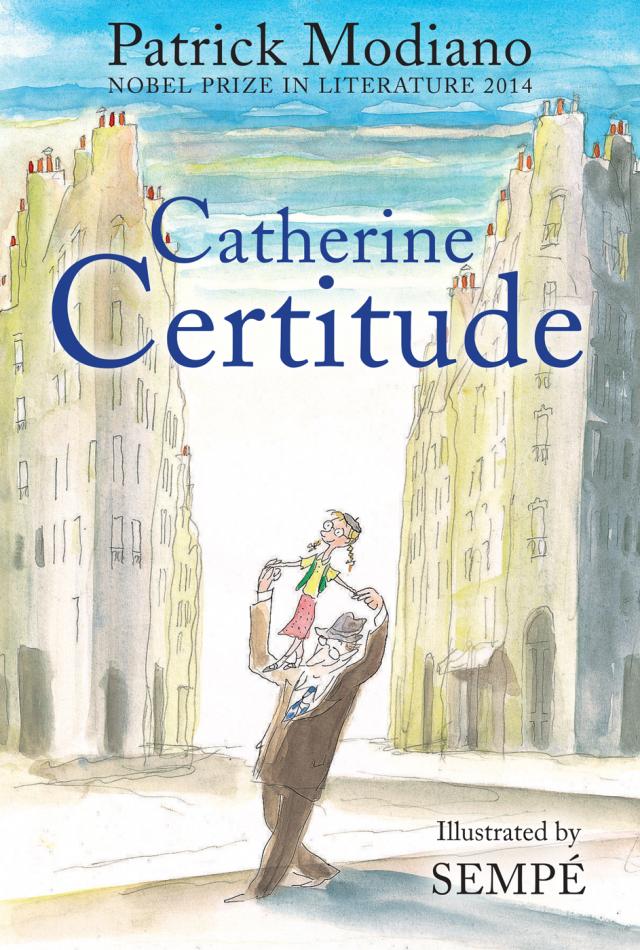
Catherine Certitude, page 1


Contents
Cover
Title Page
Copyright
Chapter 1
Chapter 2
Chapter 3
Chapter 4
Chapter 5
Chapter 6
Chapter 7
Chapter 8
Chapter 9
Chapter 10
Chapter 11
Chapter 12
Chapter 13
Chapter 14
Chapter 15
Chapter 16
Chapter 17
Chapter 18
Chapter 19
Chapter 20
Chapter 21
Chapter 22
Chapter 23
Chapter 24
Chapter 25
Chapter 26
Chapter 27
Chapter 28
Chapter 29
Chapter 30
Chapter 31
Chapter 32
First UK edition published in 2015 by
Andersen Press Limited
20 Vauxhall Bridge Road
London SW1V 2SA
First published in 1988 in France
by Éditions Gallimard
First English translation published in 2001 in the United States of America
by David R. Godine, Publisher, Inc
www.andersenpress.co.uk
2 4 6 8 10 9 7 5 3 1
All rights reserved. No part of this publication may be reproduced, stored in a retrieval system or transmitted in any form, or by any means, electronic, mechanical, photocopying, recording or otherwise, without the written permission of the publisher.
Text and illustrations copyright © Gallimard Jeunesse, 1988
Translation copyright © David R. Godine, 2001
British Library Cataloguing in Publication Data available.
978-1-78761-206-8
It’s snowing here in New York, and I’m looking out of the window of my 59th Street apartment at the building across the way where I run a dance school. Behind the large glass panes, the students in leotards have stopped their pointe work and entrechats practice. As a change of pace, my daughter, who works as my assistant, is showing them a jazz step.
I’ll join them in a few minutes.
Among the students is a little girl who wears glasses. She set them down on a chair before the lesson started, the way I used to when I was her age and taking lessons with Madame Dismailova. You don’t wear glasses when you dance. I remember that when I was with Madame Dismailova, I would practise not wearing my glasses during the day. The shapes of people and things lost their sharpness and everything was blurry. Even sounds became muffled. Without my glasses, the world lost its roughness and became as soft and downy as the big pillow I used to lean my cheek against before going to sleep.
“What are you daydreaming about, Catherine?” my father would ask me. “You should put your glasses on.”
I did as he said, and everything changed back to its everyday sharpness and precision. When I wore my glasses I saw the world as it was. I couldn’t dream any more.
Here in New York, I belonged to a ballet company for a few years, then taught dance lessons with my mother. When she retired, I continued without her. And now I work with my daughter. My father should retire, too, but can’t bring himself to. Actually, what would he be retiring from? I never knew exactly what kind of work Papa did. He and Mama live in a small Greenwich Village apartment. We’re nobody special; just New Yorkers, like so many others. Only one thing in my life is out of the ordinary: before we came to America, I spent my childhood in Paris, in a neighbourhood off the 10th arrondissement. That was almost thirty years ago.
We lived above a kind of shop on Hauteville Street, with a steel shutter that Papa rolled down every evening at seven. The place looked like the luggage room of a country railway station. There were always crates and packages piled on top of one another. There was a scale, too, with an enormous platform at floor level that must have been designed for heavy loads, because the dial went up to six hundred pounds.
I never saw anything on the scale’s platform. Except for Papa. At those rare moments when his partner, Mister Casterade, was out, Papa would stand silent and still in the centre of the platform, with his hands in his pockets and his head bowed. He would thoughtfully gaze at the dial; I remember it read one hundred and seventy pounds.
Sometimes Papa would say, “Come here, Catherine,” and I would join him on the scale. We would stand there, the two of us, Papa’s hand on my shoulders, without moving. We looked as if we were posing for a photograph. I took off my glasses, and Papa took off his. Everything around us became soft and fuzzy. Time stopped. We felt fine.
One day Mister Casterade caught us standing on the scale.
“What are you doing?” he asked.
The spell was broken. Papa and I put our glasses back on.
“We’re weighing ourselves, can’t you see?” Papa said.
Without bothering to reply, Casterade trotted briskly to the office at the back of the shop. Behind a glass partition, two big walnut desks with swivel chairs faced each other: Papa’s and Mister Casterade’s.
Mister Casterade started working with Papa after Mama left. She’s American. When she was twenty, Mama belonged to a dance troupe that came to Paris on tour. She met my father, they got married, and Mama stayed on in Paris, dancing in music halls: the Empire, the Tabarin, the Alhambra . . . I saved all the programmes. But she was homesick. After a few years, she decided to go back to America. Papa promised her we would join her there, as soon as he wrapped up his “business affairs.” Or at least that was the explanation he gave me. Later on, I understood that there were other reasons for Mama’s departure.
Every week, Papa and I would each get a letter from America, in envelopes bordered with little red and blue stripes.
Mama’s letter always ended with: “Catherine, all my hugs and kisses. I’m always thinking of you. Mama.”
Sometimes Mama made spelling mistakes.
When Papa talked to me about his partner Raymond Casterade, he always called him “The Pill.”
“Catherine, honey, I can’t pick you up at school this afternoon. I have to work all evening with ‘The Pill.’ ”
Mister Casterade had brown hair, dark eyes, and a very long chest. In fact, his chest was so long and stiff, you couldn’t see his legs moving, so he seemed to be gliding along on roller skates, or even ice skates.
Later, I learned that Papa had originally hired Mister Casterade as his secretary. He wanted someone who was good at spelling, and when he was young, Mister Casterade had got a degree in literature. Later, “The Pill” became his partner.
Mister Casterade would lecture people at the drop of a hat.
He also liked to announce catastrophes. In the morning, he would sit down at his desk and slowly open the newspaper. Papa would be sitting across from at him his desk, with his glasses off. Mister Casterade would report on the day’s crimes and disasters.
“Georges, you aren’t listening,” Mister Casterade would scold. “You’re woolgathering. You’re afraid to see the world as it is. You should put your glasses on.”
“Must I?” asked Papa.
“The Pill” had another odd habit, that of dictating letters. He would do this in a loud voice with his chest puffed out. How many times did I see Papa typing business letters while Mister Casterade dictated, without daring to tell him — out of politeness — that the letters served no purpose? Mister Casterade would spell some words out and even supply punctuation marks.
As soon as his partner turned his back, Papa would rip up the letters.
“The Pill” even enjoyed dictating my homework to me, and I had to let him. Sometimes I got good marks, but usually the teacher would write “Off the subject” on my paper.
So Papa told me, “If you feel he’s ‘off the subject,’ tear up the homework he dictated and start again on your own.”
When Mister Casterade was away, Papa would imitate him:
“Semicolon, open quote, comma, colon, open parenthesis, new line, close parenthesis, close quote.”
He would say all this while imitating Mister Casterade’s voice, and I would dissolve into hysterics.
“Let’s be serious, young lady, if you don’t mind,” Papa said, “Don’t forget to capitalise the U. And put on your glasses, so you can see the world as it is.”
One afternoon, when I was at the shop on my way home with Papa, Mister Casterade asked me to show him my report. He read it, chewing on his cigarette holder, then turned his dark eyes on me.
“Young lady,” he said, “I am very disappointed. I expected better from you, especially in spelling. All that I see, reading this report, is . . .”
But I had taken off my glasses, and couldn’t hear him any more.
“Be quiet, Casterade,” Papa said. “You’re getting on my nerves. Leave the girl alone.”
“Very well.”
Mister Casterade stood up, wreathed in scorn, and glided over to the office door. Then he disappeared, very erect, looking quite dignified on his invisible roller skates.
Papa and I looked at each other over the tops of our glasses.
Later on, when we were in America, the shop on Hauteville Street and Mister Casterade seemed so far away that we wondered if they had really existed. One afternoon, while we were walking in Central Park, I asked Papa why he had let Mister Casterade play such a large part in his business and our family life, to the point of letting him dictate his letters, and listening to his lectures without daring to interrupt.
“I didn’t have any choice,” Papa admitted. “Casterade once got me out of a real jam.”
He never said any more about it. But one day, when Mister Casterade was very angry, I had heard him tell Papa:
“Georges, you should remember that your real friends are the ones who save you from the clutches of the law.”
When Papa first met him, Casterade had just left his job teaching French in a suburban high school. It helped that Papa admired people who wrote books: Mister Casterade had once published several volumes of verse. I have one of his books, in the library here in my New York apartment; Papa must have stuffed it in his suitcase when we were leaving France, as a keepsake. The book is called Cantelina and was published by the author himself, 15 Aqueduc Street, 10th Arrondissement, Paris. A biographical note on the back cover reads, “Raymond Casterade. Laureate of the Languedoc Poetry Festival, the Mussetists of Bordeaux, and the Gascogne-North Africa Literary Association.”
Above the shop front, whose large frosted-glass window kept nosy passersby on Hauteville Street from peering in, hung a sign with navy blue letters. It read: “CASTERADE & CERTITUDE Exp.–Trans.” Certitude is Papa’s and my last name. Here in America it’s pronounced “Sir-tih-toode,” which sounds odd, but it had a good French ring to it back in Paris. Papa explained to me, later, that our real name was much more complicated. Something like Tscertitscevadze, or Chercetitudjvili.
There had been just one clerk in the deserted, sunny Civil Registry office. He was about to write my father’s very complicated name in the registry book when he sighed. Unconsciously, the clerk waved away a swarm of invisible bees, or mosquitoes, or crickets, as if the Cher, the Ttch, the Etit, and the Vili of my father’s name felt like hundreds of insects buzzing around him.
“Your name could give a person hives,” he told Papa, wiping his brow. “What if we simplified it? How about . . . ‘Certitude’?”
“Whatever you say,” said Papa.
“All right: Certitude.”
So the shop in Hauteville Street bore the sign: “CASTERADE & CERTITUDE Exp.–Trans.”
And what did “Exp.–Trans.” mean? My father has always been discreetly evasive on the subject.
Expeditions? Export? Transit? Transportation?
The work was often done at night. More than once I was awakened by the comings and goings of lorries that would pull up, leaving their motors running. From my bedroom window, I saw men carrying crates in and out of the shop. Standing on the pavement, Papa and Mister Casterade would direct this nocturnal activity. Papa held an open account book and took notes as the crates were unloaded from one lorry or loaded onto another. Among some old papers, I once found a page from that account book:
A list of everything from radio equipment to shirts, army boots to milling machines. The word “Frigidaires” is crossed out, replaced by “refrigerators” in Mister Casterade’s handwriting. I can make out Papa’s scrawled signature at the bottom of the page.
*
I went to school on Petits-Hôtels Street, very close to home. Papa would walk me there after he rolled up the shop’s steel shutter.
Every morning, we met Mister Casterade walking down Hauteville Street to the office of “CASTERADE & CERTITUDE Exp.–Trans.”
“See you in a few minutes, Raymond,” my father said.
“See you soon, Georges.”
And his long chest would glide faster and faster down the Hauteville Street hill.
We would reach the school, and Papa would pat me on the shoulder.
“Good luck, Catherine. And don’t worry if you make spelling mistakes like your Papa. . .”
I now understand that he wasn’t saying this from any lack of interest in his daughter’s education. He knew that Mister Casterade frightened me with his constant speeches and his lectures about spelling, and he, Papa, was trying to cheer me up.
I ate at the school cafeteria two days a week, and on the other days I had lunch with Papa at the Picardie, a local restaurant on Chabrol Street. Mister Casterade ate lunch there, too. Papa and I would stand on the street corner and watch for him, then wait for about ten minutes after he went into the restaurant so we wouldn’t have to sit at the same table. Papa wanted to be alone with me and was afraid that Casterade would start talking about disasters, morality, and spelling. I think Papa arranged it so the restaurant owner gave us the table that was farthest from Casterade’s.
At the door of the Picardie, Papa would say:
“Let’s take off our glasses, Catherine. That way we’ll have an excuse for not seeing Casterade.”
Papa often did business with people who would come and sit at our table after we had eaten.
I listened to them talk, but didn’t understand everything they said. They were dark-haired men who wore old overcoats. Among them was a red-headed man with gold-rimmed glasses, who would listen to Papa, slack-jawed. I remember his name was Chevreau. One day, Papa told him:
“So, Chevreau, would you be interested in fifty seats from a Constellation?”
Chevreau’s eyes widened.
“What kind of seats?”
“Constellation seats. It’s an aeroplane, as you know.”
“What in the world would I do with them?”
“Well, you could turn them into cinema seats.”
Chevreau stared at my father, slack-jawed as usual.
“You know, you really have an imagination. You amaze me, Certitude. Well, all right, I’ll take them . . . I’m really amazed.”
I could read so much admiration for Papa in Mister Chevreau’s eyes that I was amazed, too.
One afternoon, I asked Papa just exactly what he did.
“How can I explain, darling? To help move goods across Europe, each country has what are called shipping firms, and they are headed by . . . Well, to put it more simply, let’s say people send me crates and packages. I keep them in the shop. I send them to other people. I get more packages. And so forth . . .”
He took a drag on his cigarette.
“Let’s just say I’m in the package business.”
When April came, Papa would accompany me to the square in front of Saint Vincent de Paul Church. I would meet a couple of my schoolmates and play there until six o’clock. Papa sat on a bench and generally kept an eye on me while darkhaired men with moustaches and old overcoats — the same ones as in the restaurant, and Chevreau, too — would sit down next to him on the bench, one after another. They talked while Papa took notes in a notebook.
At dusk, we walked down Hauteville Street hand in hand.
“Casterade will be in a bad mood,” Papa said. “He can’t understand why I make business appointments in the square. It’s stupid; the weather’s so nice, I get much more work done outdoors.”
Casterade would be waiting for Papa in the back of the shop. And indeed, he was usually in a very bad mood.
“Has work been going well, Raymond?” Papa asked.
“Someone has to work around here.”
His chest stiffened.
“What about you, young lady?” he asked dryly. “What French poets did you study in school this afternoon?”
“Victor Hugo and Verlaine.”
“Same as usual. But they aren’t the only ones. Poetry is very vast. For example. . .”
This was no time to cross him.
Papa would sit down at his desk. I remained standing, arms folded.
From an inside pocket, Mister Casterade would pull one of the collections of poems he had written.
“I’m going to give you an example of real French metre.”
Then he would read his poems to us in a monotonous voice, beating time with his hand. I still remember the first lines of one poem he was particularly fond of:
Betty with your alabaster neck, and you, Marie Josée,
Do you still remember the promises we made