The devils cockpit km 23, p.1
The Devils Cockpit (KM 23), page 1
part #23 of Killmaster Series


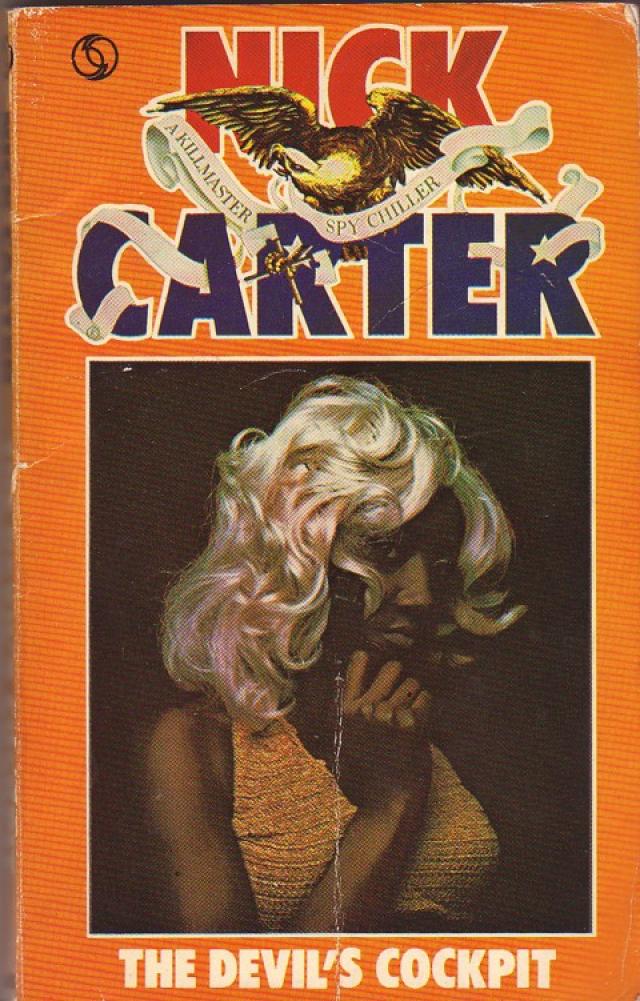
The Devil’s Cockpit (1967)
(Book 23 in the Killmaster series)
Version 0.9
Chapter 1
FORTY FLOORS above the cacophony of Broadway, the big man stirred in the bed. A look at a small golden clock on the bedside table told him it was a few minutes after ten. It was a bright, blue, shiny day beyond the velvet drapes of the penthouse, a late September day that bore the first faint harbinger of autumnal chill. The year 1966 was rounding the turn into the stretch, with the world still balanced on the razor’s edge of destruction.
The man in the bed was Nick Carter, senior-ranking Killmaster for AXE, and it was he, as much as any single man alive, who had thus far managed to keep the planet in one piece. Not that Nick ever thought of it in that way, if indeed he thought of it at all. He was given certain jobs to do. He did them. If, in the doing, as Housman put it, he “saved the sum of things,” it was quite incidental.
There was a sharp rap on the bedroom door. The matt in the bed came fully and instantly awake.
“Who is it?”
“Is me, Missa Nick. Pok. Is coffee time.”
Nick’s grin was rueful. He still had not quite gotten: used to having a houseboy—a luxury he had never allowed himself before. Pok was sixteen, a Korean war orphan who had never known a home. Nick’s last mission had been in Korea. Q.E.D. Or something. Nick still was not exactly sure how he had become a foster father. But he had—he had pulled strings and cut red tape—and so here was Pok with coffee.
Nick yawned mightily. He started to stretch, then thought better of it. He was just back from Nhatrang, in. South Vietnam, where he had undergone a survival course with the elite of the Green Berets. He had a million aches, every muscle hurt, and jungle rot festered on his back.
“Come in.” He pushed his hand beneath the pillow and felt the cold butt of the Luger, and made sure that it was out of sight. Pok knew nothing of Nick’s real profession. To the boy he was just a rich American with a heart.
Pok placed the bed tray over Nick’s flat belly. There was orange juice, steaming coffee, as black as Satan’s dreams, the hard poppy-seed rolls that Nick liked, and plenty of butter.
Pok took a step back and bowed slightly. “Good morning, sar. Is lovely sun today. Nice for my first time go to American school, I think.”
Nick smiled at the boy. He sipped coffee, buttered a roll. “That’s right. This is the big day—just remember what I told you: Be polite and don’t get into any brawls with the tough kids.”
Pok’s perfect teeth flashed in an uncomprehending smile. “Tough kids, sar? I do not understand.”
“You will,” Nick murmured, “Oh, you will. But skip it for now. Any phone calls this morning?”
Pok’s smile widened. “Yis. Three ladies call. I say you tired, sleep hard, I not wake.”
Nick nodded. “They have names, those ladies?”
“Yis. I write down on pad in kitchen. You want?”
Nick sipped coffee. He yawned again. “Not now. I’ll look at them later. Get that tube of yellow guck from the bathroom, Pok, and fix my back. I’ll be finished here in a minute.”
As Pok was spreading the foul-smelling yellow salve on a half-dozen plaques of jungle rot, the AXE agent’s mind flashed back to the week he had just spent in South Vietnam. It had been rugged, as rugged as anything he had ever experienced. Nick grimaced as the sour tang of the salve filled his nostrils. He smelled like a pharmacy.
Just what, he wondered now, had been in David Hawk’s devious old brain when he had condemned Nick to that week in hell? And just after Nick had returned from his yearly refresher course at PURG, AXE’s own version of a training hell. He had, as always, worked like the devil, at PURG—it got a little tougher every year—but he had graduated at the head of his class. Then, just when he was ready for a week of champagne and wenches, Delia Stokes had called to say his orders were being cut for South Vietnam.
He had bellowed a little—but to no avail. He had seea Hawk for a few minutes, trying to sweet-talk his way out of it. Lot of good that had been! His chief had eyes like flint and a mouth like a wolf trap, plus a gift for gentle malice.
“You’re not a kid any longer,” Hawk had said. “And the older you get the tougher it gets. You know that as well as I do. So the more you have to prove yourself …”
Nick had said that he had just goddamned well proved himself. He had come out of PURG—short for Purgatory—at the head of his class. And PURG was the toughest training school in the world.
“Not quite,” Hawk had said. “Not any more.” He had smiled at Nick in the thin-lipped manner that could infuriate the AXE agent to the point where, at times, he forgot that Hawk was nearly a father to him.
“The Green Beret people have come up with a new one,” Hawk had continued. “They call it a Recondo School—that’s a contraction of reconnaissance and commando. They tell me it’s rougher than a cob.”
Hawk had taken a chewed, unlit cigar from his month, had looked at it in disgust, and then had tossed it into a wastebasket. He had yanked the wrapper off a fresh cigar and had pointed it at Nick like a rapier. “The curriculum of this Recondo School stresses stealth, watchfulness, and survival in the midst of the enemy. Surely,”—and here Nick had detected a note of smugness, or was it amusement?—”surely, you will admit that those qualities are essentials that every AXE agent must possess?”
Nick had opened his mouth, then he had closed it. He had been about to retort that since he was still alive after dozens of missions—that since he was at that moment walking and talking and breathing—he must already possess more than a smattering of know-how in this deadly and dirty business. But Nick had said none of those things. He had known by then that he was going to South Vietnam—for a certain and specific reason. Hawk always had a reason. But Hawk was not going to tell Nick the reason until he was damned good and ready.
“I think you’ll find it interesting,” Hawk had smiled sourly. “They’ve worked out a new gimmick: pop-up targets that shoot back at you.”
Nick had stared at his boss coldly. “Just how is that done?”
“Simply,” said Hawk. “They form teams of half a dozen men. Then they fly you over and drop you right in the middle of a Vietcong hideout. Grading in the course is also very simple. If you survive—if you get back—you pass the course. Good luck, son. Delia will give you your orders.”
Now, as Pok stuck the last square of gauze on Nick’s back with tape, the AXEman had to admit that Hawk had not kidded him. After three days of intensive training, Nick and five other men had been dropped near Vungtau, in a morass of delta swamps and paddies where the VC was trying to mine the channel from the South China Sea to Saigon.
Two of them had made it back: Nick and a Sergeant Benson.
Nick rolled out of bed and patted Pok’s sleek, dark head. “Okay, kid. Thanks. Soon as you finish your chores you’re on your own. You got everything? Keys? Money? Books? Your clothes all right?”
“Got all,” said Pok. “Everything number one. I go school half day for first week, get oleintated. You like new clothes, Missa Nick?”
Nick repressed a shudder and nodded. “That’s not important. Do you like ‘em? You have to wear them.” He had turned Pok loose in the boys’ department of the best store in town and, if the pants were too tight, the coat too long and the shoes too narrow and high-heeled—well, the kid had to wear them!
“I like,” said Pok. “I like number one. First new clothes I ever have.”
“Then it’s okay,” said Nick. “Bring me that list of ladies now.”
Relaxing in the bathroom, smoking a cigarette, he studied the bit of paper with Pok’s torturous scrawl.
Gabriel Morrow—it was Gabrielle, and Nick was supposed to go to an art show with her that afternoon. She was an exuberant redhead with a slim, lovely body, a body that beckoned and taunted and teased—a body that she had not yet given to Nick Carter. Nick sighed, then smiled. Promises—promises. But they would be kept. Perhaps that very night.
Flaw Vorhis—that translated into Florence Vorhees. Nick frowned. He did not like to be pursued. He liked to do the pursuing. But the Vorhees woman was persistent. Give her that. Nick forgot her.
Derra Stok—that one baffled him for a moment. But only for a moment. Delia Stokes! Hawk’s private secre-tary. Hell’s bells!
Ten seconds later, Nick was picking up the red phone in his study. It was a direct line to AXE Headquarters in Washington and had a scrambler attachment.
Seconds later, Delia Stokes said: “He wants to talk to you, Nick. Hold on a sec.”
Hawk came on, his voice graveling around a cigar. “How are you, N3? Recuperated from your ardors in the jungle, I trust.”
Nick grinned at the phone. Sly old bastard, he thought affectionately. Sends me on a make-or-break mission, on a survive-or-die detail, then acts like I’m just back from a Boy Scout hike.
“I don’t think,” he told his boss, “that ardors is the word you want, sir. There weren’t any. If there were any women in that swamp they were shooting at me. Everybody was shooting at me. They all missed but one. I got a fanny crease. It’s healed now. So, aside from aching in every bone and muscle, and rotting away with jungle crud, I’m in fine shape. Did you have anything in mind, sir?”
Hawk chuckled. “I do. I do indeed. Could you possibly get down here this afternoon, N3? Can you tear yourself away from that wicked city long enough to come in and discuss a little business?”
More to needle Hawk th an anything else, he said, “I do have a date, sir. I was going to an art gallery. The culture bit, you know. I hate to disappoint—”
Hawk’s laugh was harsh and unamused. “You could do with a bit of culture, but you’ll have to tell your lady you’ll see her some other time. An AXE plane is waiting for you in Newark now. I just set it up. Get on it.”
“Yes, sir. But I’m afraid I won’t smell very good, sir.”
There was a little silence. Then: “You won’t what?”
“Smell very good, sir. It’s the salve they gave me for the jungle rot, you see. It smells pretty bad. Awful, in fact.”
“Forget it,” said Hawk. “Where you’re going they won’t mind your smell. Snap to it, son.”
Three hours later, Nick Carter was facing Hawk in the latter’s untidy little office in Washington. Nick had called Gabrielle to break his date, left a note for Pok, and taken a taxi to Newark. All in an hour. Now he tried to relax in one of Hawk’s uncomfortable chairs, without much success, and lit one of his long, gold-tipped cigarettes.
Hawk had made a little tower with his fingers and was staring at Nick, over the steeple, in rather an odd way. He said: “You know, son, that stuff does smell bad.”
Nick waved smoke from his cigarette. “Light that stogie, then, instead of gumming it. It will help. But how about getting to it, sir? You didn’t call me down here to discuss my odor. I’m supposed to be on leave, you know.”
Hawk lit the cigar and expelled gouts of evil-smelling gray smoke. “I know. Your leave is cancelled, as of now. Don’t be impatient—we have to wait for someone—a Mr. Glenn Boynton. He’s our current liaison man with CIA Should be here any minute now.”
Nick let his flash of irritation show. “The CIA again! What sort of jam are they in now—that they want us to get them out of?”
Hawk regarded his Number One boy with cold eyes. “That’s lousy English, you know. Using a preposition to end a sentence with.” Hawk chortled dryly at his own bad joke.
Nick stared at his chief for a moment, then locked away. An old-fashioned Western Union clock on a puce-colored wall said that it was a minute to one. He crossed his long legs and swung one expensively shod foot impatiently. He dribbled ashes on the drab, well-worn linoleum.
After a long minute of silence, pointed up by the tick of the clock, Nick said: “It’s something pretty nasty, isn’t it, sir?”
It always was when Hawk sought to relieve his own tension by cracking bad jokes and indulging in aimless word play.
Hawk nodded. “Yes, boy. Pretty nasty. When Boyntoa gets here he’s going to show you something. I think it will chill even your blood. I know it did mine. After I saw it I went to the john and threw up.”
Nick Carter asked no more questions. Anything that could produce such a reaction in Hawk had to be bad. Formidable. Nasty beyond the ordinary gutter filth he had become accustomed to in this profession.
There was a rap on the door. Hawk said, “Come in.”
The man who entered was big and running to fat. He had two chins and his sparse hair was gray around a tonsure. The fatty bags beneath his eyes were dark brown. His suit, well cut to hide a paunch, was rumpled and bagging on him. He wore a well-starched clean white shirt that did nothing to enhance his appearance. He looked like a man who had been going for seventy-two hours or more, with only time out to change his shirt and perhaps take a shower. Nick knew the feeling.
Hawk introduced them. Nick stood up to shake hands. Boynton’s hand was flaccid and clammy.
The CIA man looked at Hawk. “How much have you told him?”
Hawk shook his head. “Nothing yet. I thought he should see it for himself first. You got it with you?”
“I’ve got it,” said Boynton. He reached into his coat pocket and brought out a small cardboard box. It was square, about four inches by four and perhaps two inches deep.
Boynton handed the box to Nick. “Take a look, Carter. It’s all that’s left of a damned good agent. One of our men.”
Killmaster took the box. He removed the cover and stared down at what lay limned darkly against white cotton. “His stomach churned. For an instant he thought he was going to vomit, as Hawk had, but he managed to restrain it His instincts had been right. Hawk had been right. It was nasty.
The little box contained the shriveled genitals of a human. Tiny, shrunken little eggs. All that was left of a man.
David Hawk, watching Nick closely, saw the muscles set and quiver in the lean jaw. That was all. Hawk knew it was enough, knew he had chosen the right man for this job. A man who would pursue, avenge, and destroy.
Nick Carter fought down the hot scald of rage that rose in his throat. His face was impassive as he handed the box back to Boynton.
“Maybe you had better tell me all about it,” Killmaster said quietly. “I would like to get started on this one as soon as possible.”
Chapter 2
THE CIA MAN put the box back in his pocket. Nick wondered what in the hell they would do with a thing like that? What could you do?
Boynton read his thoughts. “We’re going to cremate it. Then we’ll give it to his widow, along with a few wood ashes to make weight, and a few white lies. She’ll never know what really happened to her husband.”
Nick flicked his lighter and held it to a cigarette, “What really did?”
“Not now,” said Hawk. “Not yet, Boynton. I want him to see the movie first. The movie and the other stuff. By that time the Brain Boys will have finished running everything through their computers. They’ll have a synthesis ready for us and we can come back and kick it around. Okay?”
Boynton nodded. “Okay. You’re right, of course. Much better to feed it to him gradually, so he gets the whole picture in the proper sequence. So let’s get on with it—if I don’t get some sleep soon I’ll die on my feet.”
A self-service elevator took them down to the basement level. They had their credentials checked by an armed guard and were given lapel badges. A second armed guard escorted them down in yet another elevator to one of the many sub-basements.
The guard led them through a labyrinth of corridors to a tall steel door. A sign on the door read: Projection Room. Above the door was a red and green light bulb. The green light was glowing.
The long, narrow room was well illuminated by ceiling chandeliers. The seats, fifty of them, were of the regular theater type and uncushioned. Nick Carter had been in this room many times. Always it reminded him of the neighborhood movie he had spent so many happy hours in as a boy. The Bijou. Every little town in those days had had a Bijou.
There was a man in an end seat about halfway down the room. He arose now and came toward them. He was tall, with a little dark moustache and curly black hair, and his clothes were exquisitely cut on a slim frame. Nick thought there was something vaguely familiar about the man’s face.
When Hawk introduced him, Nick understood why the face was familiar. He had seen it in magazines and newspapers many times. The man was a famous movie director.
“This is Preston Mohr,” Hawk said. “He’s come all the way from Hollywood to help us on this thing.”
Nick and Mohr shook hands. Hawk said: “You’ve already seen the film, Mr. Mohr?”
The director nodded. “Yes. Just finished. It really isn’t a bad piece of work, technically speaking—forgetting the content, of course.” A bleak smile touched Mohr’s face. “But then the content is the really important thing, isn’t it!”
Glenn Boynton had slumped into a seat, his big shoulders bowed in fatigue. His eyes were closed. Without opening them he said, “Can’t we get on with it?”
Hawk made a signal to the projectionist at the rear of the room. To Nick he said, “Just watch the film. Don’t talk. Don’t ask any questions. Mr. Mohr here is the only one that is to talk. From time to time he’ll try to clarify things for us. Listen carefully to what he says. Okay, let’s go.”
The ceiling lights faded. The wide screen remained dark for a moment, then leaped into a blinding white rectangle of nothing. Blank. Then black letters and numbers, code symbols from AXE’s own labs, flashed on. Then the credits.
The colophon was a huge dragon spitting fire, the great tail lashing, the fangs menacing the audience. Superimposed, in flickering letters of fire, unwinding as from a scroll, came the words: Dragon Pictures Presents—SHAME OF THE GANGSTERS.