We computers, p.1
We Computers, page 1


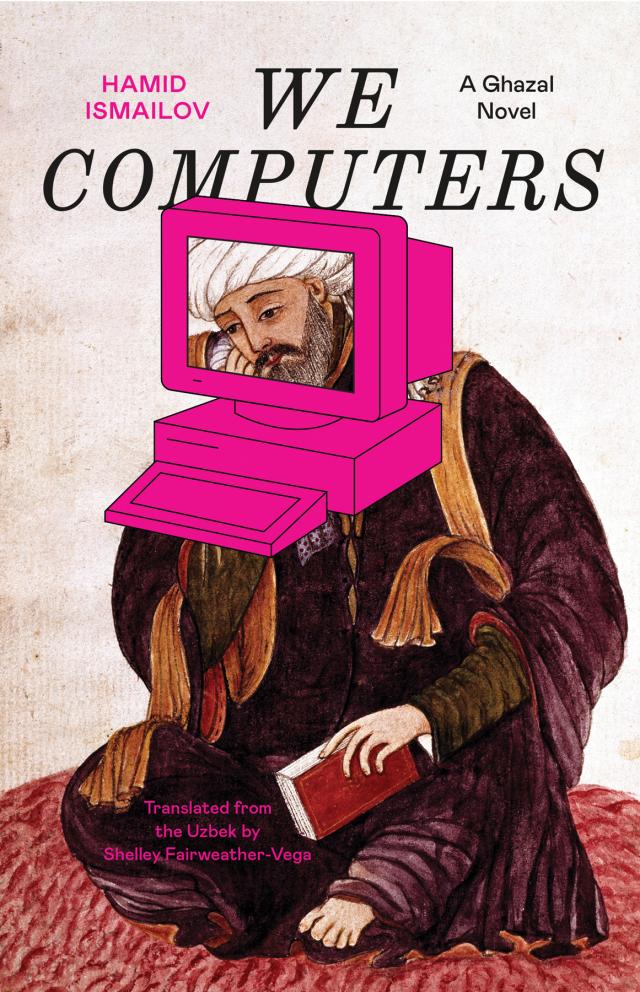
HAMID ISMAILOV
We
Computers
A GHAZAL NOVEL
Translated from the Uzbek by
Shelley Fairweather-Vega
The Margellos World Republic of Letters is dedicated to making literary works from around the globe available in English through translation. It brings to the English-speaking world the work of leading poets, novelists, essayists, philosophers, and playwrights from Europe, Latin America, Africa, Asia, and the Middle East to stimulate international discourse and creative exchange.
English translation copyright © 2025 by Shelley Fairweather-Vega.
Originally published serially as Бизким—компютерлар ё дунёнинг энг гўзал шоири on Telegram, copyright © Hamid Ismailov, 2022.
This book may not be reproduced, in whole or in part, including illustrations, in any form (beyond that copying permitted by Sections 107 and 108 of the U.S. Copyright Law and except by reviewers for the public press), without written permission from the publishers.
Yale University Press books may be purchased in quantity for educational, business, or promotional use. For information, please email sales.press@yale.edu (U.S. office) or sales@yaleup.co.uk (U.K. office).
Set in Source Serif type by Motto Publishing Services.
Printed in the United States of America.
Library of Congress Control Number: 2025932261
ISBN 978-0-300-27274-1 (paperback)
A catalogue record for this book is available from the British Library.
Authorized Representative in the EU: Easy Access System Europe, Mustamäe tee 50, 10621 Tallinn, Estonia, gpsr.requests@easproject.com
10987654321
A Note on the Ghazal Form
The ghazal is an ancient poetic form that originated in the deserts of Arabia and is still in abundant use today throughout Central and South Asia, as well as in other regions, appearing in a multitude of languages. Much has been written about it, including in We Computers. My translations of the ghazals in this novel follow the dictates and descriptions laid out in the text itself; frequently, the plot includes more than one translation of a particular poem, to accommodate the various translations, translators, and interpretations described in the book.
For the purposes of reading this novel, this is what one needs to know about the ghazal form:
A ghazal is a love song. It is always sweet and sentimental or sad, and very lovely, but it can also be sly, angry, or bitter. It always lends itself to music; today, even very old ghazals are often set to music and recorded as pop songs.
Ghazals are recited or sung from memory. They must be simple and rhythmic enough to memorize, and surprising or pleasant enough to keep a listening audience engaged.
The subject of the love song, the Beloved, might be God or all creation, or it might be a particular person. The poem does not need to specify which. It also does not need to specify the gender of the Beloved.
A ghazal is made of long self-contained couplets (each called a bayt in Uzbek), but these two-line sets do not need to follow logically one from the other. The metaphor that is often used is a string of pearls: each couplet is an individually beautiful gem. The chapters in this novel function something like the couplets in a ghazal.
Traditionally, to link these pearls together, both lines in the first couplet end with the same word (in Uzbek, a radif) or at least rhyming words, and the last line in every subsequent couplet also ends with that word or rhyme. Sometimes this works nicely in English, and sometimes it doesn’t, in which case I’ve provided this mandatory repetition in some other way (using the radif somewhere in the second line of each couplet, but not necessarily at the end; using a rhyme instead of a repeated word; using a different kind of repetition altogether).
In the last couplet, the poet “signs” their ghazal by including their own name.
—Shelley Fairweather-Vega
In lieu of an epigraph
I had a dream once, in Bamberg, in 1993. I dreamed that Osip Mandelstam had just returned from his journey to Armenia, and he was telling me about it at his place. Framed in the doorway behind him was the Moscow of the 1930s, soldiers marching, a feeling of alarm rising from the stomping of their boots … “Do you know who I saw there?” he asked, to start our conversation. “Charents?” I guessed, excited. “Yes! Yeghishe Charents! And do you know what? He told me who the loveliest, saddest poet in the world is.” “Oh? And who is that?” I inquired. “It turns out his name is Nadim.” Here, Mandelstam recited some lines by this poet whom I had never heard of, and the unbelievable beauty of those lines woke me up.
That same day, I learned from Semih Tezjan, a Turkologist friend of mine, that as a matter of fact there actually was a great eighteenth-century Turkish poet called Nadim, from the Tulip Era, when Istanbul had seemed to be coming together with Europe. Soon after, I discovered that quite a few things linked Nadim and Mandelstam: not only the events of their lives, but also the sheer beauty of their poetry. Certain lines even closely resembled each other. One small example: If you ask any connoisseur of Turkic poetry what Nadim’s most famous poem is, they will quote you the same line, “Yur, gedelim Sadabada!” (Come, let’s go to Sadabad!). Sadabad was the summer residence of the Turkish sultans back then, what today we would call a vacation home. Mandelstam also wrote one very famous line, “Poedem v Tsarskoe Selo” (Let’s go to Tsarskoe Selo), which is exactly the same thing, but in the Muscovite terms of his time.
Then I spent a long time wondering why a Jewish man, based on information from an Armenian man, had revealed to me, a Turkic man of letters, this poet Nadim from my own tradition, and the best reason I could come up with was that my subconscious mind had made an anagram out of the M-N-D in Mandelstam to create an N-D-M for Nadim.
The First Bayt
A cry comes from heaven at dawn, and I think:
“Up there, they all know Hafez by heart.”
—Hafez
Jon-Perse had never liked his own name. Worse, the reasons he had been given that name disgusted him. During the war, while his father Jean-Claude had been working in the local library in a village called Ozer, in the French Alps, he’d gotten his hands on a book called Anabase, by a poet called Saint-John Perse, and Jean-Claude was so quickly enraptured by that book that he decided to name his newborn son not “Jean-Pierre” or even “John-Jacques” but “Jon-Perse,” a pretentious name of his own creation.
On top of that, when Jon-Perse turned eighteen and was about to set off for Paris to study, hoping to escape the local children’s mockery, his father, recently retired from the library, took his long-cherished copy of Anabase from a trunk, handling it like the Holy Book itself, and presented it to his son. “Here is the most important inheritance I can leave you!” he said, with great ceremony.
No, Jon-Perse did not tuck that book away under his seat on the bus or the train, out of sight of his traveling companions. Instead, with all the perverse excitement of an adolescent digging with a needle into a festering wound, he read the thing, and as he did, his hatred only grew for the book, and his name, and the poet who was its cause. The book was written in some fake language he’d never heard, about some drugged-out things he’d never encountered, by some ghost who used the pseudonym “Saint-John Perse” instead of his own name, and it made the young man so incredibly angry that he found himself thinking, “You call that poetry? I’ll show you!” So he got off the train at the Gare de Lyon, hurried to the university residence hall in Nanterre, and scrawled out the following poem:
Passing, evenings, through this city’s
railroad stations,
abandoned lots,
exhausted sighs,
wandering the days in search of work,
the nights for a fleeting resting place
that might make my returning voice remember
at the outskirts of my thoughts …
From that moment on, young Jon-Perse felt that he was a poet.
* * *
***
After he had been enrolled for some time in the new psychology program at his university in Nanterre, Jon-Perse was invited to work in the laboratory run by Lacan, a renowned psychologist. But instead, putting psychology aside, he took a job in the communist commune of Ivry-sur-Seine on the opposite side of Paris, writing for Louis Aragon’s poetry journal Action Poétique, and with that, his poetic pretensions grew even more, never to shrink again. Sussing out spelling errors in certain poets’ work lit a fire in his eyes and made his hands feel powerful. Jon-Perse’s sense of self was taking shape.
In Paris, this was the era of not only the great Louis Aragon and his wife Elsa Triolet; it was also the era of Sartre and Camus, Picasso and Foucault, and all their ilk, who often passed through, sometimes stopping to pay a visit, sometimes to do business, sometimes to have a conversation in the Aragons’ home. Then 1968 came, and life in Paris was turned upside down by the ideas and stomping feet of rebellious students, transforming everything into imagination and poetry. The revolt born at Jon-Perse’s alma mater in Nanterre seeped out to the rest of Paris. Naturally, when Jon-Perse was ready to finish his studies and all the attention was on the protestors who were only beginning their own, Jon-Perse decided to go and have a look for himself. As he strolled along the barricades, he saw Daniel Cohn-Bendit, the rebel leader who may or may not have been French, and may have been or more likely was German, holding up two lines taken from Jon-Perse’s own poetry to serve as a revolutionary slogan:
Growing a new chaos out of ancient chaos
Could be the meaning of life!
Jon-Perse nearly shouted, “Hey! Those are my words!” But maybe he suddenly understood the point of the rebellion, which was to reject the capitalist concept of ownership, or, failing that, maybe he realized that no matter what he shouted, everyone’s attention would stay focused on that bandit Cohn-Bendit and the slogan he’d stolen. Whatever the case, Jon-Perse’s head was spinning with brand new, unfamiliar feelings, and all his individuality instantly vanished, and he became one with the revolution.
* * *
***
Late in 1982, after the elderly Louis Aragon passed away, management of the journal passed to Henri Deluy, known as the last communist among poets and the last poet among communists. Deluy appointed Jon-Perse to his own previous role of general secretary. After taking over for Aragon, Deluy spent his time traveling from country to country in search of disciples, and all the really difficult work—finding the proper poets for the journal, ushering the improper ones out the door, producing an issue every three months, getting a second issue to press while distributing the first—all this became Jon-Perse’s responsibility.
Meanwhile, to protect himself against charges of tastelessness or stupidity by the thousands of poets the journal rejected, Jon-Perse set to work on a monumental project. He published a book, supposedly for young people, called The Encyclopedia of Poetry. His book cataloged every type of poetry, providing both ancient and modern examples, and diligently explained meter, rhyme, and the art of poetry in general.
Around that same time, Jon-Perse got married and had a son named Laurent. Even while he worked for the journal, he was also invited to teach poetry back in his old haunts in Nanterre. And so Jon-Perse seemed destined to inherit a poet’s life from Deluy, who had inherited it from Aragon, except …
* * *
***
Early in the same decade, Jon-Perse first laid eyes on a personal computer at the university in Nanterre, an experience that remained stamped in his memory for life. He had so often spent all day in front of a typewriter, churning out four carbon copies of everything, and correcting every error four times. But on a computer like this one, if you wanted to, you could just replace an incorrect letter with the right one, or squeeze in a new word between two others, or make whole paragraphs switch places! Jon-Perse was practically dumbstruck by the potential.
But the technician—who was showing off the computer’s abilities like they were his own personal talents—didn’t stop there. He poured salt in the wound: “We can give this computer math problems to do, and it will solve them itself!” he said. At that, Jon-Perse snapped out of his stupor. “Can it write poems too?” he asked. The technician was interested only in mathematics and markets, so he spared just one word in response. “Sure!” Then he went back to extolling his Fermats and Freges.
But that “Sure!” had lodged in Jon-Perse’s heart like a splinter, and would stay there forever.
* * *
***
That same day, Jon-Perse asked the omniscient technician how much a computer cost. He listened to the answer and tried calculating how many months of salary it came to, but he couldn’t do the math. “I’d have to ask the computer,” he thought. But at the end of his demonstration, that same little tyrant granted him a boon: “If you want any research help using the computer, just stop by our department and ask!” And that idea attached itself to Jon-Perse’s heart as well.
Jon-Perse had examined thousands of poems for Action Poétique, using only his own taste to decide which were good and which were worthless, but he had nothing like a scientific method, and it was excruciating work. Now it occurred to him that if he could teach the computer to write poetry, the machine could compare its own compositions with those done by human beings, thereby identifying any excess of quality, or “surplus value,” as Aragon and Deluy (quoting Marx) might have put it. He started asking around. Had anyone tried anything like it before? As if that were even possible! Poets were oblivious to the existence of computers, and computer enthusiasts had no recollection that there had ever been such a thing as poetry. New horizons were opening for Jon-Perse—what the old Saint-John Perse, in his puffed-up words, used to call “infinite expanses.”
At the university in Nanterre, he began attending beginner computer programming classes. Here, his old psychology studies came in handy. Hadn’t his mentor Lacan said that the subconscious was a kind of language? Now Jon-Perse realized that a computer’s consciousness could also be seen that way.
Up to this point, the present tale has seemed all flat planes and smooth running. That’s not to say, of course, that Jon-Perse’s life ran strictly along a straight line. No, there were some unexpected bumps in that life of his (you might call it a bourgeois life, or a poet’s life). You’ll recall that Jon-Perse was married and had a baby boy. Every day, recently, he had been leaving his wife and infant alone in their small room in Ivry-sur-Seine and crossing to the far side of Paris, sometimes to teach classes, sometimes to audit classes, in Nanterre. When he got home, if he didn’t have lessons to prepare or poems to edit for the journal, he eagerly got to work on his own poetry, and he never seemed to have time to take care of the baby or lend his wife a hand. His faithful Sylvie gritted her teeth and put up with it. Whenever he did pop into the kitchen, Sylvie, all innocence, tried to lend him help and support and not be a burden.
It was good luck that their next-door neighbors Martin and Odette had also just had a baby. Not wanting to bother Jon-Perse, Sylvie often took their son to visit them. Sometimes she’d have long conversations with the all-knowing Odette, and sometimes she’d ask Martin to pick up this or that from the store when he went to do the shopping. And when Jon-Perse was at the university, their neighbors frequently dropped in to visit the chaste Sylvie. Sometimes Odette saw a terrible news report on TV and was anxious to share her thoughts with Sylvie. Sometimes Martin stopped by for a glass of Saint-Émilion on his way home from Prisunic. Soon enough, the two homes merged into one, for everyone except Jon-Perse. He had no idea what went on among the rest, but one night, when Sylvie flung an arm across her husband’s shoulders in her sleep and murmured, “Martin, Martin,” Jon-Perse realized he had a complex problem on his hands.
And as a psychologist, he realized then that none of his psychological training was remotely helpful. According to the books, once you discovered a problem, you were supposed to discuss it. But what about real life? For some reason, he decided to bury the secret, tormenting himself day and night with what was sometimes jealousy, sometimes an itch to spy, and sometimes other, everyday cares. He didn’t say anything outrageous; he simply withdrew into his own mind. Berating himself for his cowardice, he feared to take the smallest step or make any kind of decision.
You might think that Jon-Perse, the poet, would rebel, but his revolutionary fervor had subsided. Writing a poem about love is the simplest and most respectable thing in the world, but you can never write a poem about jealousy. Love is a victory, but jealousy is a defeat. And so it was that Jon-Perse, the newly minted programmer, fell under the sway of his own cold, soulless logic. One fine day, the triumphant Martin and Sylvie informed the unfortunate Jon-Perse and Odette of their love for each other and announced they would be moving from Ivry-sur-Seine to Algeria. Six months later, the much-chastened Odette and Jon-Perse, left behind in their neighboring quarters, decided to merge their rooms and lives as well. And so Jon-Perse came to have another child on his hands, in addition to his own son, Laurent: his new stepson, Olivier.
* * *
***
Whether it was because his computer programming classes came to an end or because he had no poetry students to teach or because personal computers began getting much cheaper, Jon-Perse and Odette’s lives fell into a pattern. Jon-Perse worked from home most days. Under Odette’s supervision, whether he liked it or not, he had to move constantly from chore to chore: go into the next room to change Olivier’s diaper, then get food for mother and baby from the fridge and warm it up … But at least, once the baby was asleep, he could still read Odette his latest poems, the same way he had once read them to Sylvie.