

The rarest fruit, p.1
The Rarest Fruit, page 1


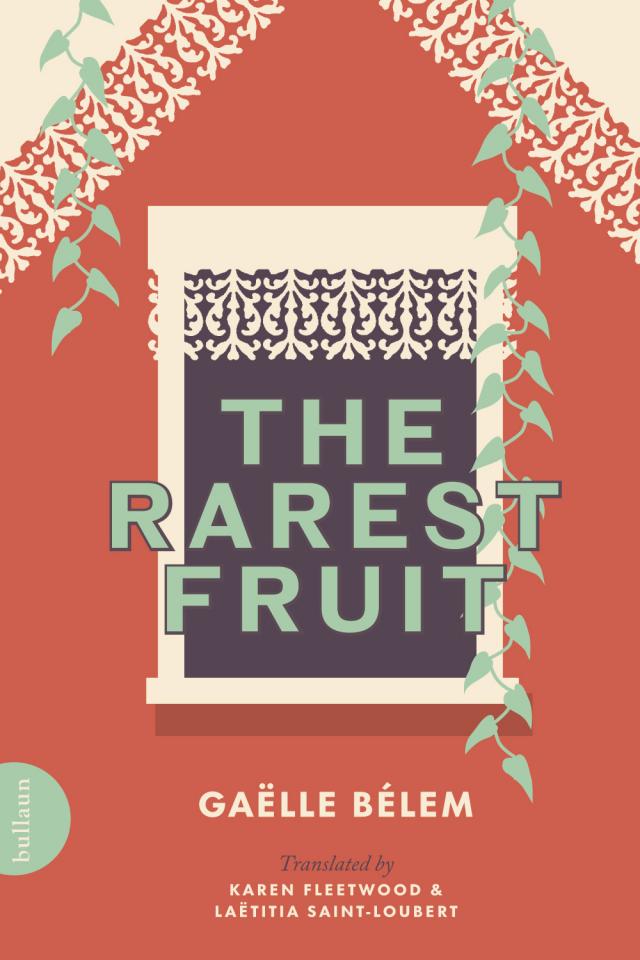
THE
RAREST
FRUIT
THE
RAREST
FRUIT
OR
THE LIFE OF
EDMOND ALBIUS
Gaëlle Bélem
Translated by
Karen Fleetwood
&
laëtitia Saint-louBert
First published 2025 by
BULLAUN PRESS
Sligo, Ireland
www.bullaunpress.com
10 9 8 7 6 5 4 3 2 1
Copyright © Éditions Gallimard, Paris, 2023
Translation copyright © Karen Fleetwood, Laëtitia Saint-Loubert, 2025 Text copyright © Gaëlle Bélem, 2023, 2025
The right of Gaëlle Bélem to be identified as the author of this work has been asserted in accordance with Copyright and Related Rights Act, 2000
All rights reserved. No part of this publication may be reproduced in any form or by any means without the prior permission of the publisher.
Sale is forbidden in the USA and Canada.
Paperback ISBN 978 1 7398423 8 3
Ebook 978 1 7398423 9 0
Bullaun Press gratefully acknowledges the financial support of the Arts Council / An Chomhairle Ealaíon.
This book was published with the support of Literature Ireland.
Cet ouvrage a bénéficié du soutien du Programme d’aide à la publication de l’Institut français
Printed in Ireland by Sprint Books
Set in 11pt on 16pt Adobe Garamond Pro by Niall McCormack
For every title produced in 2025, Bullaun Press is planting ten trees through Hometree, the nature restoration charity based in the west of Ireland (CHY 23020).
Z. for the future.
Ours, which you embody,
yours, which you are building.
M. G. A.
EDMOND
Sainte-Suzanne, start of the 19th century
‘Back then, that small Black Creole, my sister’s slave, was my little pet and was with me constantly.’
EDMOND DISCOVERS BOTANY
Ferréol’s garden, 1833
A stone’s throw from a field of watermelons and voracious blackbirds, behind a gate as grey as a donkey, there was a strange garden that everyone called ‘Ferréol’s garden’.
EDMOND DISCOVERS THE GENESIS OF PLANTS
Garden of Eden, golden age
At dawn on the third day, God created plants.
EDMOND: BOTANIST AND DISSIDENT
Ferréol’s sitting room, one stormy evening
A botanist, like you!
FERRÉOL BELLIER-BEAUMONT
Bellevue district, end of the 18th century
His first picture was of a rose surrounded by pumpkins, an absolute atrocity painted directly on the window curtains. From this picture, which everyone nevertheless considered sublime, he cultivated a firm promise: he would be a botanist.
MONSIEUR AND MADAME DEJEAN
Quartier-Français, 1823
Monsieur and Madame Dejean died on the same day, but not from the same cause.
EDMOND AS SEEN BY VOLCY-FOCARD
A record and recollections, 1830–1840
Later, when they were crippled with pain, reeking of sweat and smelling like the earth, they would still remember him as an intelligent child.
CHARLES MORREN
Belgium, 1837
In the beginning were pumpkins and glasshouses.
HERNÁN CORTÉS
Mexico–Seville, 16th century
Among the undergrowth in the Aztec Empire, baskets overflowing with vanilla were taken down to the city.
VANILLA FLOWERS
Bellevue, 1837–1840
Sounding sometimes like a hen, sometimes like a mouse rooting around in a mound of dry leaves, he badgers the vanilla flowers, his hands full of pollen.
INCONCLUSIVE TRIALS
1841, annus horribilis
Still nothing.
VANILLA PLANIFOLIA
1841, a prosperous year
His nose covered in pollen, he let out a cry of joy: ‘I’ve found it!’
EDMOND TELLS FERRÉOL THE INCREDIBLE NEWS
Vanilla plot, end of 1841
‘I couldn’t remember what he’d learnt when, that same year at the latest, I was out walking with my faithful companion and spotted a tightly knotted pod on the only vanilla plant I had at the time. I was surprised and pointed it out to him. He told me that it was he who had pollinated the flower. I refused to believe him.’
FERRÉOL THE PATIENT
On his sickbed, 1842
Ferréol is dying of who-knows-what illness, contracted in his orchard where dozens of green pods hang.
THE BELLIER-BEAUMONTS
From Burgundy to Sainte-Suzanne, 17th to 19th century
They developed a passion for windswept wilderness, shores dripping with sugar, the abundance of this white gold. It was settled. They would leave for this island that was still only a southern dot on a portolan chart.
THE NEWS SPREADS
Bourbon Island, 1842
‘That is how news of the interesting discovery spread quickly from its point of origin throughout our small country.’
EDMOND ON TOUR
Windward Coast, 1843
Treated with ‘a level of care not usually shown towards slaves’, he no longer walked anywhere: ‘a carriage or a horse was sent for him’.
EXOTIC VANILLA VS COLONIAL VANILLA
Atlantic coast, middle of the 19th century
In all the big cities by the Atlantic – from Bordeaux to Lorient – vanilla-flavoured desserts are the only topic of conversation: vanilla slices, vanilla macaroons, vanilla tarts, vanilla shortbread, vanilla meringues.
MONSIEUR DE BEAUMONT
On top of the world, middle of the 19th century
Vanilla – it was me!
EDMOND AND ICARUS
High, very high
Once upon a time there was an exceptional young man. Curious and ambitious, he was sent mad by studying, the humanities, and his daily dose of mathematics and ancient Greek.
NO, NO, NO
Slave hut, 1842–1848
Sic vos non vobis, laboratis, servi.
Thus do you work, slaves, but not for yourselves.
THE GRAND WALTZ OF NAMES
Town hall of Sainte-Suzanne, 22 November 1848
Edmond, citizen and son of the late Pamphile and Mélise, presented himself at the town hall, this Wednesday 22 November, to receive a name.
EDMOND AND SARDA GARRIGA
Place du Gouvernement, also known as Le Barachois, 20 December 1848
Free men, did you say?
EDMOND HITS ROCK BOTTOM
Rock Bottom, 1849–1850
Edmond is living by a river, on the verge of ruin.
EDMOND THE COOK
Rue du Four-à-Chaux, Saint-Denis, 1851
While waiting for Edmond’s trial, the executioner was paid his dues and a gallows erected.
EDMOND IS SENTENCED TO PRISON
Gaol on rue du Conseil, Saint-Denis, 1851–1852
All of the prisoners laugh until their sides hurt when Edmond tells them that he was the one who discovered how to hand-pollinate vanilla flowers.
EDMOND LEAVES PRISON
The north of Bourbon Island, 1852–1855
Edmond, come out!
EDMOND BECOMES A GROWER
Sainte-Suzanne, 1855–1862
World! Here I am!
ANTOINE LOUIS ROUSSIN, LITHOGRAPHER
Artist’s studio, 1862–1863
This is how people knew what Edmond looked like in an era when men still didn’t know how to smile broadly, as they didn’t suspect that happiness could exist.
CLAUDE RICHARD
Jardin du Roy, 1862
Vanilla – it was him!
EDMOND MEETS MARIE-PAULINE BASSANA
Commune-Carron, 1869
Something reignites in him, something that was cold and dry, a desert full of darkness. Edmond, wounded in a war known as life, begins to smile again in the company of a woman.
EDMOND’S FATHER-IN-LAW
India, 19th century
Worse than war, there were public embraces, trade agreements, mace and the customary peppercorns.
EDMOND AND MARIE-PAULINE BASSANA GET MARRIED
Wedding reception, 1871
Love is a simpering form of death.
YEARS OF MOURNING
Sainte-Suzanne, 1876–1880
While under the Milky Way cyclones were furiously driving against the walls, Edmond was leading a life of restraint in a thatched house with a creaking door.
EDMOND’S END
Sainte-Suzanne Hospice, 1880
Thus passes the glory of the world.
Florebo quocumque ferar.
I will flourish wherever I am taken.
1
EDMOND
Sainte-Suzanne, start of the 19th century
‘Back then, that small Black Creole, my sister’s slave, was my little pet and was with me constantly.’ 1
When Edmond first found himself in the district of Bellevue, he knew nothing of botany and the Bellier-Beaumonts. Angélique, the wife of Ferréol Bellier-Beaumont, had been dead for nearly two years, and the entire house had expired with her. Inside, life passed by in slow motion in a heavy, leaden atmosphere. In sombre rooms with a musty smell, ghost-like servants spoke in low voices of endless mourning and told of the sad phantom that haunted the corridors and the barn. Spider-webs as large as curtains veiled the wi
After four difficult years of marriage, this loss could have seemed like liberation. But, on the contrary, it had depressed the slaves and silenced Ferréol, a thirty-seven-year-old scrap of a man with sallow skin resembling bark, who no longer spoke two sentences in three days.
When Edmond first found himself in front of the Beaumonts’ Creole villa, he was unaware that he was in Sainte-Suzanne, a town less than two hundred years old with one warden and six hundred settlers – though the term ‘town’ was used loosely, purely out of passion for hyperbole.
Edmond didn’t even know that it was 1829 and that the vast majority of his future would be played out in this town, on a plot of land sown with cane and coffee, lit up at night by a clay-coloured moon.
A cyclone had just passed over Bourbon Island.2
Ferréol Beaumont’s fields of maize had been lost, his estate ravaged, the anonymous houses that bowed down beneath it swallowed up. But Edmond traversed the district, the huge, waterlogged garden and the avenue of leaning coconut palms without paying any attention. He didn’t see the broken iron gate, the displaced cross and stele, the cracked columns, the ripped-up lambrequins.3 Edmond didn’t notice the upside-down orchids, their tender green stems turned up and their flowers beneath them. Edmond didn’t even open his eyes as he passed through the flooded sitting room and the damp bedrooms.
To tell the truth, Edmond is a Black orphan born a few weeks before who had been placed in the hands of Ferréol one Sunday morning. After all, that’s the day mass is celebrated, and you can’t abandon a child after a sermon – especially not the day after a cyclone. Edmond has clean clothes and a terracotta rattle and has just gulped down a jugful of milk, so he doesn’t worry too much about the melancholic slaves, the mourning clothes or the ditches filled with mud after the rain. He flies over the patchwork of puddles and heads straight for his fate – be it good or bad – thinking summarily that in three hours it will be feeding time again and that happiness and nipples are the same thing. Ferréol Beaumont – the owner of land as wet as a lake, an inconsolable widower and a stubborn botanist – doesn’t view things in the same way. He spits on the ground as soon as he sees Edmond, a seven-week-old slave in the arms of another who is barely seven years old. As Ferréol lifts the orphan up to the grey sky, Edmond stares straight into his eyes.
‘What is it?’
‘It’ – this ebony child that casts him into partial shadow as it comes between the curve of a pale sun and his screwed-up eyes. ‘It’ – three kilos and six hundred grams of tender flesh, wrapped up like a black lamb in woollen cloth. ‘It’ – a living bundle of obvious trouble. He opens the note attached to its wrist.
From Elvire, your beloved sister.
A birth for a rebirth.
A gift from Elvire – or in other words, an umpteenth attempt to raise a smile from a widower in mortal agony. As Ferréol reflects, Edmond gurgles away in a fur-lined cloak in his arms. After a puppy that didn’t look like much and a parrot so noisy that he wanted to wring its neck, Elvire is trying a Negro as a companion! The minutes pass by. Silence sets in. Has he stooped so low that he’s become some kind of abode for ne’er-do-wells? Thoughts continue to pass through Ferréol’s mind. Perhaps later. Not now. His grief will not stand for any pity – it is entirely self-sufficient. So no. It’s out of the question. No to this creature. No to adoption.
No, unless … No, except … No, but …
And as his steward bears witness, this no gradually transforms into a tiny yes. Because he has an intuition that it is not a child that he is looking at, but some sort of sign from the heavens. A possible balm offered for his unhealed wounds. He has twenty or so slaves. A quantity of animals. Plenty of nieces and nephews. None of them have ever affected him like this unweaned imp. A resigned pout on his face, Ferréol calls Colombine, the wet nurse. Scratching his head, he presents her with the newborn baby whom she is to feed.
‘Until the next cattle market,’ he sees fit to add.
But that’s not what he means. He can’t say it. She wouldn’t understand this tale of redemption, this sense of a second chance. He speaks to Colombine without lifting his head, ashamed and worried that she might suspect a heart lurking beneath the mass of excuses, coldness and sulkiness that has defined him for the last two years. He repeats ‘next cattle market’ even though he’s dead certain that the child will never set foot in one while he’s alive. Colombine, who has seen thirty autumns and whose breasts hang down to her belly button, has just lost her unweaned infant at barely six months and twenty-two days. She looks at Edmond contemptuously through watery eyes and grunts out a yes, before resuming her work making packing bags from vacoa4 leaves. She has no milk or kindness remaining for today. He’ll have to wait until tomorrow. And from the bitter tone of her voice, the baby knows that the milk will be sour at best, absent at worst. The future looks uncertain.
With Colombine gone, Ferréol moves his face a little closer to Edmond. He inspects him from top to toe – as a whole and in detail. Edmond has eyes like black plums 5 and a domed forehead. His face is plump and chubby, his hands dance, and his smooth cheeks are as round as longan seeds.6 Ferréol, a seasoned horticulturist, patiently draws up a list of all his features as if for a new plant, a species that he is dissecting for the first time. Black eyebrows, a small round foot that gives him a kick under the chin, a Lilliputian hand that stretches out towards his own.
He is astonished to find that he can look at the thing. That he feels ready to treat him as if he were his own son. Perhaps that’s what love is. At twenty to thirty years of age, you sketch your ideal being from head to toe – the colour of their eyes, the roundness of their hands, their temperament, family, country, source of income. There are no compromises; it’s all or nothing. But ultimately, you become infatuated with the complete opposite and implore the universe to forgive you for having been so damn stupid. At least, that’s what happens to Ferréol, who falls in love with a fifty-centimetre babe-in-arms, forgets all about women, money and raisin spirits, and wants to be a father and nothing more.
In a word, Ferréol is lost. In a sense, Ferréol is saved.
–––––––––––––––
Wrapped in his blanket, the forty-nine-day-old thing who has enjoyed one hundred and fifty feeds – possessing that child’s ability to think before being able to speak and to love without knowing how to say so – senses that the gods are working in his favour. For ten seconds, he puts on a good show for his first judgment. Almost holding his breath, his eyes smile at those that are scrutinizing him.
Ferréol prods him for a couple more seconds. He understands nothing of this childish intuition. He doesn’t know the first thing about children, for the harshness of life has rendered him blind and widowerhood has left him deaf. But even he – with his severed heart – can’t deny that the thing has the softness of a watercolour cherub, its small fists as chubby as clouds. He stares wide-eyed and – for the first time in two years – says a second sentence in the space of a single day. Well, not really a sentence, more of a word! A hello issuing forth from the lips of a man who amounts to no more than clammy hands, bile and deep sighs. The eight oxen and six slaves who are watching him glimpse a smile that none of his nephews have ever earned the right to. Did he say ‘hello’? With or without a Burgundian accent? What does it matter! On stony Bourbon Island, with no electricity or gas lamps, it’s as unusual as a double rainbow, a lighthouse, a half-day holiday that isn’t Sunday afternoon. The cows stop mooing, the servants stop squabbling, the steward stops yelling along the stony path.
‘Is that the master speaking? Is he saying hello to children?’






