

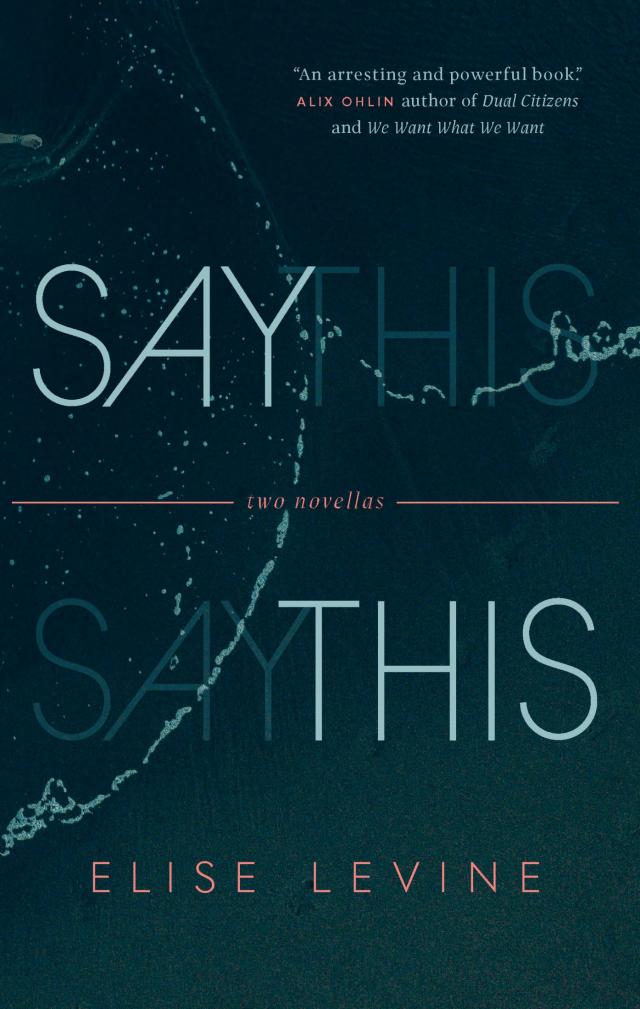
Say this, p.1
Say This, page 1


Contents
Eva Hurries Home
I everything has already happened
II commute
III now what
IV departures
V nothing she likes
VI Eva orders in
VII further in
VIII free Eva
IX Miss Blanky
X departures
XI arrival
XII Eva meets the old woman again
XIII for whom
XIV Eva learns her cousin’s true fate
Son One
XV for whom
XVI Eva drives and arrives, singing
XVII Eva learns her own true fate
XVIII nothing much happens
XIX the shitty weather continues
Acknowledgements
Also by Elise Levine
This Wicked Tongue
Blue Field
Requests and Dedications
Driving Men Mad
elise levine
A John Metcalf Book
biblioasis
Windsor, Ontario
Copyright © Elise Levine, 2022
All rights reserved. No part of this publication may be reproduced or transmitted in any form or by any means, electronic or mechanical, including photocopying, recording, or any information storage and retrieval system, without permission in writing from the publisher or a license from The Canadian Copyright Licensing Agency (Access Copy-right). For an Access Copyright license visit www.accesscopyright.ca or call toll free to 1-800-893-5777.
Library and Archives Canada Cataloguing in Publication
Title: Say this : two novellas / Elise Levine.
Names: Levine, Elise, author.
Identifiers: Canadiana (print) 20210293470
Canadiana (ebook) 20210293489
ISBN 9781771964609 (softcover)
ISBN 9781771964616 (ebook)
Classification: LCC PS8573.E9647 S29 2022 | DDC C813/.54—dc23
Edited by John Metcalf
Copyedited by Emily Donaldson
Text and cover designed by Natalie Olsen
Published with the generous assistance of the Canada Council for the Arts, which last year invested $153 million to bring the arts to Canadians throughout the country, and the financial support of the Government of Canada. Biblioasis also acknowledges the support of the Ontario Arts Council (OAC), an agency of the Government of Ontario, which last year funded 1,709 individual artists and 1,078 organizations in 204 communities across Ontario, for a total of $52.1 million, and the contribution of the Government of Ontario through the Ontario Book Publishing Tax Credit and Ontario Creates.
For John Metcalf
Vid Smooke
If you could talk what would you say?
Sleater-Kinney
One More Hour
Is not everything the search?
Joy Williams
Bromeliads
I
everything has already happened
The fog and its clearing. The fog again, a clouded mirror. Eva’s cousin. His slender back.
Eva’s cousin, his slender back. She washes it twice. The first time, the bathroom steams. She applies the worn terrycloth to the mole near the base of his spine, as best she can make out. Just above his crack. She drips water along his neck. Exactly as his dead sister did. The knobs along his spine flex as he speaks. Eva stops. She hadn’t known about a dead sister. Exactly the same. Eva dips the cloth again into the tub. She strokes his forearms and chest. Am I hurting you? Rain hisses against the roof. Eva’s cousin falls asleep in the cooling water while she crouches on her heels. His long lashes, full lips. Sort-of moustache. The rain stops. A car crunches on the gravel drive. A car door slams. Eva closes the bathroom door behind her.
The second time Eva washes her cousin, she’s high from the bowl he offered after parking his own car. Which makes her fourteen. Or twelve. Or eleven, same summer as the first time.
Sixteen would be right—when on a cloud-jammed July afternoon her cousin sweeps aside his curtain of long hair, leans across the kitchen table and plants a swift kiss. He is twenty-one. He still lives in this old house on a hill with his stepmother who works and works. His nose upturns to a point. He is slight, not tall. It’s the house that is tall, and taller that afternoon in the kitchen. The ceiling shoves up and the air thins and Eva and her cousin grow tiny, turn into small, amazing children. His laugh foams. Outside the kitchen window, the steeply serried streets of Astoria, Oregon. Whitecaps curl on the river below town. Freighters and distant forests bear crowns of mist. If she’s sixteen, it’s 1993. Let’s go for a drive.
She’s sixteen, sure. The songs he’ll write about her when he gets famous, providing he can sweet-talk his stepmother into buying that red guitar. His collection of seven silver dollars he’ll split with Eva once their value jacks. Loopy grin each time he takes his gaze from the wet road. Clogs her throat so hard it’s like dying except probably better. It’s raining hard when he turns onto an old logging road and the car shudders into the woods. Trees splash above. He brakes and turns off the engine. Smokes, pops the top on a brew. The windows glaze. The air grows thick. He hikes her thin skirt and lifts the band on the leg of her underwear with an inquisitive finger and hunches over her. Spilled beer pools on the floor mat. His cat tongue makes sticky sounds. So much rain. Eva comes hard. Really hard. He kisses her bare, beer-sticky soles. He rubs himself on her, all over her. He gentles her head down.
The clouds haul off. Purple sky. Eva’s cousin drives along the river. Just drives. The radio busted. For once Eva feels loose in herself. A new sensation. She is someone she can admire. Really something. Big girl.
After, Eva’s cousin sits propped in the tub like a pale boy-king tired from a long day of chasing puppies and tying ribbons in girls’ hair and chewing meat soaked in milk.
The white-flower cups of his knees. The bathroom window wide open, a fat moon. Eva covers her cousin’s face with the ratty washcloth. As if admiring her handiwork, she takes in his narrow chest, the delicate neck. Slick with water, his thatch of brown hair resembles the fur of a sleek animal that changes with ease. She wonders if she can. Is she already? In a strangled voice he says, Still like me?
Do you? Eva thinks, though not often, over the course of the next twenty-five years. Or twenty-eight. Or twenty-seven. She can never be sure. Her mind glazes. She only knows the affair was their last summer together, before she flew back east for the final time. Left for good. Still like me? Miss me. Think of me.
II
commute
Eva is at work when she gets the email. It’s 2018, a cold spring. A famous journalist wants to know, can he talk to her? He lists his main credentials, but she mostly already knows who he is and the rest she quickly googles.
Twenty-five years ago, possibly around the time of Eva’s affair with her cousin, the journalist published a book on basketball as played by teens in a small town in North Carolina. The book became the basis for a movie and a TV series. Since then he has written about his designer-clothing obsession and how he hates fucking his second wife. He has written a respectful, thoughtfully inflected as-told-to with a transgender reality-TV star.
In the email the journalist is professional and polite. He’s in the research stage for a book he’s writing under contract. It’s about Eva’s cousin. Can she help?
Eva hits reply. She stares at the empty space where her standard demurral will go. She is no stranger to such requests, though they had dwindled to nothing as time wore on, as hopefuls checking family connections failed to turn up fruitful leads.
She rereads the journalist’s words. He lives in southern Washington State, not far from Astoria, Oregon, in the same coastal region her cousin once had. This is the reason, in part, for the journalist’s abiding interest. It haunted him all the while he was tied to other projects, unable to get the story out of his head. He has tracked her down through her cousin’s stepmother, who gave Eva’s name. It took the journalist a while to figure it out, but he’s pretty sure she’s the right person. Can she confirm?
Eva is late for her afternoon meeting. She closes her laptop and pushes from her desk. She stands. Her breath clicks in her throat.
The old woman is still alive. News to Eva. She never received a response to the several letters she wrote, and the last time she checked, she can’t remember how long ago, the phone number was unlisted.
Eva tucks her laptop under her arm. She straightens her shirt collar around her suit jacket and gathers her keys and ID on their lanyard.
She is halfway to the elevator bank when she realizes she pressed send on the blank.
Early evening. Washington, DC. Eva at forty-one. She sweeps through the downpour. Gutters choke and traffic stands still. Chins bob beneath black umbrellas. Her bare legs are chilled raw. She has trains to catch. She has terrible thoughts. Tears were shed at the afternoon meeting but not by her—not yet. The world at large also continues to exist—for now. No lunatic has yet pushed a button. Colossal fires and floods and migratory cataclysms rage elsewhere, but for now she and her world are safe.
Only the smell of damp bodies rises from the Dupont Metro entrance. Belowground she swipes her card at precisely the same moment as a stranger on her left and a stranger on her right. The turnstiles clatter open and Eva and her shadows charge thr ough. The gates clank shut behind and, in a burst of self-consciousness or misplaced competitive spirit or an untethered fear, difficult sometimes to distinguish among them, Eva breaks ranks and bolts.
Another floor down, a worker on the opposite platform sponges a section of tiled wall where graffiti lunges in magenta. GIVE ME HEAD TILL I’M DEAD. Eva’s train roars in and she shoulders aboard.
She gets off at Union Station and locates her track for the MARC, hurries and attains an aisle seat beside an older woman playing a game on her phone. Thin humanoid shapes spindle outside a tall clapboard house on a hill. Twilight. The woman taps the screen. A very old woman appears at the house’s front door. Another tap and a grinning ginger saunters across the porch, sits and licks its paw.
The train rumbles from the station and Eva fishes a book from her bag and tries to read. It’s snowing in Norway. A fox slips through drifts. A woman lingers beneath a streetlight, some crime to solve.
Eva can’t quite follow. She closes the book on her lap. Across the aisle a man eats a succession of breath mints from a tin. Cleaning-solvent smell. The woman next to Eva rests her wet sleeve against Eva’s and falls asleep.
Eva cannot sleep. Before she left the office, she read the journalist’s second email, apparently sent in reply to Eva’s accidental non-response. He expects she has insights. That she more than draws blanks. In sharing what she knows, she might help others to heal. For example, the family of the victim, who despite the thirteen years that have passed since the murder and the two years of trial hell continue to suffer the after effects. For example, the close friends and associates, and those the victim served over the years in his capacity as respected lawyer, champion of the underdog—these people continue to endure emotional burdens too. Despite the eleven years since Eva’s cousin began serving his sentence in a federal penitentiary in Oregon. There is still, there must be, the possibility to mend.
For Eva too, the journalist bets. He would like to know, how has she felt, what does she think, how have the murder and sentencing and serving changed her? Surely they have?
Aggravated murder, the journalist noted toward the end of this email. Her cousin lucky. Instead of the death penalty that Oregon still had at the time, he got life with no parole. His sentence the result of a deal he struck for his cooperation, which allowed the authorities to locate and recover the victim’s body. Quite the story, the journalist said.
Eva could almost hear his appreciative whistle.
The train trundles over the tracks and she rocks from side to side. Why tell her what she already knows? He strikes her as presumptuous, vaguely threatening. As if he believes he holds some kind of power over her. As if she’s in no position to refuse to cooperate.
Prick. His aggressive bullshit the same as those who preceded him. The assertion that he’s different from the rest who might have, who surely have, contacted her. The declaration that he alone wants to understand the case at granular and global levels. Will strive to unpack the legal and psychological ramifications, uncover the nuances. Get into the weeds and soar above, see a humanizing justice done for all.
Including Eva. He has set his heart on it. Wouldn’t talking to him help her too? He expects it might.
Wants, expects. Eva flushes cold. Is this guy for fucking real?
Outside the train window, platforms and commuter parking lots bubble with black water. Between stations, darkness scrawls.
The conductor announces Odenton next and Eva’s head jerks. She swipes drool from the corner of her mouth. The woman next to Eva grapples upright and she swings her legs sideways to let the woman shuffle past. Her yellowing hair brushes Eva’s cheek and she tries not to recoil.
The main lights flicker and go out. The car goes silent. Now what? the woman huffs, a dim bulk in the aisle. She peers accusingly at Eva through thick lenses that seem coated with a greasy film.
She shrugs and reopens her book, flips pages, though it’s hard to see the words clearly now.
After a minute the engine roars. The main lights switch on again and Eva’s seatmate is gone, the man across the aisle vanished.
The train lumbers forward. Sodden trees and shrubs, tentatively leafed, black the sky. Up an incline, a deer wavers in the rain.
Past BWI Eva stows her book in her bag and collects her dripping umbrella from between her feet, but the train idles outside the West Baltimore station, last stop before hers. No explanation for the wait is announced over the intercom but Eva suspects flooding. Expects. The waters rise often in Baltimore streets and basements, though not her own basement or street. She lives on a modest-sized hill where there is good drainage, a consideration she took into account when she bought the place two years ago—and anyway the previous owner thoughtfully, neurotically installed a sump pump next to the washer-dryer. Eva does sometimes notice seepage and mould blooms. Par for the course in the city’s ruinous humidity, but nothing like the catastrophes she sometimes reads about in the news. Sinkholes that crack open to swallow sidewalks and cars. Occasionally someone hurt or killed.
She leans back again in her seat.
Here are her own knees, knobby and chapped. Her middle-aged face shorn of detail in the vaporing window.
The train jolts to life again. The shitty weather continues.
III
now what
The shuttle bounces north on Charles Street. Shops are closing, closed, the sidewalks deserted. The Wyman Park Dell like a blank pool. The art museum puts in a luminous appearance, flood-lit exterior ascendant above the park’s massed treetops, the neon sculpture near its rooftop flashing VIOLENCE VIOLINS SILENCE VIOLINS VIOLENCE SILENCE.
Eva misses her stop. She gets off and doubles back. The university’s winding red-brick pathways seem empty but for horizontal slashes of rain. She clutches her useless umbrella and leans into the wind, lamppost to lamppost to blue security post. Her teeth chatter. The marble facings on retainer walls shiver with rivulets. Near the glass pavilion, two students skip by, jackets hoisted over their heads, laughing like gulls.
Eva spies the clock tower and nears the library with its marble dome and books moled away in the basement levels like material for pervs. Not that she’s been inside. She has only heard rumours based on insider-knowledge she herself does not possess, though she works for this very university—but as staff and not faculty, and at another division. She’s a number cruncher, name-taker, maker of lists at the satellite campus in the capitol, where she cannot afford to live.
At least she still has her job. For now. Two months ago her division announced a convulsion of restructuring moves. A kill-off among staff. Contracts that will not be renewed come June, the end of the fiscal year.
Eva climbs the steps to the library anyway, attracted by the radiance of a gathering in the rotunda, visible through the plate glass. A large cake with white icing edged in coral on a long table draped in a white tablecloth. A young woman with short orange hair and pale oval face who stands at the centre of the crowd. She opens and closes her mouth like a pretty fish.
Eva opens and closes her own mouth and the cold skittles through her on its way elsewhere. The young woman gives a faint curtsy to a froth of clapping hands, and Eva bows her bedraggled head and dips too. Her heart leaps then drops. Shame on you, Eva. Exhibit A at the trial of How Low Have You Gone? Living or pretending to live another person’s life—not for the first time.
The crowd inside readies to leave. Doors open and close. Water blows in sheets down the marble stairs and Eva melts back into the storm.
Almost home, jiggety-jig. Lightning flashes on bewilderments of daffodils. Windows glow and porch lights burn to deter crime on this nice-enough block of smallish row homes built in the 1920s. Things could be worse. Eva crosses the street to avoid a tree branch sprawled across the sidewalk. She steps around a manhole cover, known to pop in heavy rains. She reaches the curb and the wind gusts, her umbrella turns inside out. Another gust and her hair swims into the air and tentacles around her head.






