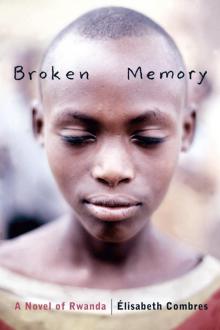
Broken memory, p.5
Broken Memory, page 5


Before long she was the only one left. Afraid that she would never find the courage to finish her journey, she looked around and just started to walk. She passed the old cars that had been abandoned behind the shack that housed the ticket office.
When she reached the edge of the depot, she stopped again. She felt the night deepen, saw the red earth of the road in front of her turning brown.
She placed her small blue-and-black backpack on the ground and searched through one of the pockets, pulling out a piece of paper and carefully unfolding it. Mukecuru had written down the name of the woman she was supposed to stay with overnight. Emma didn’t know how to read very well — the old woman had taught her only the basics, which was all she knew herself — but she knew enough to get by.
Small shops surrounded the open-air terminal, so she headed toward one that was lit up — a grocer’s with telephone service according to the symbols on the sign — and asked a man sitting in front of the door for directions.
He looked tired, his eyes dull, a bitter wrinkle running from the corner of his mouth where his pipe was wedged. He barely looked alive.
“He’s not old, though,” Emma thought. She tried to imagine what kind of a life he had led, but she was in a bleak mood. She imagined him in 1994, decided he was a torturer at first, then a victim, a survivor without family who had come out of it well, judging by the grocery store. No matter what, he had still ended up with dull eyes, tired features and a bitter mouth.
The man slowly dragged twice on his pipe, held it in his left hand and without a word pointed it toward the house she was looking for.
27.
Emma had never seen a house so full of things. In the salon, the furniture seemed to be fighting for space. Embroidered and crocheted white doilies smothered every armchair, bureau and table. The walls were scattered with religious pictures to cover up cracks in the plaster.
Emma had a hard time concentrating as the woman welcomed her. Her attention kept shifting between the doilies that threatened to slide off the sofa where she was sitting and the sheer fabric of her hostess’s blouse, which seemed to be struggling to contain a powerful and generous bosom.
“The button is going to pop off,” Emma thought, distracted by so much luxury.
Everything here was the exact opposite of Mukecuru and the life she led. Yet she had recommended this woman, whose name she had been given by a neighbor who knew her family.
She welcomed Emma warmly.
“I knew your mother, you know. We went to the same school. We never talked to each other much, because she was younger than me. But I remember her well. She was very smart. It caused a lot of jealousy. However, I believe she only wanted the same thing all us Tutsi students wanted back in those days. She wanted to get by without being noticed. There weren’t a lot of us in the school. Only the best and some of the privileged had the right to go to school.”
Emma forgot about the doilies and the blouse and tried to imagine her mother as a child. What kind of a little girl was she? Had she looked like her mother when she was six years old, ten, thirteen? Would she be like her when she was twenty or twenty-four? Had her mother been twenty-four? She didn’t even know how old she was when she died.
“Would you like a Fanta?” the woman repeated, touching Emma’s arm lightly.
“Um…yes…thank you,” she babbled. She smiled at the sight of the low-cut sea blue neckline right in front of her nose.
Her hostess took the smile as being aimed at herself, and she smiled back.
“I stayed away a long time,” she went on, as she took the cap off the lemonade. “I went to work with my aunt, who left the country for Kinshasa in 1973. We came back after the end of the war in 1994 like most of the exiled Tutsis. We’d at least been tolerated there before the war, but after the victory of the FPR, we had to get out fast. But I’m boring you with my stories. You’re falling asleep. Tomorrow, if you like, I can show you your house.”
“Is someone living there?” Emma asked, awkwardly trying to pull herself out of the sofa while she tried to replace the doilies that she had rolled into a ball on her knees without even noticing.
“Oh, no. It’s nothing but a ruin now.”
28.
The next day Emma went through the necessary formalities to get the document that proved that she really was the daughter of Pacifique, a young Tutsi woman murdered during the genocide at the age of twenty-two.
After that she found out how to get to her house. She went alone and had no trouble finding it. It lay in ruins below the main road on a hill overlooking the valley.
Emma had escaped right after her mother’s murderers left. She didn’t know whether the killers had returned to destroy the house and finish their work, or whether looters had come by later. Whatever had happened, they had gone at it with a vengeance. And time had done the rest. Ten years had passed.
She walked down toward the ruin. She was both dreading and hoping to uncover her buried memories. Had she really once been four years old and living here with her beloved mother?
She looked at the rubble, circled the trees, scanned the horizon, the hills. Then she ran her hands over the stones and took off her sandals so she could walk in the grass in her bare feet.
Her eyes, her hands, the soles of her feet — would they be able to remember?
She walked around for a long time before she dared to turn her attention to the inside of the crumbling house, though she knew she would not find her mother’s body there. After the genocide the dead had been gathered and taken to an official memorial to the victims.
Emma tried to concentrate, but she couldn’t think straight.
Coming here had been a mistake. This place was so familiar and yet completely strange at the same time. She couldn’t get hold of it, couldn’t get hold of her past. She couldn’t find the courage to walk into the ruins. She was too afraid of stirring up the old nightmares.
But before she gave up and left, she tried one last time, casting her eyes over the rocks piled inside the entrance to the house.
She suddenly noticed a piece of blue plastic inside the roofless walls. She hesitated for a moment, then carefully placed one foot on the rubble and tugged on the tarpaulin.
It wouldn’t budge. It was bigger than it looked.
Finally throwing caution to the wind, Emma crouched down and frantically started to clear away earth and stones until she managed to lift up the old plastic. Underneath was a small pile of books weathered by the damp.
The girl sat down, stared at the old books, then timidly brushed her finger over the faded covers. Her heart raced. All this had belonged to her mother…
Feeling bolder, she grabbed a book that was larger than the others, the soft cover bending between her fingers.
Her slender brown hands turned the illustrated pages, and suddenly, she was there. Holding her breath, Emma raised her eyes and, for the first time in ten years, she saw her mother bending over her, her eyes filled with an unanswered question.
When she came to her senses, her cheeks were covered with tears. In each hand she was holding a piece of the big book, which had fallen apart under the pressure. She glanced at the pages scattered on the ground, then at the ones she was clutching in her hands.
That’s when she noticed the photograph pinned under her right thumb. The paper had yellowed, the edges were frayed. Emma saw the questioning eyes of her mother and smiled back weakly.
Her search was over.
Exhausted, she lay down on the ground. She had finally managed to rebuild the walls of the ruined house where she had been born, and where her mother had died. The murderers had failed to crush her memory.
“Mama,” she murmured. “Mama,” she repeated more loudly, laughing and crying at the same time.
Emma was still lying in the middle of the rubble when night fell — so suddenly, it was as if someone had turned off the light. She turned onto her side and fell fast asleep, her damp cheek glued to the faded photo.
EPILOGUE
Ten Years Later
That journey changed Emma, and under the watchful gaze of her mother she continued to grow stronger. When she returned to Mukecuru’s, she enrolled in school, and after spending several years studying beside much younger classmates, she became a teacher.
Today she is twenty-four years old. She lives in her parents’ house, which has been rebuilt to look exactly the way it used to. She was able to find her mother’s remains in the memorial dedicated to the genocide victims and had her buried in the garden overlooking the valley. She devotes all her energy to her work, but whenever she can, she spends long hours near the gravesite.
She is now at peace with her past, and she looks to the future with confidence.
Ndoli has continued to see the old man. Things are getting better now that he understands that he was not responsible for the deaths of his relatives, and that he should not feel guilty for surviving them.
But every year Emma spends the first two weeks of April with him, on the anniversary of the genocide — a time when the country remembers and the young man is once again racked by nightmares.
Mukecuru died after Emma received her diploma, knowing that the young woman would now be able to manage without her.
The old man continued to work with the child survivors of 1994. Now he sees many children orphaned by AIDS. He encourages some of them to go to school, as he did with Ndoli and Emma.
He also spends a great deal of time testifying about the genocide, to build a bridge between the victims of this unspeakable tragedy and the rest of the world, and to help the survivors find their way back into the human community.
Author’s Note
This book is a work of fiction. The people and places described in it are inspired by the real Rwanda as I experienced it, but they are imaginary.
But the historical context is absolutely real.
Rwanda is a small country in central Africa. Its 10.3 million inhabitants are divided into three groups: Hutu, Tutsi and Twa. Before the 1994 genocide, Hutus made up 91.1 percent of the population and Tutsis 8.4 percent. Today the census does not identify people by these groups.
Between 1899 and 1950, Rwanda was colonized by the Germans, then the Belgians.
Traditionally, to be Hutu or Tutsi was similar to having a social status linked to an activity such as agriculture or raising livestock. The colonizers solidified these societal groups by associating them with ethnic groups and issuing identity cards, thus increasing tension between the populations. They began by favoring the Tutsis, who were at the top of the social scale. Then, with the coming of decolonization, they facilitated the taking of power by the majority Hutus.
In 1961, a Hutu government was elected and declared themselves opposed to “Tutsi domination.” As the government rapidly slid into dictatorship, it began to practice anti-Tutsi discrimination and commit large-scale massacres. Subsequent governments continued to commit the same crimes, making violence against the Tutsis commonplace for four decades. In 1994 the conditions were in place to carry out the worst crime of all — the genocide of the Tutsis.
The extermination of the Tutsis, which involved close to a million deaths, began the night of April 6, 1994, after the assassination of Rwandan president Juvénal Habyarimana. The massacres were aimed primarily at the Tutsis, but also at Hutus who were opposed to the government in power. They were committed by the Rwandan army and by militias, with the complicity of the local authorities and certain members of the Catholic church. Villagers killed their neighbors, encouraged by the official media promoting hatred against the Tutsis. It was the rebels — sons and grandsons of the Tutsis who had been exiled from Rwanda since the 1950s, who brought an end to the genocide in July 1994 by defeating the Rwandan army.
As for the international community, it did not intervene to prevent or stop the genocide. An operation led by the French army was put in place at the end of June 1994, but it continues to be the subject of heated controversy. The gray areas that remain revolve around the role and intentions of France toward Rwanda, before and during the genocide.
Rwanda continues to rebuild, but the tensions between the populations have not disappeared. Inspired by traditional village tribunals, gacaca (ga-cha-cha) courts have been set up. Though not perfect, they have allowed more than a million cases involving crimes committed by men, women and children during the genocide to move through the justice system. The perpetrators of the most serious crimes have been referred to Rwanda’s regular justice system, and the organizers of the genocide appear before the International Criminal Tribunal for Rwanda set up by the United Nations in Arusha, Tanzania.
Acknowledgements
This book would not have seen the light of day without the cooperation of all those who agreed to respond to my questions, tell me about their lives, explain their work, guide me, talk to me about everything and nothing…
A big thanks to the young Rwandan genocide survivors who shared their stories and to those who allowed me to meet with them, especially Gasana Ndoba; to the professionals who spoke to me about the trauma suffered by child survivors and their difficult search for identity, Célestin Sebuhoro and Jean Damascène Ndayambaje in particular; to all those who, in Brussels, Kigali and Paris, shared their knowledge and explained their views about Rwanda; to Jacqueline Uwimana and Gaspard Kalinganire for their warm welcome, our long discussions and sharing with me on a daily basis.
Special thanks to Pierre Vincke and Janouk Bélanger from RCN Justice et Démocratie, for their excellent contacts.
About the Author
A former journalist, ÉlLISABETH COMBRES has worked as a reporter in France, Latin America and Africa. She began writing for young people after working as editor-in-chief for the magazine Mikado. She is the author of several children’s non-fiction titles, including Mondes Rebelles Junior, winner of the Prix Sorcières in 2002. In 2004 she collected the accounts of adolescent survivors, psychologists and humanitarian aid workers to use as the basis for this book, her first novel. Originally published in French, Broken Memory was selected for the Prix NRP (Nouvelle Revue Pédagogique) and the Prix des lycéens allemands. Élisabeth lives in Grenoble, France.
About the Publisher
GROUNDWOOD BOOKS, established in 1978, is dedicated to the production of children’s books for all ages, including fiction, picture books and non-fiction. We publish in Canada, the United States and Latin America. Our books aim to be of the highest possible quality in both language and illustration. Our primary focus has been on works by Canadians, though we sometimes also buy outstanding books from other countries.
Many of our books tell the stories of people whose voices are not always heard in this age of global publishing by media conglomerates. Books by the First Peoples of this hemisphere have always been a special interest, as have those of others who through circumstance have been marginalized and whose contribution to our society is not always visible. Since 1998 we have been publishing works by people of Latin American origin living in the Americas both in English and in Spanish under our Libros Tigrillo imprint.
We believe that by reflecting intensely individual experiences, our books are of universal interest. The fact that our authors are published around the world attests to this and to their quality. Even more important, our books are read and loved by children all over the globe.
Elisabeth Combres, Broken Memory