

The wildcatters, p.1
The Wildcatters, page 1
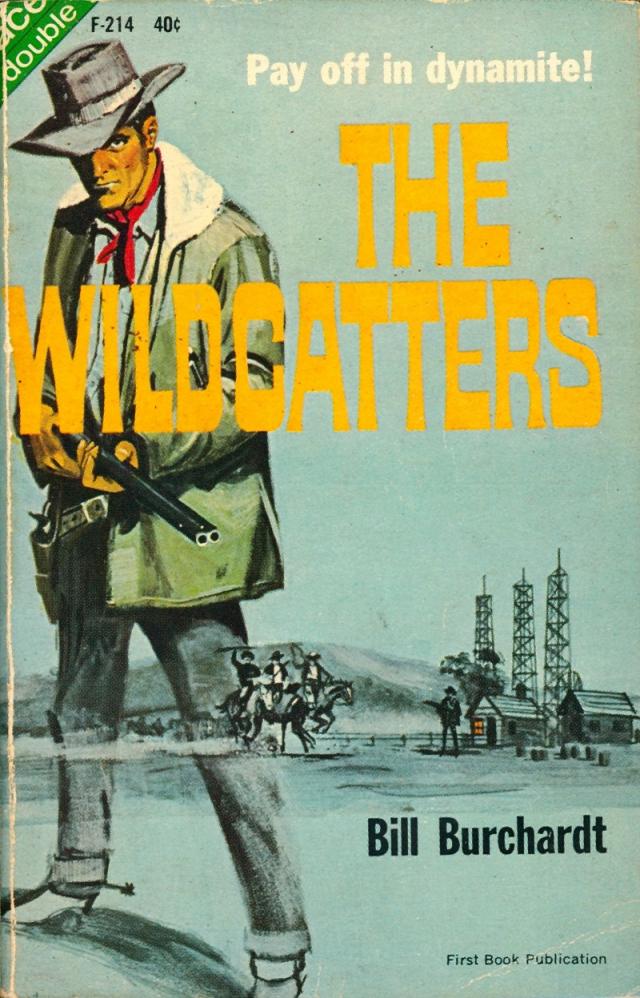


FAST FUSE AT SADDLE ROCK
Saddle Rock was a boom town where oil and blood mingled freely and formed ugly pools in the roaring streets. Into it came men like—
Barrett Goss, who had decided long ago that the quickest path to riches lay in the pockets of dead men…
Cash Pickett, a hardcase who was an expert in the art of death by dynamite…
Duke Ivy, a gambler who carried a spare ace up his sleeve and a loaded .32 in his coat…
All three came to have reason to hate another newcomer, Ben South, the man who was determined to put an end to their crooked schemes.
But the odds were too high for South, until he thought of a way to make the very lawlessness of Saddle Rock work against them.
Turn this book over for second complete novel
BILL BURCHARDT is a very versatile man. For instance, we could say that he is an honorary chief of the Kiowa Indians. We could mention that he has won awards for his writings, that he has taught and lectured at schools and colleges, and that in spite of being a native of a landlocked state, he was a professor of seamanship at Cornell University during World War II. We could state that he is the editor of his state’s widely circulated illustrated magazine, Oklahoma Today.
But perhaps Bill Burchardt is proudest of his association with the Western Writers of America, an organization of which he is past-president and an active officer, and whose members write at least ninety per cent of all western stories, novels, articles, TV and screen plays.
THE WILDCATTERS is his first novel for Ace Books.
The Wildcatters
by
BILL BURCHARDT
ACE BOOKS, INC.
1120 Avenue of the Americas
New York 36, N.Y.
The Wildcatters
Copyright ©, 1963, by Ace Books, Inc.
All Rights Reserved
The Man From Colorado
Copyright ©, 1963, by Ace Books, Inc.
Printed in U.S.A.
I
Barrett Goss fired the black cigar as he stood before the window to watch the mill and shove in the gas lit street below. A teamster with a load of rig timbers was hub deep in curb mud, weird in the dance of the Old Campfire’s gas flare, blacksnaking six-span of mules on a supply wagon. Barrett Goss drew on the cigar, the lips of his abnormally wide mouth pursing, quivering, betraying the eagerness in him.
The street milled with roughnecks from the off-tower, beginning the night’s hellbender. Knots of wagons clung around the supply houses. The dank, heavy smell of crude oil hung everywhere. If the Saddle Rock pool was playing out, this town showed little sign of it. Standing here, watching the crowded sidewalks, Barrett Goss found it hard to credit the gossip. His eyelid twitched with nervous eagerness. At ten o’clock Ed Petty’s Mercantile was still open, and busy. Goss limped away from the window.
At a hitching gait on his short leg, Goss crossed the office, opening the door onto the saloon balcony. A jangling piano and a whining fiddle penetrated above the noise. The pungent odor of crude oil was lost in the smell of sour-mash whiskey. Goss looked along the bar. There were few empty spaces. All the pool tables were busy. Big Fry’s dice game was idle, but Duke Ivy had all six chairs filled at the stud table, and the chuck-a-luck and faro layouts were crowded. The swamper, old Forty-Rod, stumped over to a pool table, racking the balls into a new triangle. Goss let his gaze wander on to the stage curtain with its litter of advertising: Bud Poole’s OIL FIELD SUPPLY; Abner Fenton, SHOES AND FINDINGS; Sumner’s LIVERY AND WAGON YARD; a garish dozen others. The first thing he would do, Goss contemplated, would be to put in an extravagant stage show, which Kate had never permitted. Kate had fought everything he had accomplished, even the gambling. It would be different now.
An oil field driller brought a girl in from the street, swinging her up to sit on the bar. He leaned against her knees, talking up into her simpering, giggling face. Goss listened to the croupier’s chant and the clacking of the roulette wheel. His flaccid,- wide mouth pursed as he drew on the cigar. He leaned against the balcony rail, listening—it should come any moment now.
In the backstage dressing room, Eve Tansel worked hurriedly with her costume snaps. It was a costume she had brought from New York; a deep, shining green to set off the auburn glint in her hair, carefully fitted to her full-bodied beauty. She felt no eagerness but a strong determination to show her mother she wasn’t too good to dance on a saloon stage. Her rouged cheeks already flushed with excitement, Eve began to pat on powder. Kate insisted that she go back east for more study, for the career in concert ballet that was opening for her. Perhaps if the Old Campfire was still a little cowtown saloon, as it had been when Eve’s father died, but now the town was big and Eve knew there was a job for her here.
Somehow, her mother seemed to expect Eve to be ashamed of her. Perhaps because of the way the Old Campfire had gone wide-open since the oil boom. Or perhaps because Kate had so lately married again. Eve sensed that behind the hard front Kate was frightened. That alone would account for her mother’s marriage to Barrett Goss. Eve guessed that as the town had gone out of control, Kate had married Barrett Goss for help in managing the Old
Campfire. Eve tried not to think of Goss with distaste. A knock rattled the dressing room door.
Eve touched the powder puff to the back of her neck, calling, “Come in.”
Alvin York, the show’s burlesque comedian, came in. He was made up: sagging pants with each leg a different color, polka-dot tie, bulb nose, and huge flared-toe shoes. The elaborate make-up did not conceal his worry.
“Lordy, do you reckon it’ll be all right, Miss Tansel?”
“Eve!”
“Eve…did you tell your mother?”
“No”
“My God! Kate’ll kill me. Anyway, I’ve forgot all I ever knew about handling a ballet act. You seen how clumsy I was with you this afternoon.”
“You’ll be all right,” she assured him. “We’ll rehearse some more tomorrow.”
Eve stood up at the dressing table, straightening the long seams of her opera hose. If she could just go over tonight, Eve was certain she could help Kate straighten things out.
“Sit down,” she said. “We’ll run over our cues.”
Cash Pickett consulted his turnip watch intently with a whiskey-fuzzed scrutiny, and left the Old Campfire by the alley door. He weaved slightly; a heavy brawn of blond-whiskered man whose jowls sagged with fat. The past week’s rain had left the alley a morass of gumbo mud. Fog was coming. Street flares stained the fog, filling the alley with drifting tails of vapor. Pickett unstacked a pair of beer kegs and fumbled in the bottom one, among sawdust that smelled of glycerine. The wax-wrapped cylinders he took from the keg were already wired together. He crimped a cap with his teeth, carelessly, and shoved the coil of fuse in his jacket pocket.
At this moment, Ben South stepped out of the Saddle Rock Hotel. He stood on the hotel veranda, a tall, somberly intense man. His eyes wandered over the oil town as he took a crooked cheroot from a vest pocket and bit die end. He wore a conservative dark suit with seeming urbanity, but there was something rugged and untamed about him, a stubborn, phlegmatic man. He spat the cheroot tip through die passing crowd, then paced down the hotel steps to the sidewalk’s edge.
Muddy clay had already dulled the polish of his boots, and he ignored the gumbo as he stepped to the hitch rail and paused to light his cigar. He untied the reins of the livery stable horse, ducked under the rail and booted a stirrup. The fog was turning to heavy mist now, accenting the smell of crude oil. Ben swung up and tried to adjust his posterior to the warped misfit of the rented saddle. The horse left the rail and turned determinedly toward the livery barn. Ben sawed the reins, bearing the horse back toward the flow of traffic.
It was a big sorrel gelding, with a mind on its own dry stall and feed box. The horse shook its head high, trying to dislodge the bit, then snorted and pitched. Ben dug his knees against the stirrup leather, hauling up doggedly as the sorrel bogged its head, reining it again toward the flow of traffic.
The sorrel balked.
Now what, Ben thought. The mud was hock deep. He had the apparent choice of riding the sorrel back to the livery stable, or wading the mud to the Old Campfire. The sorrel stood firm. The mist became a fine, cold rain.
Roustabouts, tool-dressers and drillers moving along the sidewalk seemed to ignore the rain. The roar of oil field boilers below town meshed with the noise of passing teamsters. Ben could see the Old Campfire half-a-block down the flare lit street. He set his mind to the task of deciding. He had no particular urge to see Barrett Goss again, but the offer was good. It had brought him here from Chicago to a tough town, a stubborn horse, and a warped saddle, Ben thought. The rain was beginning to drip off his hat brim.
All I need is a brass plaque and pigeons, he thought. The sorrel was immovable. Ben tried the reins again, the gelding humped desultorily, and then the explosion came. It was a guttural roar that shuddered the buildings and shook the mud into jelly around the sorrel’s hoofs.
The horse moved now, caracoling nervously as the shock died. Ben looked toward the oil field, half expecting to see the angry thrust of a roaring rig fire, thinking of an exploding boiler. His ears still rang.
The startled horse answered unwillingly as Ben reined around. Ben kicked the sorrel into a lope as he gained the head of the crowd and slewed into a side street beyond the Saddle Rock Hotel. The mud had been less churned here by heavy freight wagons and the horse ran easier.
There wer e scattered houses along the street. Ben’s horse ran on, slewing through ruts and mud holes as Ben saw where he was headed. His first clue was a fragment of shattered board, over which the horse stumbled. It floundered to its knees in the mud, then came up and Ben followed the increasing litter of splintered wood. It lead into the yard of what had been a small house set far back from the street. Aided by the luminous, red-hued aura from the main street flares, Ben found a blast tom tree. He dismounted, tied the horse and picked his way through the debris to the wreckage of the house. There was no sign of fire among the ruins. The misting rain had prevented that. Ben listened for human sound. The house looked as if it had been lifted from its foundation and exploded in mid-air. Whole sections of wall lay sprawled beside the foundation, leaving the remains of a shingled roof shattered beyond repair.
As Ben climbed into the debris and splintered furniture, he had a sharp impression of an acrid, distinctive odor…exploded dynamite.
As he paused there, listening intently, his rain-wet boot sole slipped suddenly. He slid off the edge of a crumbled wall, falling almost upon a lump of a human body in the edge of the wreckage. It was a woman, past middle-age, much battered by the explosion. Ben managed to strike a match. She was short and stocky, a muscular woman with the dark hue of temper in her face, even in death. The bright figure of her wrapper, and hard features, suggested she had been battered by life, as well as by death.
Ben took up her wrist feeling for a pulse. A voice shouted from behind him, “Douse that match, mister. There’s a pipe spewing raw gas in there.”
Ben turned to see, a blond-whiskered man struggling up the mud-slick rise. Ben was about to remark that he hadn’t smelled any gas when the man said, “That cigar too, damn it.”
The cigar, long since extinguished by the misting rain, was cold in his clenched teeth.
Ben dropped it into the mud and said, “Let’s get this woman out of here.”
The blond man stared down at her, then peered through the wreckage as though searching for something.
Ben said, “This will do,” and wrenched a door from the single hinge that held it to a collapsed wall. He could hear more voices then as the crowd, which had come on foot from main street, began to enter the yard.
With hoofs sucking mud, a horse walked up the hill. Its rider dismounted and thrust slowly through the growing press of men. He was small, round-shouldered, with a mist-beaded shield glinting dully on his coat.
He said, “Kate Tansel,,ain’t it? Stay back, boys! Give er air!
Still holding the door he had torn loose, Ben said, “She doesn’t need air.”
The hump shouldered shield-wearer looked closely at the blond man beside Ben. “That you, Cash?” His voice had a tang of waspish caution. “What happened?”
The man called Cash said, “Kate’s newfangled gas stove blew up on her, I reckon. There’s a gas pipe blowed open in there, Lucius.”
Ben wondered where the blond whiskered man had come from, how he came by so much information. Ben somehow doubted that a lone stove could cause this. He was about to volunteer that he had smelled dynamite here when the round-shouldered man yelled, “Don’t nobody light no matches! Move ’er outa there,” he ordered.
Ben South helped Cash Pickett lay the woman on the door. As they carried her from the wreckage, the shield-wearer peered closely at Ben.
“What’re you doin’ here?” he asked. He seemed nervous and trying to hide it behind official irritation. “I’m Constable Lucius Sloan,” he said. “I got a right to ask.”
“Just curious, I guess,” said Ben. “Same as the rest of you.”
Someone in the crowd asked, “Who’s gonna tell Eve, Lucius?”
“Well—me, I reckon,” Sloan mumbled, “but not right yet. One of you fellers go get Doc Shaw.” He looked at Ben, “You the one that found her?”
“It blew her clean out of the house,” Cash Pickett said. “She was in the kitchen—”
Ben interrupted curiously, “How do you know all that? Seemed like I got here first.”
The man called Cash turned belligerent. “Well, ain’t a woman usually in the kitchen? Anyway, she had to be in the kitchen if she was fooling with that stove. It blew the house up.”
Constable Sloan said, “Now, let’s not have any trouble. Did anybody smell anything like nitro or dynamite around here?”
Ben looked at the lawman sharply, wondering if this were a routine question.
Cash said surlily, “Don’t smell nothin’ but raw gas.”
Lucius Sloan said, “Well—” hesitated, and fell silent.
Ben turned and started across the yard to his horse.
“I ain’t finished with you,” Sloan blurted. “I don’t recollect seein’ you before.”
Ben untied his horse and led him forward. “I came in on the evening train,” he said.
“What’s your business?”
“Nothing, yet.”
Constable Sloan’s interest rose. “Just passin’ through?” he asked suspiciously.
Ben was certain the lawman had smelled the dynamite; it had been an identifiable, acrid odor, instantly known to anyone who had used dynamite. Ben knew that nitroglycerine was a common oil field explosive, that dynamite is sawdust saturated with nitro. Perhaps it had been nitro he smelled. He guessed that, exploded, they would smell about the same…and that Lucius Sloan was looking for someone to suspect.
Ben felt a sudden desire to abandon the role of the convenient stranger, and thrust his boot in the stirrup. “I’m here to see a man on business,” he said.
“Mind sayin’ who?”
“Barrett Goss.”
Cash Pickett had been standing expressionless, like a man whose whiskey is wearing off, staring down at the body. He looked up, a frown furrowing his meaty forehead, hooding his eyes. He shifted his weight and hung his thumbs in a belt that sagged with the weight of a .45, then turned and walked into the crowd.
Constable Sloan let him go. He came over and grasped the reins of Ben’s horse near the bit.
“Did you know that this here is Mrs. Barrett Goss?” Sloan jerked his head at the body.
Ben, bland faced, said, “No, I did not.”
“Does Barrett Goss know you?”
“He sent for me.”
Lucius Sloan became more nervous and uncertain. “Well—she ain’t been Mrs. Goss very long. Hadn’t hardly had time to get used to callin’ her that myself.” He let go of Ben’s reins and glanced away, “Guess she hadn’t either. Kate Tansel was well liked around here.”
Ben held his reins against the saddle horn and swung up.
“I’ll want to see you again, mister,” Lucius Sloan said. “What’s your name?”
“Ben South.”
Ben reined the horse around behind the crowd. He suddenly felt that tonight might be as good a time as any to look up Barrett Goss.
II
As Ben turned back into the main street the rain had stopped. The late October night was turning colder. Across the plain that fell away to the west, Ben could see the flares of drilling wells. Less muffled as the fog lifted, he could hear the deep, many-toned roar of the steam boilers that powered the wooden, cable-tool rigs. He passed a supply house, an open shed roofed with corrugated iron, filled with casing pipe and reels of cable. The sheaves of a crown block were being hoisted on a freight wagon, already overloaded with rig-timbers. The stench of crude oil and tar and creosote made a heady vigorous smell.
Ben turned into the hitch rail in front of the Old Campfire. It had been less than two months since Barrett Goss left Chicago, with no thought of marriage. The blare of a comet assaulted Ben as he stepped inside. A four piece orchestra sat in front of the platform at the back of the saloon.
In the glare of gas footlights, the girl dancing on that platform seemed wholly out of place in this barrel house. A skinny comedian, sweating through his make-up, hopped around in flapping shoes. She was small and piquant. Ben South watched her graceful dancing, forgetting Barrett Goss as he wondered why she should be dancing in an oil field saloon. The burlesque clown slipped, almost losing his footing as he tried to bear her aloft, and the crowd howled. It seemed amateurish, unrehearsed, yet there was nothing amateurish about the girl as she whirled away. Her charm and skill gave dignity even to the labored effort of the orchestra.






