Hellforged, p.1
Hellforged, page 1
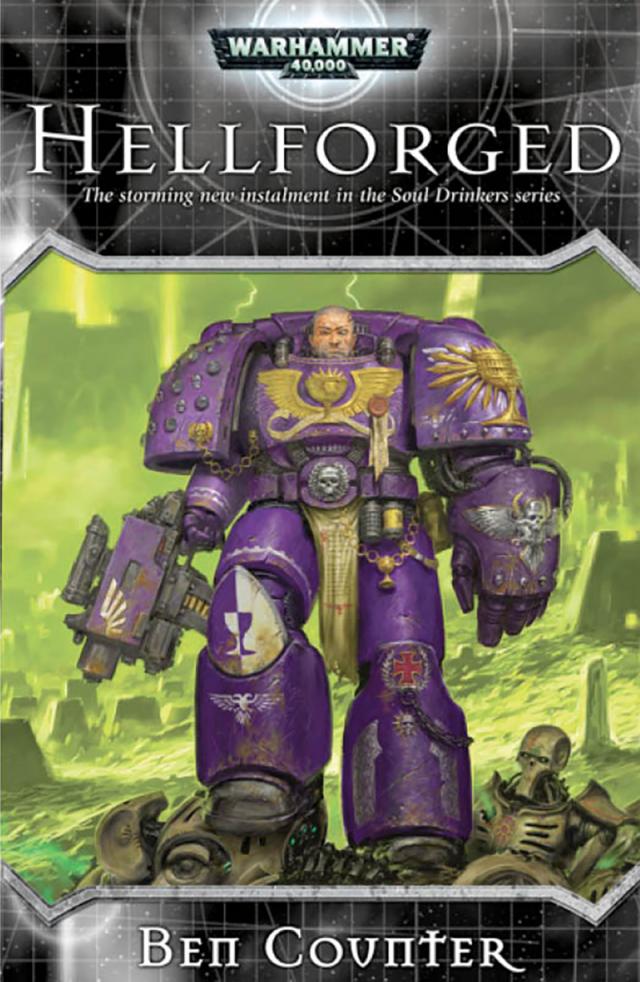


WARHAMMER 40,000
It is the 41st millennium. For more than a hundred centuries the Emperor has sat immobile on the Golden Throne of Earth. He is the master of mankind by the will of the gods, and master of a million worlds by the might of his inexhaustible armies. He is a rotting carcass writhing invisibly with power from the Dark Age of Technology. He is the Carrion Lord of the Imperium for whom a thousand souls are sacrificed every day, so that he may never truly die.
Yet even in his deathless state, the Emperor continues his eternal vigilance. Mighty battlefleets cross the daemon-infested miasma of the warp, the only route between distant stars, their way lit by the Astronomican, the psychic manifestation of the Emperor’s will. Vast armies give battle in his name on uncounted worlds. Greatest amongst His soldiers are the Adeptus Astartes, the Space Marines, bio-engineered super-warriors. Their comrades in arms are legion: the Imperial Guard and countless planetary defence forces, the ever-vigilant Inquisition and the tech-priests of the Adeptus Mechanicus to name only a few. But for all their multitudes, they are barely enough to hold off the ever-present threat from aliens, heretics, mutants - and worse.
To be a man in such times is to be one amongst untold billions. It is to live in the cruellest and most bloody regime imaginable. These are the tales of those times. Forget the power of technology and science, for so much has been forgotten, never to be re-learned. Forget the promise of progress and understanding, for in the grim dark future there is only war. There is no peace amongst the stars, only an eternity of carnage and slaughter, and the laughter of thirsting gods.
‘Even when the battlefield gives us every advantage, it is still a part of the universe. And this universe, never forget, despises us.’
Daenyathos, Reliquerae Tactica
CHAPTER ONE
‘I swear,’ said the rat-like man cowering in the corner. ‘I swear I have told you all I know.’
The cell was tiny, just large enough for the prisoner to be shackled against the wall. The prisoner blinked in the sudden light flooding in from the open door, silhouetting the robed figure of Archmagos Voar standing in the doorway. Voar knelt down so he was level with the prisoner.
‘I have no reason to believe you,’ said Voar.
The prisoner gulped down the recycled air, and sweat ran down his face. The cell was infernally hot, kept sweltering by its proximity to the engines. The man was still shaking, though, his eyes flickering around as if searching for a way out that he had somehow missed in the previous months of his incarceration.
‘He told me… He told me he got it from some... some rogue trader, he called himself. Not the real thing, I guess, just some chancer, some salvager. I really don’t know anything else.’
‘You know,’ said Archmagos Voar, ‘that it was from the Veiled Region. You know, and you knew when you bought it, that it was forbidden.’
‘Of course I did! I told you all that! What more can you want from me? What more is there?’
The man’s name was Baradrin Thaal, and once, he had possessed far more money than was necessary. He was the second son of a noble house where a younger sibling, not expected to inherit the responsibilities of the household, was free to waste his family’s money on banal sins. One of those sins had been to buy the object that Archmagos Voar of the Adeptus Mechanicus now carried with him. It was Thaal’s last and biggest mistake. Men like Thaal had died at the hands of the Mechanicus for tech-heresies far less heinous than his.
Voar took the object out from below his deep crimson robes. It was a mask, roughly humanoid and stylised as if made by some brutalist sculptor. It was not, however, made by a human hand. Any fool could see that. The eyes were triangular slits and the nose was flat, a simple oblong above the grimacing slot of the mouth. The forehead was disfigured by a green gemstone, like a third eye. From the back of the mask hung a nest of wires and probes. It was not meant to be worn – it was meant to be implanted.
‘The trader’s name was… Devian, I think. Devian something. He got it from some salvager who found it in an archeotech load towed out of the Veiled Region. I don’t know any names or anything else. He told me this thing would… That it was the best high xenos tech, better than any nerve-glove or cortical stimm. I just… I just looked for the next thing, you know? Please, I’ve told you everything I know. Everything. More than you wanted. Let me go. My family needs to know where I am.’
Thaal was crying, his tears mingling with his sweat.
Voar did not feel the heat. His core temperature was well above the human maximum, his sensors told him, but such things had ceased to matter to him now that he had abandoned most of the weaknesses of the flesh. The hand with which he held the xenos artefact was bionic, as were his legs and most of his organs. His face was rebuilt from synthetic flesh, given a cruel, noble caste. His brain was original. That could never be replaced. The rest of him had been almost completely dispensed with.
Voar stood. He glanced behind him. He had not come to Thaal’s cell alone. He had hoped that it would not prove necessary to bring Crystavayne along, but Thaal’s ignorance could not remain unprobed.
The magos standing behind him, in the doorway of the cell, stepped forwards. He was robed, like Voar, but moved with the stilted clumsiness of a man whose body was still mostly natural. On one of his hands, he wore an elaborate gauntlet with a bundle of blades and knives extending from the palm.
‘This man is a magos biologis neuralis,’ said Voar to Thaal. ‘He can illuminate you as to memories you did not know you had. Though I have given up much of myself to the machine, I have yet to let go of those human weaknesses that compel me to respect the corporal integrity of a fellow human. Therefore, I am reluctant to have him exercise his art upon you.’
‘I don’t know,’ said Thaal, ‘what you want me to say. Tell me, and I’ll say it. I’ll admit to anything. I’ll do whatever you say.’
Voar turned to the magos behind him.
‘Proceed,’ he said.
Magos Biologis Crystavayne knelt over Thaal. The neural gauntlet lit up, the vials on the back of the hand filling with chemicals that formed clear beads at the end of its many needles.
‘Please,’ said Thaal.
‘What dosage do you command, archmagos?’ asked Crystavayne. His voice was synthesised and sounded like the buzzing of metallic insects.
‘Let him know,’ said Voar, ‘that he has displeased the Omnissiah.’
‘No! Throne, no! I’ll admit to anything. I’ll sign a confession. Whatever you want, but by the Throne of Earth I do not know!’
The needles of the gauntlet touched Thaal’s neck. He was too weak to fight off the magos. He closed his eyes and sobbed.
‘Stop,’ said Voar.
Crystavayne took the gauntlet away from Thaal’s neck. Thaal shook and whimpered, like a scolded animal.
‘He is primed,’ said Crystavayne. ‘His biological readings suggest he is at the point of maximum malleability. If it is to be done, this is an excellent time.’
‘He does not know anything more,’ continued Voar. ‘To your post, magos.’
The magos stood, bowed his head in deference and left the cell.
‘I am not an unmerciful man,’ said Voar. ‘You have transgressed at a time when I am still capable of compassion for a pathetic creature like you.’
‘Oh Emperor enthroned,’ sobbed Thaal. ‘Oh, all His saints…’
‘You will never see your family again. You will forever be branded a tech-heretic. That is punishment enough.’ Voar held up the xenos mask. ‘I have one further question, Baradrin Thaal. Did you ever wear this?’
‘No,’ said Thaal. ‘I dared not. I had to drum up the courage. I was… I was thinking about it on the morning your men came for me.’
‘Good,’ said Voar. ‘Perhaps I will find some use for you on my ship. Until then, your thoughts will be your tormentors.’
Voar stepped out of the cell, placed a bionic hand on the scrutiny plate outside, and the door slid closed on Baradrin Thaal’s cell.
Even the magi astrophysicus could not discern quite what had happened to that patch of space to the galactic west of the core. Some speculated that the vacuum had become somehow denser, dragging in matter from all around. Others suggested that some great cosmic event had occurred there, a supernova or the collision of two super-dense stars that had started a chain reaction of collapse and rebirth still reverberating through the area. Certainly, it had been a momentous event indeed, because the warp was thick and sluggish there, the beacon of the Astronomican like a night sky’s moon reflected in stagnant water.
The place had been known as the Veiled Region since the beginning of recorded Imperial history. It was a place of dense nebulae and newborn stars, buffeted by waves of radiation and discarded stellar matter. Navigation, on the few times it had been tried, was dangerous and haphazard even by the lethal standards of space travel, and settlements within the Veiled Region were prohibited by Imperial law.
The primary danger within the Veiled Region, however, was isolation. Astropathic communications were difficult, and became more so the further a ship went. Eventually, psychic communication was blocked entirely, the warp resembling a sucking mire or endless doldrums where an astropath’s mental voice echoed back only silence. Exploring the Region, then, was a task rarely attempted and never successful.
Then came Baradrin Thaal and his ill-advised purchase of an alien trinket from a salvager-trader who had never been identified. The artefact was from an alien civilisation that showed signs of great technological advancement. The Mechanicus, having apprehended Thaal and examined the artefact, could not make any sense of its origins, and put Archmagos Voar in charge of finding its source. It was from somewhere in the Veiled Region, Thaal had claimed, and so Voar had assembled a Mechanicus explorator fleet to penetrate the Veiled Region and hunt down the alien hand that had created the mask. His flagship was the Antithesis, a fast, tough armed explorer that had forged the first route through the Garon Nebula and circumnavigated the Varlian Anomalies. He had cruisers and escorts drawn from the Martian fleet and regiments of tech-guard with him, because he expected trouble within the Veiled Region.
Stylised and heretical though it was, the mask was of a human face. That meant humans and xenos in the Veiled Region, and with the xenos capable of such technology it was likely the humans were subjects or, even worse, willing allies of the heathen aliens. Human settlements within the Veiled Region were a persistent but unproven rumour, and one of Voar’s objectives was to find any human worlds, free them of xenos taint and bring them back into the fold of the Imperium of Man.
The mission was in its second year. The Veil had been penetrated, and light years of steadily thickening nebulae and stellar clouds now lay between the Mechanicus fleet and clear void.
Voar had assembled the officers of his fleet on the bridge of the Antithesis. The bridge was a monument to knowledge, a library crammed with thousands of volumes covering millions of subjects, as if the light of that knowledge could illuminate the ship’s officers or, by basking in it, they could absorb the collective wisdom and become closer to the Omnissiah.
Like Voar, the fleet’s officers were all on the ladder towards the Mechanicus’s upper echelons, where a man might lose the vestiges of humanity and become more like the machine. One day they would lose their ability to communicate effectively with humans, their brain functions solely given over to contemplating the greater problems of doing the Omnissiah’s work. To earn that exalted status, however, they had to serve.
‘Brother magi,’ began Voar as he ascended the steps to the altar that crowned the bridge-library. ‘Thaal has no more to tell us. Everything we learn from now on, we uncover with our own hands.’
The magi made for a fine officer cadre. They were masters at a variety of disciplines, and, should the mission come to violence, a few of them were capable military leaders. Magos Gladius Hepsebah was a fine weaponsmith and an excellent shot. Her robed form concealed a torso taken up with the power cells for the rotator laser cannon that had replaced her left arm, and one eye was a complicated multi-spectrum targeting array. Magos Metallurgicus Vionel was similarly formidable, although in his case it was his oversized dense metallic skeleton and exposed
nerve-fibre bundles, originally intended for industrial purposes, that made him so intimidating in battle.
Others were pure researchers. Magos Biologis Crystavayne, who had threatened Baradrin Thaal with a horribly painful fate, was equipped with enough surgical implements and refrigerated sample containers to make him a walking medical laboratory. The inhuman figure of Magos Xenophysicus Khrul, with his tracked lower body and radiation shielding barely fitting beneath his robes, was invaluable in exploring hostile environments. The fifth magos of the fleet command, Magos Astrophysicus Devwyn, was the most human-looking of the officers, with cranial interface circuits and a pair of verispex mechadendrites his only obvious augmentations.
‘It is unlikely,’ said Hepsebah, ‘that we will receive further human intelligence. Thaal was our best source.’
‘Our only source,’ said Voar, ‘save our own intellects.’
‘Then what is to be our course of action?’ asked Khrul. His voice was a deep rumble from a vocaliser unit built into his torso.
‘We forge on,’ said Voar, ‘unless the Omnissiah’s wisdom can teach us otherwise.’
‘The Veiled Region,’ said Crystavayne, ‘is vast and unmapped. To seek an alien world, even an alien empire, would be beyond a reliable statistical model.’
‘I disagree,’ said Khrul. ‘The Veiled Region has remained unexplored because the resources to penetrate it have yet to be deployed. Thaal’s information created the first compelling reason to commit such resources to the region for centuries. We would be in dereliction of our duties towards the Omnissiah if we passed up the chance, not only to locate the source of the artefact, but also to discover what other knowledge lies here. Explorator fleets have barely skimmed the surface of its nebulae since the Great Crusade. There is no telling what we might discover.’
‘Devwyn?’ said Voar. ‘What have you to say on this matter?’
Devwyn kept his eyes on the archmagos, but the glassy artificial eyes on the snake-like mechadendrites fixed to his shoulders wove between his fellow magi. Devwyn, being an observer of the skies, had learned to use his extra senses to keep two eyes on the ground as well.
‘The Region is a puzzle box to be opened up, Archmagos,’ said Devwyn. His voice was natural as his larynx had yet to be augmented or replaced. ‘The unknown nature of its contents has dissuaded many, otherwise brave and knowledgeable men, from solving this puzzle. I can think of nothing more worthwhile than working towards gaining an insight into the forces that created this place, and the entities that might dwell herein.’
Voar turned away from his magi. The cogitator units built into his thoracic spine whirred as they augmented his thought processes. It was knowledge the Adeptus Mechanicus sought, and it was knowledge that would guide him.
The command altar of the bridge was on top of a shallow pyramid rising from the labyrinthine library, kilometres of bookshelves winding in a complicated pattern that filled the bridge. Thousands of books and data-slates, loaded with accumulated space-faring wisdom and the philosophy of the Cult Mechanicus, loaded the shelves and stood in piles at every intersection. The ship’s navigation crew, tech-priests in their red, cog-toothed robes, stood poring over stellar maps inked on parchment, plotting courses with compasses and quill pens. Dark grottoes among the bookshelf caves hid communications and sensorium helms. The ordnance crew had a room of glass-fronted cases holding rare and sacred tomes of naval battle-lore. They did their bloody work with abaci on large map-tables scattered with markers representing the ship and the area around it. The bridge had few direct readouts of the area around the ship, such as a viewscreen or tactical orrery, because the crew of the Antithesis solved most problems through abstract mathematics and geometry rather than through the sensory guesswork that governed lesser craft.
‘We forge on,’ repeated Voar. ‘The Omnissiah’s work has yet to be done in this place, and it will be another age before the Veiled Region is penetrated again. Your misgivings have some truth about them, however, and we are to treat the Veiled Region as hostile territory. We have reached the end of the Von Carnath Plateau, the only stable route into the Region, and soon we will pass beyond the point where our astropaths can communicate with the outside Imperium. Should we encounter trouble, Mars will be ignorant of our plight. Though we go on, we will pray for deliverance from the enemies that surely lie in wait for us. Return to your craft, scholars of Mars, and ensure that their crews are ready for battle.’
The magi bowed and left the bridge, leaving Voar on his pyramid.
Unexplored space: there was so much of it. After ten thousands years questing, only a fraction of the Imperium had been properly explored and catalogued. It was a sacred task that, like humanity’s many other battles, would never end, and yet required the dedication of its servants to the exclusion of all else. Space beyond the Von Carnath Plateau was completely unknown, and, for anyone but the Mechanicus with their sacred duties and technology, entering it would be both suicidal and illegal.
Voar looked at the alien mask he still carried. Its obscenity was one of defiled brilliance, of high technology deformed to meet an alien vision. If the principles behind it could be uncovered then one more line of the Omnissiah’s eternal work, the book of all knowledge, would be written.
One of the tech-priests was ascending the pyramid. The tech-priest was of sufficiently low rank and limited augmentations that gender was still apparent; it was a woman, with eyes obscured by smoky lenses and her hair tied back to reveal a large information port on her temple.