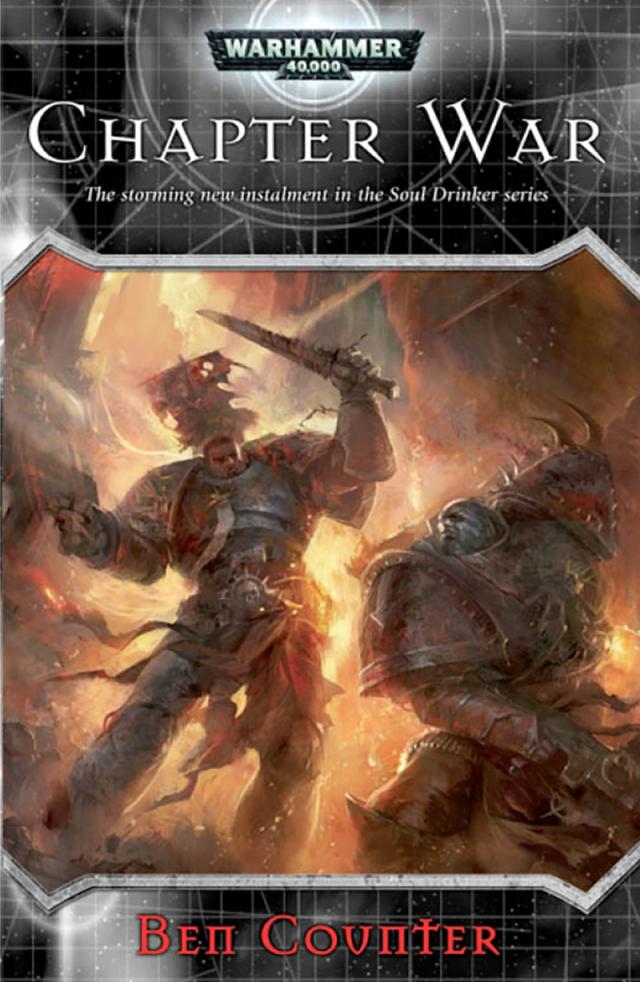
Chapter war, p.1
Chapter War, page 1


WARHAMMER 40,000
It is the 41st millennium. For more than a hundred centuries the Emperor has sat immobile on the Golden Throne of Earth. He is the master of mankind by the will of the gods, and master of a million worlds by the might of his inexhaustible armies. He is a rotting carcass writhing invisibly with power from the Dark Age of Technology. He is the Carrion Lord of the Imperium for whom a thousand souls are sacrificed every day, so that he may never truly die.
Yet even in his deathless state, the Emperor continues his eternal vigilance. Mighty battlefleets cross the daemon-infested miasma of the warp, the only route between distant stars, their way lit by the Astronomican, the psychic manifestation of the Emperor’s will. Vast armies give battle in his name on uncounted worlds. Greatest amongst His soldiers are the Adeptus Astartes, the Space Marines, bio-engineered super-warriors. Their comrades in arms are legion: the Imperial Guard and countless planetary defence forces, the ever-vigilant Inquisition and the tech-priests of the Adeptus Mechanicus to name only a few. But for all their multitudes, they are barely enough to hold off the ever-present threat from aliens, heretics, mutants - and worse.
To be a man in such times is to be one amongst untold billions. It is to live in the cruellest and most bloody regime imaginable. These are the tales of those times. Forget the power of technology and science, for so much has been forgotten, never to be re-learned. Forget the promise of progress and understanding, for in the grim dark future there is only war. There is no peace amongst the stars, only an eternity of carnage and slaughter, and the laughter of thirsting gods.
CHAPTER ONE
‘What is the greatest failure against which we must guard?’
‘The failure to die when death would serve the Emperor’s purpose.’
– Daenyathos, Catechisms Martial
‘Present arms!’ yelled Lord Globus Falken, and thousands of troops drew up their autoguns to salute the Aristarchical Pavilion. Magnificent in white bearskins and jackets of midnight blue and silver brocade, the Warders of the Vanqualian Republic trooped in perfect formation across the grand Processional Quarter with the banners of their ancient regiments flying alongside the topmost spires of Palatium. They were by far the mightiest fighting force in the Scaephan sector, the primary defenders of the Obsidian system and the proud sons of Vanqualis, and they looked the part. Their officers were resplendent in the heraldry of the Falken family from which they all hailed, and even the casings of their artillery and the hulls of their tanks shone in brass and blue.
‘Sloppy this year,’ said Count Luchosin Falken, whose uniform was so ornate it looked like his ample frame was swathed in hundreds of clashing flags. In a way it was, for he had to symbolise all the regiments of the Warders. The sun beat down hard on Palatium. The Aristarchical Pavilion, tented in silks and with several valet-servitors trundling around serving drinks, was one of the few places in the Processional Quarter that was not sweltering. Even so, Count Luchosin sweated gently where he sat.
‘Globus has got them digging trenches and mucking out the horses,’ said Lady Akania Falken-Kaal, standing idly beside Count Luchosin. Lady Akania looked rather more rakish than most of the men, sporting an athlete’s frame under her cavalrywoman’s uniform and an eye patch thanks to a hunting accident in her youth. ‘No damn respect.’
Lord Sovelin Falken, sweating under his bearskin and the heavy crimson sash of the Vanqualian Artillery, looked out across the sea of marching men and their forest of raised autoguns. To him it was still astonishing, a wondrous and powerful statement of Vanqualis’s stability and traditions. Far away from the jungles that surrounded Palatium and covered the continent of Nevermourn, there were towering hives with billions of citizens who lived and died beneath their churning factories. Were it not for the rule of the Falken family, and the traditions such as the Trooping of the Warding Standard, the whole of Vanqualis would be like that. Nevermourn, a continent of magnificent natural beauty, was a miracle. It was far more fashionable to denounce it as dull and crude, but it filled Lord Sovelin’s heart with pride.
‘Globus wants them ready to fight,’ said Lord Sovelin. ‘I don’t think there’s anything wrong with that.’
Lady Akania cocked her one visible eyebrow. ‘Fight? This is not an army for fighting, Sovelin! This is an army for reminding those vermin in the cities who is in charge. If it weren’t for that the citizens might realise there are more of them than there are of us. The Falkens rule Vanqualis by magnificence, Sovelin, not by the gun! Killing them in the streets is fine for the rest of the Imperium but we do things differently. Do you not agree it is better this way?’
‘Of course, Lady Akania,’ said Sovelin. Lady Akania was an aunt of his a couple of times removed, though he was not much younger, and he was fairly sure she had seniority over him. Most of the family members on the Pavilion were higher up the ladder than Sovelin, which was probably why he had been palmed off on the artillery.
‘Fight!’ snorted Lord Luchosin with derision. ‘What’s there to fight?’
A sharp volley of gunshots rippled across the assembled troops, tens of thousands of autoguns loosed off to salute the sons and daughters of the Falken family. With perfect timing the regimental bands opened up and blared the ancient songs of war and rulership, the rhythm punctuated by volleys of disciplined gunfire. It echoed around the white stone spires of Palatium and the immense jungle trees that crowded up around the city walls, around the regimental banners and the gilded eagles atop the minarets of the Temple of Imperator Ascendant.
‘No respect,’ spat Lady Akania. She turned and walked off briskly, waving away a regimental underling who tried to get her attention. He was carrying a field vox-unit.
‘Not now,’ said Lord Globus. ‘It’s not the time.’
‘My lord,’ said the officer. ‘It is a communication from Fleet Admiral Thalak.’
‘Thalak has no idea what we are doing here!’ growled Lord Globus. ‘The man’s a peasant. He can wait.’
Sovelin waved over the officer. The man was sweating and it wasn’t just from the heat. He wore the uniform of the Mechanised Cavalry.
‘It’s the emergency channel, my lord,’ said the officer.
‘Give it to me,’ said Sovelin. He took the vox handset and put it to his ear, wincing at the harsh screech of feedback.
‘…the love of the Throne!’ shouted a voice, barely distinguishable from the howl of static. ‘The Starstrider is down! They’ve hit the docks! They’re killing us up here! They’re killing us!’
‘Killing us, you hear?’
Fleet Admiral Thalak was thrown off his feet as the Sanctis Chirosian rocked again, as if it were afloat in an endless sea and great waves were battering against it. Thalak’s head cracked against the deck and the vox handset kicked out of his hand and clattered away.
Hot blood sprayed over him. He coughed, covering his face, trying to wipe it out of his eyes with the sleeve of his black Naval greatcoat. The sound was tremendous, metal screaming – and men screaming, too, screams cut short as steel pounded against steel.
Thalak rolled onto his front and got to his knees. The blood was from Petty Officer van Staelem, who had been impaled through the abdomen by a great shard of metal. Her body was split open and she shuddered as she died, blood running down her chin.
Thalak had to fight to remember where he was. This place, with its dark wood panelling and friezes of silver cherubim, was the Cartographers’ Hall where the navigation officers pored over huge map tables or immense orreries suspended from the ceiling alongside the chandeliers. Now half the hall was caved in, huge jagged blades of twisted metal pushing through from the industrial guts of the ship. Lights flared as a display of planets and stars fell free of its mountings and crashed to the floor, enormous metal globes crushing fleeing crewmen as they ran, sections of the silver hoops cutting ratings in half. Greyish liquid sprayed in from a torn fuel line and caught light, flame flowing around the wrecked metal and devouring the injured crewmen crawling away from the destruction.
Thalak spat out a mouthful of van Staelem’s blood and ran, stumbling as the deck tilted again. It felt as if some huge hand had grabbed the Sanctis Chirosian and was dismembering it, crushing it here and tearing it apart there.
He ran towards the communications helm that budded off from one end of the Cartographers’ Hall. A ringed planet rolled by, its thin silver rings slicing through the floor like a blade as it rolled, cutting Senior Navigation Officer Rorkren in two. Fragments of burning star charts fell in flurries. The ship tilted alarmingly again and the mass of twisted metal forced its way in further, crewmen scrabbling away from it and screaming as it crushed them against the far wall.
‘Admiral!’ yelled someone from the communications helm. Thalak looked up and saw an arm reaching down to drag him into the helm. The helm was set into a large spherical room with its walls covered in monitors, its officers slumped in grav-couches with their faces covered by the heavy interface units through which they communicated with the other ships of Battlefleet Scaephan. Several of the monitors had blown out, like blinded eyes, and the others showed images from throughout the battlefleet’s moorings around the orbital station Ollanius XIV.
The young woman officer’s face was streaked with blood and oil. She was a junior officer, probably from the communications support crew whose duties involved making sure the officers were tended to during the months they were wired into the Sanctis Chirosian. ‘Admiral, what is happening?
‘I don’t know,’ said Thalak, breaking his own rule of never revealing any ignorance or weakness to his crew. ‘Someone who was waiting for us. It’s not just us, they’re going for the whole system.’
‘You’ve heard from Vanqualis?’
‘I don’t need to,’ replied Thalak bleakly. ‘It’s the Trooping of the Warding Standard. The whole damn army’s in Palatium. That’s what the attackers were waiting for.’
The officer pushed a strand of bloody hair back from her face and looked up at one of the monitors. It was showing a great chunk of burning wreckage drifting above the pitted metal surface of Ollanius XIV, venting streams of burning fuel and air. ‘The Skystrider is down,’ she said.
‘I know,’ replied Thalak. The Skystrider was a grand cruiser, the largest and most powerful ship in Battlefleet Scaephan. Without it, the battlefleet’s power to oppose an invasion was cut in half. ‘The Defence of Phantis, too. They’ve hurt us. But we’re not down yet.’
As if in reply, the Sanctis Chirosian was wrenched over savagely. The ship’s gravity suddenly shifted and snapped into reverse, the floor becoming the ceiling. Thalak grabbed onto the doorframe as he fell, stomach lurching as the din grew. Massive map tables heavy as boulders crashed into the chandeliers of the Cartographers’ Hall, and bodies broke against the decorative bosses of the ceiling.
The communications officer fell past him and smashed into the monitors on the ceiling of the communications helm, her body spasming as electric current ran through her and spat sparks from her fingers. The smell of cooking blood turned Thalak’s stomach one final time and he vomited, heaving up his guts as he clung grimly to the doorway. He heard a grisly snap above him and a pair of booted feet hung beside him. The comms officers, hard-wired into the ship’s systems, had fallen down but they were still attached by the interface units clamped around their heads and their necks had snapped. Like a scene from a mass execution, they all hung silent and dead in a ring above Thalak.
A new sound, louder and even more appalling, battered against Thalak’s ears. It was a rhythmic scream of metal through metal. Something was biting through the ship, crunching through decks and bulkheads.
Thalak looked through at the Cartographers’ Hall and somewhere in his battered mind it all made perfect sense. He was in hell. The Imperial creed had many hells, although some priests argued they were all one and the same, but one of them definitely looked like this. Bodies impaled on shards of metal. Corpses guttering in the flames, some of them still alive and writhing. Great wet streaks of blood sprayed up the walls. Lights flickering, screams cut off, the boom of escaping air shuddering through the ship. Thalak had served his Emperor, but it had not been enough, and now he was in hell.
As if to prove him right, the ruined side of the Cartographers’ Hall was forced open like a great metal mouth with teeth of jagged steel. Bodies slid into it as it howled, metal against metal screeching. Guttural voices yelled from inside and dark shapes clambered out, misshapen, hulking forms.
Thalak snarled and clambered back into the burning ruin of the Cartographers’ Hall. He took his laspistol from its holster – it was a good gun, and it had been his uncle’s before Thalak had followed him into the Imperial Navy.
There were more of them. Dozens. A hundred. Dark and monstrous, swarming into his ship.
‘For the Emperor!’ yelled Thalak, and fired. The crimson las-blasts streaked past gnarled dark green skin and flickered in tiny, furious red eyes. Gunfire opened up in response, heavy-calibre fire sprayed at random, splintering the panelling behind Thalak. Thalak dived to the floor, rolled and came up firing, forcing himself to ignore the pain.
He was terrified. The fear inside him was like a chunk of ice where his heart should be, freezing his mind. But the rest of him kept fighting, because some part of him told him that was what an officer did.
A fist slammed into him and he was driven into the floor. The shattered remains of a chandelier cut into him. A brutal face with tiny violent eyes above a huge mouth filled with filthy tusks roared down at him and a kick crunched into his ribs. One of the creatures stamped down on his hand and the laspistol was gone.
Greenskins. Orks. Animals, killers, the oldest enemy that mankind had among the stars. They were on Thalak’s ship, and they were killing him.
An ork bellowed and the creatures bearing down on Thalak parted for one of their number, easily twice the height of a man and hugely muscled. Its face was so deeply scarred it was barely a face at all but in the midst of the ugliness, there was a glimmer of intelligence and malice in its eyes far more terrifying than a hundred ignorant killers.
There was no part of Thalak now that felt anything other than terror. The greenskin leader reached down and gripped Thalak by his shoulder. Its other arm was artificial, a bionic so crude it looked like it could have been powered by steam. Metal claws fixed around Thalak’s elbow and tore his arm off at the shoulder; white horror flooded through him and his body reeled with the shock.
The greenskin held Thalak up into the air. For a moment he could see the ocean of orks flooding into the Sanctis Chirosian, butchering injured crewmen where they lay, blazing away with crude deafening guns at those few still on their feet. The orks seemed completely at home amid the destruction and death. They were a natural part of this hell.
Thalak was held high and shaken like a standard to rally the orks. The leader roared and the orks roared with him, cheering the death of the ship and the mutilation of the fleet’s commander. Then Thalak was thrown back down and a dozen feet stamped down on him, shattering his bones and battering against his head. Finally the Sanctis Chirosian was gone, and there was only blackness.
It was just after the Warding Standard was unfurled that the attack came.
The first blast hit the Processional Quarter square on, throwing broken bodies and severed limbs into the air, a hundred men blown to bits in a split second and dozens more sliced apart by shards of shrapnel. The Warding Standard itself, stitched together from a dozen regimental banners and festooned with battle honours and campaign ribbons, fell tattered and bloody to the ground, draping itself over the chunks of uniformed meat that remained of the honour guard regiment escorting it.
The second blast hit the Aristarchical Pavilion. Lord Globus was vaporised. Lady Akania was beheaded by a shard of missile casing and tumbled down onto the square. Counts and barons were shredded. Lords and ladies were thrown broken against the front of the Herald’s Chapel and the Lord Magister’s Basilica.
It was an orbital artillery strike. Guns high up in orbit above Vanqualis threw explosive shells down at Palatium. It came utterly without warning, because with Battlefleet Scaephan stationed in the system nothing could possibly have got through to threaten Vanqualis. And yet it had, because now enemy spaceships were spitting fire and death down at the jewel of Nevermourn.
In the moments that followed, the Warders of the Vanqualian Republic reacted to the shock. Guns were hurriedly loaded, officers yelled for battle order, and cavalry tried to control their starting horses. The gates leading from the vast parade grounds of the Processional Quarter were jammed as thousands of troops tried to get out and take cover among the lofty civic buildings of Palatium. In the panic, few of them took heed of the shadow now cast over the parade ground, or of the dark spot that appeared in the air and got larger and larger.
The third blast was not a missile or bomb. It was the impact of a huge dark slab of rock, pitted like an asteroid, that slammed into the centre of the parade ground so hard it drove a deep crater into the ground. The front of the Herald’s Chapel collapsed and the roof of the Lawkeeper’s Chamber fell in. Spires fell with the impact, buildings spilling their floors out into the parade ground.
Through the choking dust, the survivors could see hundreds of bodies and scores of groaning wounded. They helped their brother soldiers, dragging them towards the scrum at the processional gates. Cries went up for regimental medics, only a few of whom had been permitted to carry their bulky, inelegant medi-packs on procession. Men screamed, shorn of limbs or with their abdomens split open by shrapnel. Some tried to claw their way out from beneath the dead. Others bit back the pain and waited to die, knowing no one would come to save them. Many looked to the scions of House Falken to deliver them, but House Falken’s proud sons and daughters were mostly dead in the burning wreckage of the pavilion.